C-LUX 1 - Camera LEICA - Free user manual and instructions
Find the device manual for free C-LUX 1 LEICA in PDF.


| Product Type | Digital Compact Camera |
| Brand | Leica |
| Model | C-LUX 1 |
| Effective Megapixels | 7.2 MP |
| Optical Zoom | 3.6x (28-102mm equivalent) |
| Digital Zoom | 4x |
| Sensor Type | 1/2.5-inch CCD |
| Display | 2.5-inch TFT LCD, 207,000 pixels |
| Dimensions (W x H x D) | 94 x 52 x 26 mm |
| Weight (with battery) | Approx. 155 g |
| Power Source | Rechargeable Lithium-Ion Battery (3.7V, 1000 mAh) |
| Memory Media | SD / SDHC / MMC |
| ISO Sensitivity | Auto / ISO 80 / 100 / 200 / 400 / 800 / 1600 |
| Shutter Speed | 8 - 1/2000 sec |
| Aperture Range | f/2.8 - f/5.6 (wide), f/5.6 - f/11 (tele) |
| Metering Modes | Multi-pattern, Center-weighted, Spot |
| Focus Modes | Auto Focus, Macro, Normal |
| White Balance | Auto, Daylight, Cloudy, Shade, Halogen, Custom |
| Scene Modes | Portrait, Sports, Night, Sunset, etc. |
| Video Recording | Motion JPEG (640x480 @ 30fps) |
| Flash Modes | Auto, Red-eye Reduction, Forced On, Slow Sync, Off |
| Connectivity | USB 2.0, AV output |
| Cleaning | Use a soft, dry cloth; avoid solvents |
| Safety | Do not disassemble; avoid water and extreme temperatures |
| Spare Parts & Repairability | Contact Leica authorized service centers |
Frequently Asked Questions - C-LUX 1 LEICA
User questions about C-LUX 1 LEICA
0 question about this device. Answer the ones you know or ask your own.
Ask a new question about this device
Download the instructions for your Camera in PDF format for free! Find your manual C-LUX 1 - LEICA and take your electronic device back in hand. On this page are published all the documents necessary for the use of your device. C-LUX 1 by LEICA.
USER MANUAL C-LUX 1 LEICA
We would like to take this opportunity to thank you for purchasing this LEICA C-LUX 1. Please read these Instructions carefully and keep them handy for future reference.
Information for Your Safety
WARNING
TO REDUCE THE RISK OF FIRE OR SHOCK HAZARD AND ANNOYING INTERFERENCE, USE ONLY THE RECOMMENDED ACCESSORIES AND DO NOT EXPOSE THIS EQUIPMENT TO RAIN OR MOISTURE. DO NOT REMOVE THE COVER (OR BACK); THERE ARE NO USER SERVICEABLE PARTS INSIDE. REFER SERVICING TO QUALIFIED SERVICE PERSONNEL.
Carefully observe copyright laws. Recording of pre-recorded tapes or discs or other published or broadcast material for purposes other than your own private use may infringe copyright laws. Even for the purpose of private use, recording of certain material may be restricted.
- Please note that the actual controls and components, menu items, etc. of your digital camera may look somewhat different from those shown in the illustrations in these Operating Instructions.
• SD Logo is a trademark. - Other names, company names, and product names printed in these instructions are trademarks or registered trademarks of the companies concerned.
The socket outlet shall be installed near the equipment and easily accessible or the mains plug or an appliance coupler shall remain readily operable.
CAUTION
Danger of explosion if battery is incorrectly replaced. Replace only with the same or equivalent type recommended by the manufacturer. Dispose of used batteries according to the manufacturer's instructions.
(U.S.only)

Alithiumion/polymerbatterythatisrecyclablepowersthe productyouhavepurchased.Pleasecall1-800-8-BATTERYfor informationonhowtorecyclethisbattery.

QuickTime
QuickTime and the QuickTime logo are trademarks or registered trademarks of Apple Computer, Inc., used under license.
FCC Note: (U.S. only)
This equipment has been tested and found to comply with the limits for a Class B digital device, pursuant to Part 15 of the FCC Rules. These limits are designed to provide reasonable protection against harmful interference in a residential installation. This equipment generates, uses, and can radiate radio frequency energy and, if not installed and used in accordance with the instructions, may cause harmful interference to radio communications. However, there is no guarantee that interference will not occur in a particular installation. If this equipment does cause harmful interference to radio or television reception, which can be determined by turning the equipment off and on, the user is encouraged to try to correct the interference by one or more of the following measures:
- Reorient or relocate the receiving antenna.
- Increase the separation between the equipment and receiver.
- Connect the equipment into an outlet on a circuit different from that to which the receiver is connected.
- Consult the dealer or an experienced radio/TV technician for help.
FCC Caution: To assure continued compliance, follow the attached installation instructions and use only shielded interface cables with ferrite core when connecting to computer or peripheral devices.
Any changes or modifications not expressly approved by the party responsible for compliance could void the user's authority to operate this equipment.
Trade Name: LEICA
Model No.: C-LUX 1
Responsible party / Support Contact: Leica Camera AG Oskar-Barnack-Str. 11 D-35606 Solms Tel.: +49 (0) 64 42-208-0 Fax: +49 (0) 64 42-208-333 www.leica.camera.com info@leica-camera.com
This device complies with Part 15 of the FCC Rules. Operation is subject to the following two conditions: (1) This device may not cause harmful interference, and (2) this device must accept any interference received, including interference that may cause undesired operation.
This Class B digital apparatus complies with Canadian ICES-003

LEICA C-LUX 1
Only for Great Britain Camera
The rating plate is on the underside of the digital camera.
Caution for AC mains lead
For your safety, please read the following text carefully.
This appliance is supplied with a moulded three-pin mains plug for your safety and convenience. A 5-ampere fuse is fitted in this plug.
Should the fuse need to be replaced, please ensure that the replacement fuse has a rating of 5-amperes and it is approved by ASTA or BSI to BS1362.
Check for the ASTA mark 📂 or the BSI mark 🌿 on the body of the fuse.
If the plug contains a removable fuse cover you must ensure that it is refitted when the fuse is replaced. If you lose the fuse cover, the plug must not be used until a replacement cover is obtained. A replacement fuse cover can be purchased from your local Leica Dealer.
IF THE FITTED MOULDED PLUG IS UNSUITABLE FOR THE SOCKET OUTLET IN YOUR HOME THEN THE FUSE SHOULD BE REMOVED AND THE PLUG CUT OFF AND DISPOSED OF SAFELY.
THERE IS A DANGER OF SEVERE ELECTRICAL SHOCK IF THE CUT OFF PLUG IS INSERTED INTO ANY 13-AMPERE SOCKET.
If a new plug is to be fitted, please observe the wiring code as shown below. If in any doubt, please consult a qualified electrician.
IMPORTANT
The wires in this mains lead are coloured in accordance with the following code: Blue: Neutral
Brown: Live
As the colours of the wires in the mains lead of this appliance may not correspond with the coloured markings identifying the terminals in your plug, proceed as follows:
The wire which is coloured BLUE must be connected to the terminal in the plug which is marked with the letter N or coloured BLACK.
The wire which is coloured BROWN must be connected to the terminal in the plug which is marked with the letter L or coloured RED.
Under no circumstances should either of these wires be connected to the earth terminal of the three-pin plug, marked with the letter E or the Earth Symbol.
Before Use
Remove the Connector Cover.
■ How to replace the Fuse
The location of the fuse differ according to the type of AC mains plug (figures A and B). Confirm the AC mains plug fitted and follow the instructions below. Illustrations may differ from actual AC mains plug.
1) Open the fuse cover with a screwdriver.
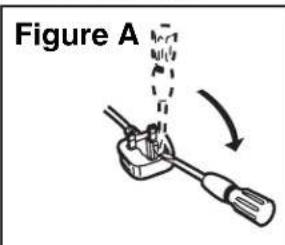
text_image
Figure A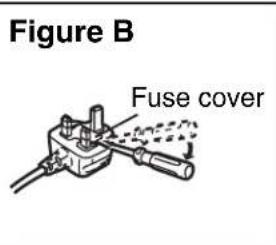
text_image
Figure B Fuse cover2) Replace the fuse and close or attach the fuse cover.
Figure A
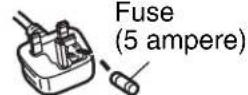
Figure B

■ Care for the camera
- Do not strongly shake or bump the camera. The camera may stop operating normally, pictures may not be recorded or the lens may be damaged.
- Sand or dust may cause a malfunction of the camera. When you use the camera on a beach etc., take care so that sand or dust does not get into the camera.
- When you use the camera on a rainy day or on a beach, take care so that water does not get into the camera.
- If seawater splashes onto the camera, wet a soft cloth with tap water, wring it well, and use it to wipe the camera body carefully. Then, wipe it again with a dry cloth.
■ About the LCD monitor
- Do not press the LCD monitor strongly. It may cause uneven colours on the LCD monitor or a malfunction of the LCD monitor.
- In a place with drastic temperature changes, condensation may form on the LCD monitor. Wipe it with a soft, dry cloth.
- If the camera is extremely cold when you turn it on, the image on the LCD monitor is slightly darker than usual at first. However, as the internal temperature increases, it returns to the normal brightness.
Extremely high precision technology is employed to produce the LCD monitor screen. However there may be some dark or bright spots (red, blue or green) on the screen. This is not a malfunction. The LCD monitor screen has more than 99.99% effective pixels with a mere 0.01% of the pixels inactive or always lit. The spots will not be recorded on pictures on a card.
■ About the Lens
- Do not direct the lens to the sun or strong light sources. It may cause not only a malfunction of the camera but irreversible damage to your eye.
- Do not press the lens strongly.
- Do not leave the camera with the lens facing the sun as it may cause the camera to malfunction. Also, be careful when you leave the camera outside or near a window.
■ About Condensation (When the lens is fogged up)
Condensation occurs when the ambient temperature or humidity is changed as follows:
Be careful of condensation since it causes stains on the lens, fungus or malfunction.
- When the camera is brought inside from the cold to a warm room.
- When the camera is taken from the outside to an air-conditioned car.
- When cool wind from an air conditioner etc. is directly blown onto the camera.
• In humid places
To prevent condensation, put the camera in a plastic bag until the temperature of the camera is close to the ambient temperature. In case of condensation, turn the camera off and then leave it for about 2 hours. The fog will disappear naturally when the temperature of the camera nears that of the ambient temperature.
■ If you will not be using the camera for a long time
- Store the battery in a cool and dry place with a relatively stable temperature.
[Recommended temperature: 15°C to 25°C, Recommended humidity: 40% to 60%]
- Be sure to remove the battery and the card from the camera.
- When the battery is left inserted in the camera for a long time, discharge takes place even if the camera is turned off. If you leave the battery inserted for an extended period of time, it will be excessively discharged and it may become unusable even after it is charged.
- When storing the battery for a long period of time, we recommend
a. to make sure it is not charged fully, i.e. a maximum of two segments are shown in the battery indication (P14), and b. to charge it to this level every 3 months.
- When you keep the camera in a closet or a cabinet, we recommend storing it with a desiccant (silica gel).
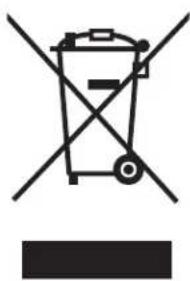
-If you see this symbol-
Information on Disposal for Users of Waste Electrical & Electronic Equipment (private households)
natural_image
Symbol of a trash bin crossed with two crossed lines, no text or labels presentThis symbol on the products and/or accompanying documents means that used electrical and electronic products should not be mixed with general household waste. For proper treatment,
recovery and recycling, please take these products to designated collection points, where they will be accepted on a free of charge basis. Alternatively, in some countries you may be able to return your products to your local retailer upon the purchase of an equivalent new product.
Disposing of this product correctly will help to save valuable resources and prevent any potential negative effects on human health and the environment which could otherwise arise from inappropriate waste handling. Please contact your local authority for further details of your nearest designated collection point.
Penalties may be applicable for incorrect disposal of this waste, in accordance with national legislation.
For business users in the European Union
If you wish to discard electrical and electronic equipment, please contact your dealer or supplier for further information.
Information on Disposal in other Countries outside the European Union
This symbol is only valid in the European Union.
If you wish to discard this product, please contact your local authorities or dealer and ask for the correct method of disposal.
About The Mode Dial
Adjust part Ⓐ to the desired mode.
Rotate the mode dial slowly and surely to adjust to each mode.
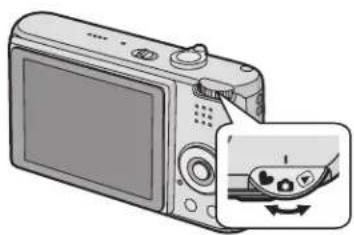
natural_image
Illustration of a digital camera with an inset showing a cable being inserted (no text or symbols present): Normal picture mode (P24)
Use this mode for normal recording.
: Macro mode (P48)
This mode allows you to take a close-up picture of a subject.
: Motion picture mode (P58)
This mode allows you to record motion pictures.
SCN : Scene mode (P49)
This mode allows you to take pictures depending on the recording scenes.
❤️ : Simple mode (P27)
This mode is recommended for beginners.
This mode allows you to play back recorded pictures.
■ About indications in these operating instructions

Modes indicated here allow you to use the functions or settings described on this page. Set the mode dial to any of the modes to use the functions or settings.

Convenient or helpful information for use of the camera is described.
■ About illustrations in these operating instructions
Please note that the appearance of the product, the illustration or the menu screen are a little different from those in actual use.
■ About illustrations of the cursor button
In these operating instructions, the operations on the cursor button are described as illustrated as shown. e.g.: When you press the ▼ button
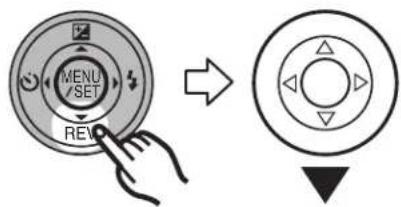
text_image
MENU /SET REV → ↓Contents
Before Use
Information for Your Safety......2
About The Mode Dial....7
Preparation
Scope of Delivery.... 10
Additional Accessories....10
Names of the Components .....11
Quick Guide ....13
Charging the Battery with the Charger ... 14
About the Battery (charging/number of recordable pictures) .....14
Inserting/Removing the Battery .....15
Inserting/Removing the Card ....16
About the Card....17
Setting Date/Time (Clock Set) 18
About the Setup Menu ....19
Basic
Taking Pictures ....24
Taking Pictures in Simple Mode 27
Taking Pictures with the Zoom .....29
• Using the Optical Zoom .....29
• Using the Extended
Optical Zoom (EZ) 29
- Using the Digital Zoom
Further extending the zoom ....30
Checking the Recorded Picture (Review) 31
Playing Back Pictures 32
Deleting Pictures....33
Advanced
About the LCD Monitor ....35
- Changing the information displayed .... 35
- Brightening the LCD Monitor (Power LCD/High angle mode) .....37
Taking Pictures using the Built-in Flash....38
Taking Pictures with the Self-timer ..... 42
Compensating the Exposure ....43
Taking Pictures using Auto Bracket......44
Optical Image Stabilizer....45
Taking Pictures using Continuous Mode 46
Taking Close-up Pictures....47
Scene Mode....48
- Portrait mode....49
- Soft skin mode.... 49
- Scenery mode 49
– Sports mode 49
– Night portrait mode .....50
– Night scenery mode......50 - Self portrait mode ....51
- Food mode ....51
- Party mode ....51
– Candle light mode.... 52 - Fireworks mode.... 52
- Starry sky mode.... 53
– Baby mode 1/Baby mode 2 ......53
-Snow mode....54
– High Sensitivity mode ..... 54
Recording which day of the vacation you take the picture ....56
Motion Picture Mode....58
Displaying Multiple Images (Multi Playback)....60
Displaying pictures by recording date (Calendar playback) ....61
Using the Playback Zoom ....62
Playing Back Motion Pictures/ Pictures with Audio....63
Menu Settings
Using the [REC] Mode Menu ....64
• [W.BALANCE] Adjusting the hue for a more natural picture.... 65
• [SENSITIVITY] Setting the light sensitivity ..... 66
• [ASPECT RATIO] Setting the aspect ratio of pictures ... 67
- [PICT.SIZE]/[QUALITY] Setting a picture size and quality that matches your use of the pictures ..... 67
• [AUDIO REC.] Recording still pictures with audio .... 68
• [AF MODE] Setting the focus method.... 69
• [AF ASSIST LAMP] Focusing in low light conditions becomes easier ....70
• [SLOW SHUTTER] Recording bright pictures in dark places....70
• [COL.EFFECT] Setting color effects for the recorded pictures....71
• [PICT.ADJ.] Adjusting the picture quality for the recorded pictures....71
Using the [PLAY] mode menu 72
• [SLIDE SHOW] Playing back pictures in order for a fixed duration....72
• [FAVORITE] Setting your favorite pictures...... 73
- [ROTATE DISP.]/[ROTATE] To display the picture rotated .... 74
• [DPOF PRINT] Setting the picture to print and the number of prints .... 75
• [PROTECT] Preventing accidental erasure of pictures.... 77
• [AUDIO DUB.] Adding audio after taking pictures .... 78
- [RESIZE] Making the picture smaller .... 78
• [TRIMMING] Enlarging a picture and trimming it... 79
• [ASPECT CONV.] Changing the aspect ratio of a 16:9 picture....80
• [FORMAT] Initializing the card.....81
Connecting to other equipment
Installing the Software on the CD ..... 82
Connecting to a PC....84
Printing the Pictures.... 86
Playing Back Pictures on a TV Screen 90
Others
Screen Display.... 91
Cautions for Use 94
Message Display 96
Troubleshooting 98
Number of recordable pictures and available recording time ....103
Specifications.... 106
Index.... 108
Leica Academy.... 110
Leica on the Internet....110
Leica Information Service....111
Leica Customer Service....111
Scope of Delivery
Check that all the accessories are included before using the camera.
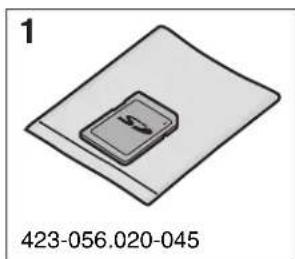
natural_image
Simple line drawing of a rectangular object with a small arrow inside, placed on a flat surface (no text or symbols)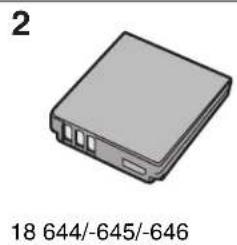
natural_image
3D illustration of a gray rectangular electronic device with ports and connectors, labeled with part numbers 18 and 644/645/646 (no text or symbols on the device itself)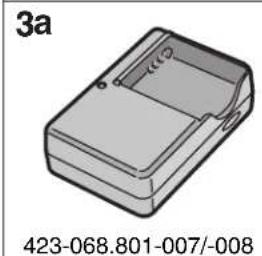
natural_image
3D rendering of a rectangular electronic device casing with internal components (no text or symbols visible)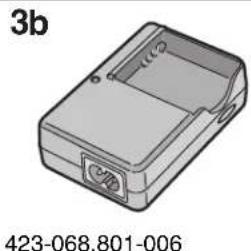
natural_image
Illustration of a gray electronic device casing with ports and connectors (no text or symbols)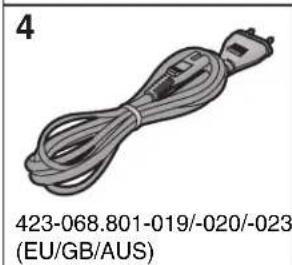
natural_image
Coiled cable with connector, no visible text or symbols on the cable itself
natural_image
Illustration of a USB cable with connector and connector (no text or symbols on the diagram itself)
natural_image
Coiled audio cable with two leads and a rectangular connector (no text or symbols visible)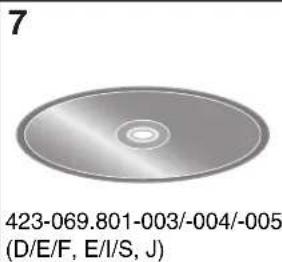
text_image
7 423-069.801-003/-004/-005 (D/E/F, E/I/S, J)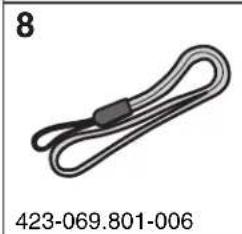
natural_image
Coiled black cable with a black strap, labeled '8' and identifier '423-069.801-006' (no other text or symbols)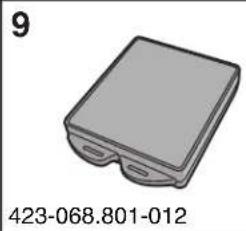
natural_image
3D rendered image of a rectangular electronic component with two side slots (no text or symbols visible)1 SD Memory Card (64 MB)
(Indicated as "Card" in the text)
2 Battery Pack BP-DC4-E/U/J
(Indicated as "Battery" in the text)
3 Battery Charger
(Indicated as "Charger" in the text)
a. U.S. and Japan BC-DC4-U/J
b. Other countries BC-DC4-E
4 AC Mains Lead (not in U.S. and Japan)
5 USB Connection Cable
6 A V C a b l e
7 CD-ROM
8 S tr a p
9 Battery Carrying Case
- If any accessories are lost, customers should contact their Leica dealer for further information about obtaining replacement parts.
Additional Accessories
| Cases |
| 18 651/-652/-653 |
| AC Adaptor |
| ACA-DC4-E/U/J18 640/-641/-642 |
Names of the Components
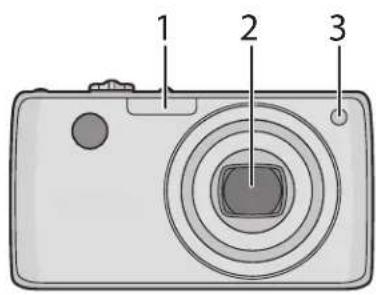
text_image
1 2 31 Flash (P38)
2 Lens (P6)
3 Self-timer indicator (P42)
AF assist lamp (P70)
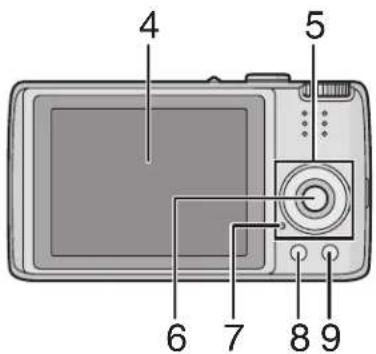
text_image
4 5 6 7 8 94 LCD monitor (P35, 91)
5 Cursor buttons
◀/Self-timer button (P42)
▼/[REV] button (P31)
▶/Flash setting button (P38)
▲/Exposure compensation (P43)/Auto bracket (P44)/White balance fine adjustment
(P66)/Backlight compensation in simple mode (P28) button
6 [MENU/SET] button (P19)
7 Status indicator (P14, 20)
8 [DISPLAY/LCD MODE] button (P35, 91)
9 Single or burst mode (P46)/Delete (P33) button
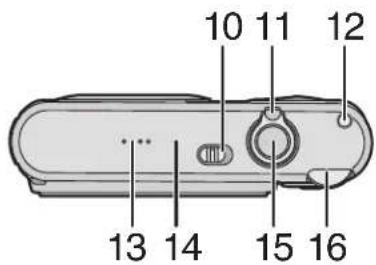
text_image
10 11 12 13 14 15 1610 Camera ON/OFF switch (P13)
11 Zoom lever (P29, 29)
12 Optical image stabilizer button (P45)
13 Speaker (P63)
14 Microphone (P58, 68, 78)
15 Shutter button (P24, 59)
16 Mode dial (P5)
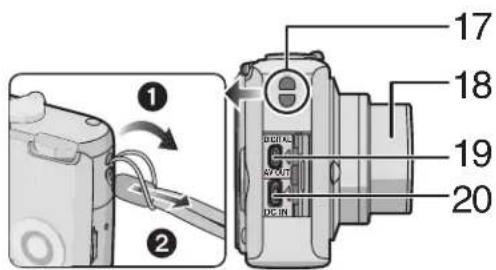
text_image
17 18 19 20 1 2 1 2 A A OUT DC IN17 Strap eyelet
18 Lens barrel
19 [DIGITAL/AV OUT] socket (P90, 82, 86)
20 [DC IN] socket (P82, 86)
• Always use genuine Leica AC adaptor (ACA-DC4-E/U/J; optional).
- The camera cannot charge the battery when the AC adaptor (ACA-DC4-E/U/J; optional) is connected to it.

text_image
21 22 OPEN LOCK 2321 Tripod receptacle
- When you use a tripod, make sure the tripod is stable when the camera is attached to it.
22 Card/Battery door (P15, 16)
23 Release lever (P15, 16)
Quick Guide
This is an overview of how to record and playback pictures with the camera. For each step, be sure to refer to the pages indicated in brackets.
1 Charge the battery. (P14)
A. Only U.S. and Japan

text_image
90° AB. Other countries

natural_image
Illustration of a USB cable connector with an external port and an arrow indicating direction (no text or symbols)- The battery is not charged when the camera is shipped. Charge the battery before use.
2Insert the battery and the card. (P15, 16)
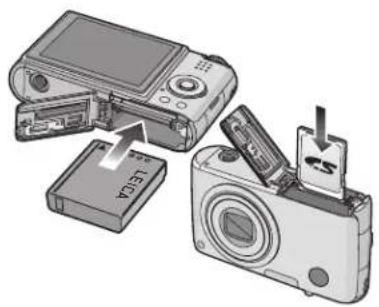
natural_image
Illustration of a digital camera with an open case and a close-up of its internal components (no text or symbols visible)3Turn the camera on to take pictures.
- Set the clock. (P18)
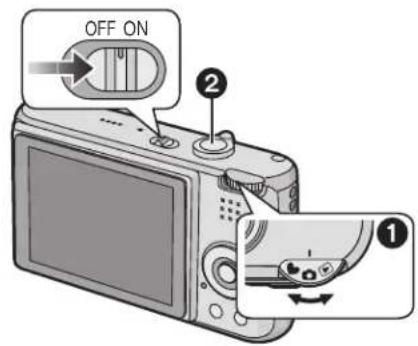
text_image
OFF ON ② ①① Set the mode dial to 📄
② Press the shutter button to take pictures. (P24)
4Play back the pictures.
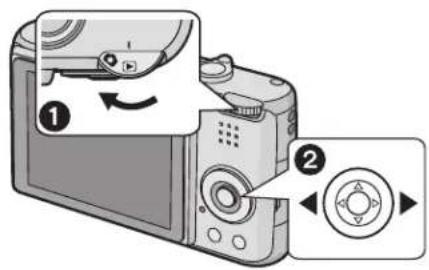
text_image
Diagram showing a camera module with labeled parts and directional arrows indicating rotation or adjustment.① Set the mode dial to
② Select the picture you want to view. (P32)
Charging the Battery with the Charger
The battery is not charged when the camera is shipped. Charge the battery before use.
1 Attach the battery with attention to the direction of the battery.

text_image
LEICA2Connect the charger to the electrical outlet.
A. Only U.S. and Japan

text_image
90° AB. Other countries

natural_image
Illustration of a plug and connector with an arrow indicating direction (no text or symbols)- Charging starts when the [CHARGE] indicator Ⓐ lights green.
- Charging is complete when the [CHARGE] indicator Ⓐ turns off (after about 130 minutes).
3 Detach the battery after charging is complete.
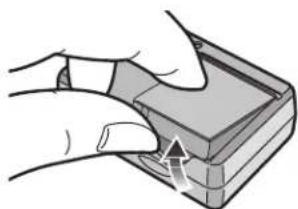
natural_image
Illustration of hands pressing a button on a rectangular object (no text or symbols)
• After charging is completed, be sure to disconnect the charger from the electrical outlet.
- The battery becomes warm after using it and during and after charging. The camera also becomes warm during use. This is not a malfunction.
- The battery will be exhausted if left for a long period of time after being charged.
Recharge the battery when it is exhausted.
- Use the dedicated charger and battery.
- Charge the battery with the charger indoors.
- Do not disassemble or modify the charger.
About the Battery
(charging/number of recordable pictures)
■ Battery indication
The remaining battery power appears on the screen. [It does not appear when you use the camera with the AC adaptor (ACA-DC4-E/U/J; optional) connected.]

- The battery indication turns red and flashes. (The status indicator blinks when the LCD monitor turns off.) Recharge the battery or replace it with fully charged battery.
■ The battery life
The number of recordable pictures (By CIPA standard in normal picture mode)
Number of Approx. 320 pictures recordable pictures (Approx. 160 min)
The number of recordable pictures varies depending on the recording interval time.
If the recording interval time becomes longer, the number of recordable pictures decreases.
[e.g. When recording once every 2 minutes, the number of recordable pictures decreases to about 80.]
Playback time
Playback time Approx. 360 min
The number of recordable pictures and playback time will vary depending on the operating conditions and storing condition of the battery.
■ Charging
Charging time Approx. 130 min
- The [CHARGE] indicator lights when charging starts.
■ When the [CHARGE] indicator flashes
- The battery is over discharged (discharged excessively). In a while, [CHARGE] indicator will light up and normal charging will start.
- When the battery temperature is excessively high or low, [CHARGE] indicator flashes and the charging time will be longer than normal.
- The terminals of the charger or the battery are dirty. In this case, wipe them with a dry cloth.
- When the operating time of the camera becomes extremely short even after properly charging the battery, the life of the battery may have expired. Buy a new battery.
■ Charging conditions
- Charge the battery in a temperature between 10^ to 35^ (50°F to 95°F). (The battery temperature should also be the same.)
- The performance of the battery may temporarily deteriorate and the operating time may become shorter in low temperature conditions (e.g. skiing/snowboarding).
Inserting/Removing the Battery
- Check that the camera is turned off and that the lens is retracted.
1 Slide the release lever in the direction of arrow and open the card/battery door.
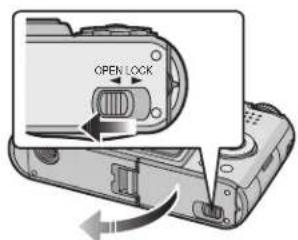
text_image
OPEN LOCK• Always use genuine Leica batteries (BP-DC4-E/U/J).
2Insert:
Insert the charged battery fully paying attention to its direction.
Remove:
Slide the lock Ⓐ to remove the battery.
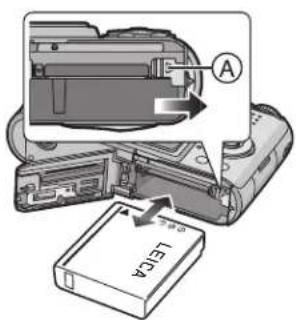
text_image
LEK43① Close the card/battery door. ② Slide the release lever in the direction of the arrow.
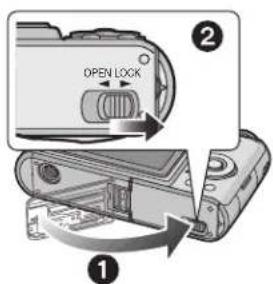
text_image
OPEN LOCK ① ②
- Remove the battery after use. Store the removed battery in the battery carrying case (supplied).
-
When a fully charged battery has been inserted for more than 24 hours, the clock setting is stored (in the camera) for at least 3 months even if the battery is removed. (If you insert a battery that is not sufficiently charged, the length of time that the clock setting is stored may become less.) However, the clock setting is cancelled after this length of time. In this case, set the clock again. (P18)
-
Do not remove the card or the battery while the card is being accessed. The data may be damaged. (P17)
- Do not remove the battery with the camera turned on as the settings on the camera may not be stored properly.
- Do not remove the battery until the LCD monitor and the status indicator (green) turn off as the settings on the camera may not be stored properly.
- The supplied battery is designed only for the camera. Do not use it with any other equipment.
Inserting/Removing the Card
- Check that the camera is turned off and that the lens is retracted.
- Prepare an SD Memory Card (supplied) or a MultiMediaCard (optional).
1 Slide the release lever in the direction of the arrow and open the card/battery door.
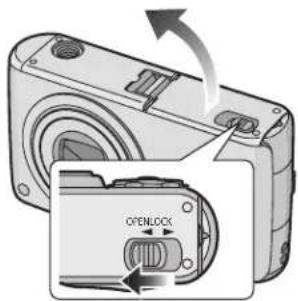
text_image
OPENLOCK2Insert:
Insert the card fully until it clicks and it is locked.
Remove:
Push the card until it clicks, then pull the card out upright.

natural_image
Illustration of a digital camera with an open lid and a paper clip, showing no text or symbols.- Check the direction of the card.
- Do not touch the connection terminals on the back side of the card.
- The card may be damaged if it is not fully inserted.
3①
Close the card/battery door.
② Slide the release lever in the direction of the arrow.
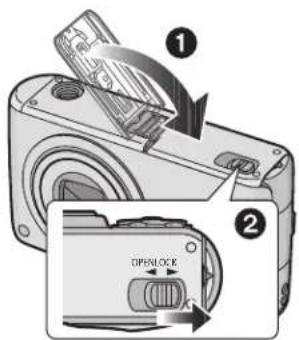
text_image
① ② OPENLOCK- If the card/battery door cannot be completely closed, remove the card and insert it again.

- The card and the data may be damaged if it is inserted or removed while the camera is on.
About the Card
■ Access to the card
The card access indication Ⓐ lights red when pictures are being recorded onto the card.
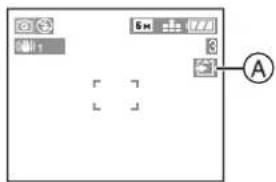
text_image
Screenshot of a software interface with tool icons and a labeled button 'A'When, the card access indication lights, pictures are being read or deleted or the card is being formatted. Do not:
- turn the camera off.
- remove the battery or the card.
- shake or impact the camera.
- disconnect AC adaptor (ACA-DC4-E/U/J; optional)
The card and the data may be damaged or the camera may not operate normally.
■ About handling a card
Transfer important pictures/motion pictures from your card to your PC periodically (P84). The data on the card may be damaged or lost due to electromagnetic waves, static electricity, the camera breaking down or a defective card.
- Do not format the card on your PC or other equipment. Format it on the camera only to ensure proper operation. (P81)
■ SD Memory Card (supplied) and MultiMediaCard (optional)
- The SD Memory Card and MultiMediaCard are small, lightweight, removable external cards.
- The reading/writing speed of an SD Memory Card is fast. The SD Memory Card is equipped with a Write-Protect switch Ⓑ that can inhibit writing and formatting a card. (When the switch is slid to the [LOCK] side, it is not possible to write or delete data on the card and format it. When the switch is unlocked, these functions become available.)
SD Memory Card

- On this unit, you can use SD Memory Cards of the following capacity (from 8 MB to 2 GB).
8 MB, 16 MB, 32 MB, 64 MB, 128 MB, 256 MB, 512 MB, 1 GB, 2 GB (Maximum)
• Refer to P103 for information about the number of recordable pictures and the available recording time for each SD Memory Card.
- This unit supports SD Memory Cards formatted in FAT12 system and FAT16 system based on SD Memory Card Specifications. This unit does not support SD Memory Cards formatted in FAT32 system.
- This unit does not support recording motion pictures on MultiMediaCards. We recommend using High Speed SD Memory Cards when recording motion pictures. (P58)

- The reading/writing speed of a MultiMediaCard is slower than an SD Memory Card. When a MultiMediaCard is used, the performance of certain features may be slightly slower than advertised.
- Keep the Memory Card out of reach of children to prevent swallowing.
Setting Date/Time (Clock Set)
■ Initial setting
The clock is not set so the following screen appears when you turn the camera on.

text_image
OFF ON A B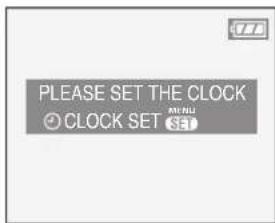
text_image
PLEASE SET THE CLOCK © CLOCK SET MENUⒶ: [MENU/SET] button
⑧: Cursor buttons
• The screen disappears after about 5 seconds. Turn the camera off and on again.
1 Press [MENU/SET].
2 Press ▲/▼/◄/► to select the date and time.

text_image
CLOCK SET 0:00 JAN 1.2006 M/D/Y SELECT SET EXIT• ◀/▶: Select the desired item.
- ▲/▼: Set the display order for the date and time.
3Press [MENU/SET] several times to close the menu.
- Turn the camera off after finishing setting the clock. Then turn it on and check that the clock setting is correct.
■ Changing the clock setting
1 Press [MENU/SET] to display the menu and then press ◀.
2 Press ▼ to select the [SETUP] menu icon [💡 and then press ▶.
3 Press ▲/▼ to select [CLOCK SET] and then press ▶. Set as shown previously.
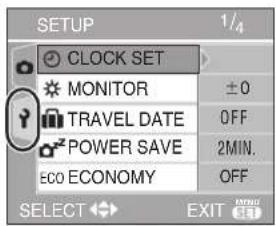
text_image
SETUP 1/4 CLOCK SET MONITOR ±0 TRAVEL DATE OFF POWER SAVE 2MIN. ECO ECONOMY OFF SELECT EXIT[Non-Text]
- When a fully charged battery has been inserted for more than 24 hours, the clock setting is stored (in the camera) for at least 3 months even if the battery is removed.
- You can set the year from 2000 to 2099. The 24-hour system is used.
- If the date is not set in the camera it will not be printed when you use a photo printing service, even if the store provides a date printing option for your photographs. (P76)
About the Setup Menu
- Set items as required. (Refer to P20 to 23 for each menu item.)
- Menu items differ depending on the mode selected with the mode dial (P5).
- Select [RESET] to return the settings to the initial settings at the time of purchase. (P22)
1 Press [MENU/SET] and then press ◀.
![LEICA C-LUX 1 - Press [MENU/SET] and then press ◀. - 1](/content/2026/05/1008992/images/b8f91e61bb277622c0812a33fd5952bfce86982720740531ca1e460c0eb263fa.jpg)
text_image
REC 1/3 W.BALANCE AUTO SENSITIVITY AUTO ASPECT RATIO 4.3 PICT.SIZE 6 M QUALITY SELECT EXIT MENU/ SET2 Press ▼ to select the [SETUP] menu icon [¶] and then press ▶.
![LEICA C-LUX 1 - Press ▼ to select the [SETUP] menu icon [¶] and then press ▶. - 1](/content/2026/05/1008992/images/c09aa127c31a3b839f43f09674da3b41d97a7c961caac05f2c4c00a8d682da02.jpg)
text_image
SETUP 1/4 CLOCK SET MONITOR ±0 TRAVEL DATE OFF POWER SAVE 2MIN. ECO ECONOMY OFF SELECT EXIT3 Press ▲/▼ to select the menu item.
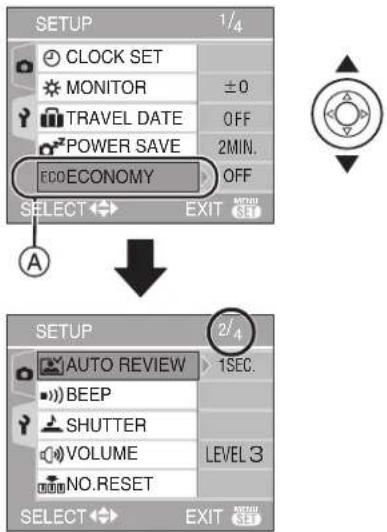
text_image
SETUP 1/4 CLOCK SET MONITOR ±0 TRAVEL DATE OFF POWER SAVE 2MIN. ECO ECONOMY OFF SELECT EXIT A SETUP 2/4 AUTO REVIEW 1SEC. BEEP SHUTTER VOLUME LEVEL 3 NO RESET SELECT EXIT- Press ▼ at Ⓐ to switch to the next menu screen.
4 Press ▶, press ▲/▼ to select the setting and then press [MENU/SET].
![LEICA C-LUX 1 - Press ▶, press ▲/▼ to select the setting and then press [MENU/SET]. - 1](/content/2026/05/1008992/images/7d1d79fe1344ccd8934d19707e728ea934389c1d0464a85aa86e6e6e00dd1851.jpg)
text_image
SETUP 2/4 AUTO REVIEW OFF BEEP 1SEC. SHUTTER 3SEC. VOLUME ZOOM NO.RESET SELECT SET MENU MENU/SET5Press [MENU/SET] to close the menu.
- You can also press the shutter button halfway to close the menu.
■ About the menu screen items
- There are 4 menu screens (1/4, 2/4, 3/4 and 4/4).
- You can switch menu screens from any menu item by rotating the zoom lever.
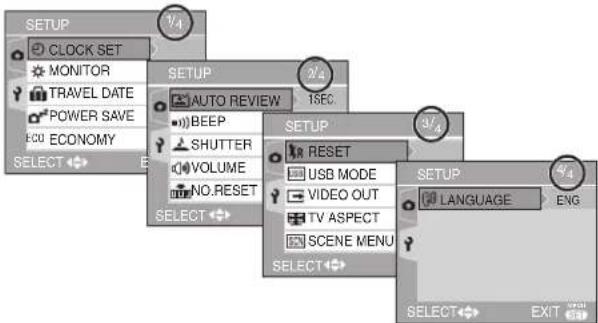
text_image
SETUP CLOCK SET MONITOR TRAVEL DATE POWER SAVE ECO ECONOMY SELECT AUTO REVIEW BEEP SHUTTER VOLUME NO.RESET SELECT SETUP RESET USB MODE VIDEO OUT TV ASPECT SCENE MENU SELECT SETUP LANGUAGE EXIT(CLOCK SET)
Press [1] to display the [SETUP] menu and select the item to set. (P19) Change date and time. (P18)
[MONITOR]
Press [1] to display the [SETUP] menu and select the item to set. (P19) Adjust the brightness of the LCD monitor in 7 steps.
• The [MONITOR] setting also affects simple mode [♥
[TRAVEL DATE]
Press [J] to display the [SETUP] menu and select the item to set. (P19)
[SET]: When taking a picture, the date on which it was taken is recorded.
[OFF]: When taking a picture, the date on which it was taken it is not recorded.
• Refer to P56 for information about setting [TRAVEL DATE].
- The [TRAVEL DATE] setting also affects simple mode [♥
^z^Z [POWER SAVE]
Press [MEN to display the [SETUP] menu and select the item to set. (P19)
[1MIN.]/[2MIN.]/[5MIN.]/[10MIN.]:
Power save mode is activated (the camera is automatically turned off to save the battery life) if the camera has not been used for the time selected on the setting.
[OFF]: Power save mode is not activated.
- Press the shutter button halfway or turn the camera off and on to cancel power save mode.
- In simple mode [1] and economy mode, power save mode is fixed to [2MIN.].
- When using the AC adaptor (ACA-DC4-E/U/J; optional), connecting to a PC or a printer, recording or playing back motion pictures and during a slide show, power save mode is not activated. (However, the setting for power save mode is fixed to [10MIN.] while pausing a slide show or playing back a manual slide show.)
ECO [ECONOMY]
Press [1] to display the [SETUP] menu and select the item to set. (P19) Battery life is saved by reducing the brightness of the LCD monitor and turning it off automatically when the camera is not being used in recording mode.
[LEVEL 1]: The LCD monitor turns off if the camera is not operated for about 15 seconds in recording mode.
[LEVEL 2]: The LCD monitor turns off if the camera is not operated for about 15 seconds in recording mode or for about 5 seconds after taking a picture.
[OFF]: Economy mode cannot be activated.
- In economy mode, the LCD monitor is turned off while the flash is being charged.
- The status indicator lights while the LCD monitor is turned off. Press any button to turn on the LCD monitor again.
- Power save mode is fixed to [2MIN.] in economy mode.
[However, power save mode is not activated when using the AC adaptor (ACA-DC4-E/U/J; optional).] - Economy mode will not work in simple mode [ ] when using the AC adaptor (ACA-DC4-E/U/J; optional), recording motion pictures, the menu screen is displayed or the self-timer is set.
- The brightness of the LCD monitor is not reduced in Power LCD mode and high angle mode.
![LEICA C-LUX 1 - ECO [ECONOMY] - 1](/content/2026/05/1008992/images/52880d79ee2c0323ff14d1ab2d16494d5fe7f4d048560fb2a71656da9f8b6878.jpg)
[AUTO REVIEW]
Press [ ] to display the [SETUP] menu and select the item to set. (P19)
[1SEC.]: The recorded picture automatically appears on the screen for about 1 second.
[3SEC.]: The recorded picture automatically appears on the screen for about 3 seconds.
[ZOOM]: The recorded picture automatically appears on the screen for about 1 second. It is then enlarged 4 times and appears for about 1 second. This mode is useful for confirming focus. Pictures recorded using
auto bracket or continuous mode and pictures with audio are not enlarged even if [ZOOM] is selected.
[OFF]: The recorded picture does not automatically appear.
- The auto review function is not activated in motion picture mode [ ]
- When pictures are recorded in auto bracket (P44) or continuous mode (P46), the auto review function is activated regardless of the setting on the auto review function. (The picture is not enlarged.)
- The auto review function is activated while pictures with audio (P68) are being recorded regardless of its setting. (The picture is not enlarged.)
- The auto review setting is disabled when using auto bracket or continuous mode, in motion picture mode or when [AUDIO REC.] or [SELF PORTRAIT] in scene mode is set to [ON].
■) [BEEP]
Press [SETUP] display the [SETUP] menu and select the item to set. (P19)
■)) [BEEP LEVEL]:
[No operation sound
[...] Soft operation sound
[27]oud operation sound
[BEEP TONE]:
- The [BEEP] setting also affects simple mode [ ]
![LEICA C-LUX 1 - [BEEP TONE]: - 1](/content/2026/05/1008992/images/7ef11ed76ff1d3dfa42be3a49a255d06eeb55b0ed1bd3058fa3fdbe7060ea9dd.jpg)
[SHUTTER]
Press [1] to display the [SETUP] menu and select the item to set. (P19) Set to select the volume of shutter sound.
![LEICA C-LUX 1 - [SHUTTER] - 1](/content/2026/05/1008992/images/77c03df3ff6fded92662ae98aadcad20559b84e80dab67763d7b47a2f4a27b56.jpg)
[SHUTTER VOL.]
[×]
: No shutter sound
[♪]
: Soft shutter sound
[ ]
: Loud shutter sound
![LEICA C-LUX 1 - [SHUTTER VOL.] - 1](/content/2026/05/1008992/images/e7dd56084e3194a04d17fc6f2fda5f43c2f41865a2acabeb6daab6b1e3bc5eec.jpg)
[SHUTTER TONE]: /1 2 3
- The [SHUTTER] setting also affects simple mode [♥
![LEICA C-LUX 1 - [SHUTTER TONE]: /1 2 3 - 1](/content/2026/05/1008992/images/456d5830900e48b3c2f1b321e5aa9fc94fdcce428d2c5b8927e8fcaba8acfa8a.jpg)
[VOLUME]
Press [NETO display the [SETUP] menu and select the item to set. (P19)
The volume of speakers can be adjusted in 7 steps from level 6 to 0.
- When you connect the camera to a TV, the volume of the TV speakers does not change.
![LEICA C-LUX 1 - [VOLUME] - 1](/content/2026/05/1008992/images/cf58033e88775dec7773c1381a036568f759845a42fb46307499a9cd9e8e5223.jpg)
[NO.RESET]
Press [1] to display the [SETUP] menu and select the item to set. (P19)
Set this when you want the file number of the next recording to start from 0001. (The folder number is updated and the file number starts from 0001.)
- A folder number between 100 and 999 can be assigned.
When the folder number reaches 999, the number cannot be reset. We recommend formatting the card after saving the data on a PC or elsewhere.
- To reset the folder number to 100, format (P81) the card first and then use this function to reset the file number.
A reset screen for the folder number will then appear. Select [YES] to reset the folder number.
- Refer to P85 for detailed information about the file number and the folder number.
• The [NO.RESET] setting also affects simple mode [♥
![LEICA C-LUX 1 - [NO.RESET] - 1](/content/2026/05/1008992/images/5d8fe5e3b5a24b0aabf647edf83c7ad6420efd8980e0cab1495879e393afe94e.jpg)
[RESET]
Press [to] display the [SETUP] menu and select the item to set. (P19) The [REC] or [SETUP] menu settings are reset to the initial settings.
- The birthday setting for [BABY1]/[BABY2] (P53) in scene mode and the number of days that have passed since the departure date for [TRAVEL DATE] (P56) are also reset when the [SETUP] menu settings are reset. Also, [FAVORITE] (P73) is fixed to [OFF] and [ROTATE DISP.] (P74) is fixed to [ON].
- The folder number and the clock setting are not changed.
![LEICA C-LUX 1 - [RESET] - 1](/content/2026/05/1008992/images/87181c594540a8a3856751754eaa8fb5cc1fe9f9c48f72552be1ac8c35d8683c.jpg)
[USB MODE]
Press [1] to display the [SETUP] menu and select the item to set. (P19) Select the USB communication system after or before connecting the camera to your PC or your printer with the USB connection cable (supplied).
![LEICA C-LUX 1 - [USB MODE] - 1](/content/2026/05/1008992/images/1d05750e530f93d5125e603357425ead24033b323d6f4497754df3bc6af7f655.jpg)
[LECT ON CONNECTION]:
Select either [PC] or [PictBridge (PTP)] if you connected the camera to a PC or a printer supporting PictBridge.
![LEICA C-LUX 1 - [LECT ON CONNECTION]: - 1](/content/2026/05/1008992/images/c9c33f9a23cbfc053d5bc64a057852bb385db053b145efd73443d27937c2a4e9.jpg)
P C ]:
Set after or before connecting to a PC.
![LEICA C-LUX 1 - P C ]: - 1](/content/2026/05/1008992/images/c551692e06d33cd016ee039bd5adfbc6282f1b18da57dbd24e4af461199cbf8e.jpg)
ctBridge (PTP)]:
Set after or before connecting to a printer supporting PictBridge.
- When [PC] is selected, the camera is connected via the USB Mass Storage communication system.
- When [PictBridge (PTP)] is selected, the camera is connected via the PTP (Picture Transfer Protocol) communication system.
![LEICA C-LUX 1 - ctBridge (PTP)]: - 1](/content/2026/05/1008992/images/2e6ae40a96508849c24d83c1891128cb9dc4ef15206bbd22f357333b8c3c18c0.jpg)
[VIDEO OUT]
(Playback mode only) (P90)
Press [NETO display the [SETUP] menu and select the item to set. (P19)
[NTSC]: Video output is set to NTSC system.
[PAL]: Video output is set to PAL system.
![LEICA C-LUX 1 - [VIDEO OUT] - 1](/content/2026/05/1008992/images/ce7b6d95879aa801b0570d7f1c179e4cc79f166e3c3f17ce3aa13b54714cf786.jpg)
[TV ASPECT]
(Playback mode only) (P90)
Press [ ] to display the [SETUP] menu and select the item to set. (P19)
[15:9
Select this if connecting the camera to a 16:9 TV.
[4:3]:
Select this if connecting the camera to a 4:3 screen TV.
- This is suitable for displaying pictures recorded with a [16:3]ect on the full screen of a 16:9 TV. Pictures recorded with a [4:3] [ ] 3:2 aspect are displayed with black bands on the left and right of the screen.
- When [4:3] selected, pictures recorded with a 16:9 3:2 aspect are displayed with black bands on the top and bottom of the screen.
- When you select 16.9 d use the AV cable (supplied) for output (P90), pictures are displayed vertically on the LCD monitor.
![LEICA C-LUX 1 - [TV ASPECT] - 1](/content/2026/05/1008992/images/ec8f316193584f73f13c103c962d10e6c61d984e7b2390b324378f74cc7da2c2.jpg)
[SCENE MENU]
Press [ ] to display the [SETUP] menu and select the item to set. (P19)
[AUTO]: [SCENE MODE] menu appears automatically when setting the mode dial to scene mode. Select the desired scene mode. (P48)
[OFF]: [SCENE MODE] menu does not appear when setting the mode dial to scene mode and the camera is operated in scene mode currently selected. If you change the scene mode, press
[MENU/SET] to display the [SCENE MODE] menu and then select the desired scene mode.
![LEICA C-LUX 1 - [SCENE MENU] - 1](/content/2026/05/1008992/images/5e227e4a85561a24428f09258459ddbee334234f65151a74ce9dafed38a31973.jpg)
[LANGUAGE]
Press [MENU SET] to display the [SETUP] menu and select the item to set. (P19)
Set the language on the menu screen from the following languages. Set to the desired language with ▲/▼ and store it with [MENU/SET].
- If you set a different language by mistake, select [Q] from the menu icons to set the desired language.
- The [LANGUAGE] setting also affects simple mode [♥].
Taking Pictures

The camera automatically sets the shutter speed and the aperture value according to the brightness of the subject.
1① Turn the camera on.
② Select normal picture mode [☐].
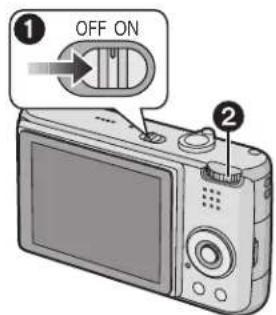
text_image
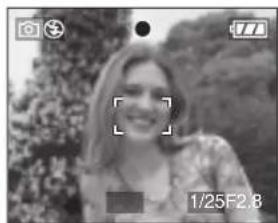
OFF ON ① ②2 Aim the AF area ① to the point you want to focus on and then press the shutter button halfway.

text_image
① ② 1/25F2.8 ③ ④ A- Ⓐ: Press the shutter button halfway to focus.
- The focus indication ② lights and then the aperture value ③ and the shutter speed ④ are displayed.
- If 5-area-focusing or 3-area-focusing (High speed) is used in AF mode, the AF area does not appear until the subject is brought into focus. (P69)
- The AF area displayed is bigger than usual when using the digital zoom or when taking pictures in dark places. (P69)
| When the subject is not focused | When the subject is focused | |
| Focus indication | Flashes (green) | On (green) |
| AF area Turns white to red or no AF area | Turns white to green | |
| Sound Beeps 4 times Beeps 2 times | ||
3Take a picture.
natural_image
Black-and-white photo of a smiling person outdoors with blurred foliage background (no visible text or symbols)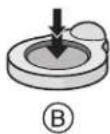
- Ⓑ: Press the shutter button fully to take the picture.
[Non-Text]
• We recommend checking that the clock is set properly before taking pictures. (P18)
- When you press the shutter button, the screen may become bright or dark for a moment. This function allows easy adjustment of focus and the recorded picture will not be affected.
- When a time is set for power save (P20), the camera automatically turns off if you do not operate it within the set time. To operate the camera again, press the shutter button halfway or turn the camera off and on.
• To avoid noise, we recommend decreasing the ISO sensitivity (P66) or setting [PICT.ADJ.] to [NATURAL]. (P71)
■ Tips for taking good pictures
- Hold the camera gently with both hands, keep your arms still at your side and stand with your feet slightly apart.
• Make sure the camera does not shake when you press the shutter button.
- Do not cover the flash or the AF assist lamp with your fingers or other objects.
- Do not touch the front of the lens.
- If the LCD monitor screen is difficult to see because of light from the sun etc. shining on it, we recommend using your hand or another object to block the light when using the camera.
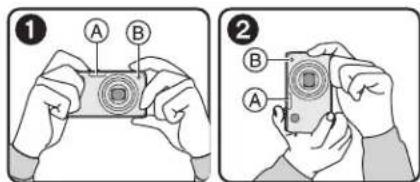
text_image
Two-step diagram showing hands holding a camera with labeled parts A and B, likely illustrating camera or device positioning.①: When holding the camera sideways
②: When holding the camera vertically
Ⓐ: Flash
⑧: AF assist lamp
■ Direction detection function
Pictures recorded with the camera held vertically are played back vertically (rotated). (Only when [ROTATE DISP.] (P74) is set to [ON])
- Pictures may not be displayed vertically if they were taken with the camera aimed up or down.
- Motion pictures taken with the camera held vertically are not displayed vertically.
■ When you want to take a subject outside the AF area (AF/AE Lock)
When recording a picture of people with a composition like the following picture, you will not be able to focus the camera on the subject because the people are outside the AF area.
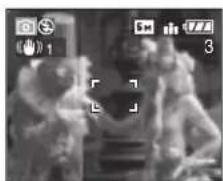
natural_image
Black-and-white photo of two people in a dimly lit room, no visible text or symbolsIn this case,
1 Aim the AF area at the subject.
2 Press the shutter button halfway to fix the focus and the exposure.
- The focus indication lights when the subject is focused.
3 Press and hold the shutter button halfway while moving the camera as you compose the picture.
4 Press the shutter button fully.
- You can repeatedly retry AF/AE lock before pressing the shutter button fully.

text_image
1/25F2.8 1/25F2.8■ Focusing
- The focus range is 50 cm (1' 7 ^11 /16" feet) to . Use macro mode when recording close-up pictures. (P47)
- If the distance between the camera and the subject is beyond the focus range of the camera, the picture may not be properly focused even if the focus indication appears.
- In the following cases, the camera will not focus on subjects properly.
- When there are both near and distant subjects in a scene.
- When there is dirt or dust on the lens.
- When there are illuminated or glittering objects around the subject.
- When taking a picture in dark places.
- When the subject is moving fast.
- When the scene has low contrast.
- When jitter occurs.
- When recording a very bright subject.
We recommend taking pictures using AF/AE lock. In dark places, the AF assist lamp (P70) may turn on to focus on the subject.
- Even when the focus indication appears and the subject is focused, it is canceled if you release the shutter button. Press the shutter button halfway again.
■ Preventing jitter (camera shake)
- Be careful of jittering when pressing the shutter button.
- If jitter could occur because of slow shutter speed, the jitter alert Ⓐ appears.
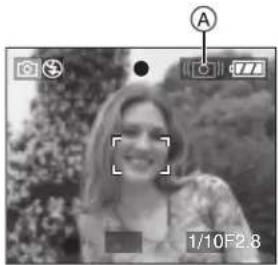
natural_image
Black-and-white photo of a smiling person outdoors, with camera control buttons and no readable text or symbols.- When the jitter alert appears, we recommend using a tripod. If you cannot use a tripod, be careful how you hold the camera (P25). The use of the self-timer prevents jittering caused by pressing the shutter button when you are using a tripod (P42).
- Shutter speed will be slower particularly in the following cases. Keep the camera still from the moment the shutter button is pressed until the picture appears on the screen. We recommend using a tripod.
- Slow sync./Red-eye reduction (P38)
- When the shutter speed is slowed in [SLOW SHUTTER] (P70)
■ Exposure
- If you press the shutter button halfway when the exposure is not adequate, the aperture value and the shutter speed turn red. (They do not turn red when the flash is activated.)
- The brightness of the screen may differ from the brightness of the recorded pictures especially when recording in low light conditions.
- When most of the subjects on the screen are bright (e.g. a blue sky on a clear day, a snowy field etc.), the recorded pictures may become dark. In this case, compensate the exposure value on the camera. (P43)
Taking Pictures in Simple Mode

This mode allows beginners to take pictures easily. Only the basic functions appear in the menu to make operations simple.
■ Basic menu settings
1 Press [MENU/SET].
2 Press ▲/▼ to select the desired menu item and then press ▶.

text_image
SIMPLE MODE PICT.MODE ENLARGE AUTO REVIEW 4.6710 x15cm BEEP E-MAIL CLOCK SET SELECT &T NET NO. $11
3 Press ▲/▼ to select the desired setting and then press [MENU/SET].
4Press [MENU/SET] to close the menu.
- You can also press the shutter button halfway to close the menu.
■ Settings in Simple mode
[PICT.MODE]
![LEICA C-LUX 1 - [PICT.MODE] - 1](/content/2026/05/1008992/images/9ec223df82d810dcf2973dcdb0bb20e9a15f1f6ba4aa63d9c75a7df0bc95a4a0.jpg) ENLARGE ENLARGE | Suitable for enlarging the pictures to be printed to 8"×10" size, letter size etc. |
![LEICA C-LUX 1 - [PICT.MODE] - 2](/content/2026/05/1008992/images/63a265d1c67a09ffe42ff257f740a4eb9a4adce4b5ffecaad9b159a8f4c8f994.jpg) 4"×6"/ 10×15cm 4"×6"/ 10×15cm | Suitable for regular size printing. |
![LEICA C-LUX 1 - [PICT.MODE] - 3](/content/2026/05/1008992/images/354075eb0eeb7a19e26e08c948b9e562eaedb5731394df59f4bf74c424bb0948.jpg) E-MAIL Suitable for attaching pictures to e-mails or adding pictures to websites. E-MAIL Suitable for attaching pictures to e-mails or adding pictures to websites. | |
[AUTO REVIEW]
| OFF OFF The recorded picture does not automatically appear. |
| ON ON The recorded picture automatically appears on the screen for about 1 second. |
[BEEP]
| OFF | No operation sound |
| LOW | Soft operation sound |
| HIGH | Loud operation sound |
[CLOCK SET]
Change date and time. (P18)
- If [4'' × 6'' / 10 × 15cm] or [E-MAIL] are set in [PICT.MODE], the extended optical zoom is activated and the zoom ratio is extended to a maximum of 5 × . (P29)
- The settings for [BEEP] and [CLOCK SET] in simple mode are also applied to other recording modes.
- The settings for [MONITOR] (P20), [TRAVEL DATE] (P20), [BEEP] (P21), [SHUTTER] (P21), [NO.RESET] (P22) and [LANGUAGE] (P23) in the [SETUP] menu are applied to simple mode.
■ Other Settings in Simple mode
In simple mode, other settings are fixed as follows. For more information about each setting, refer to the page indicated.
• [POWER SAVE] (P20): [2MIN.]
• [ECONOMY] (P20): [OFF]
• Self-timer (P42): 10 seconds
• Optical Image Stabilizer (P45): [MODE2]
Basic
•Frequency (P46):
Low frequency (2 frames/second)
• [W.BALANCE] (P65): [AUTO]
• [SENSITIVITY] (P66): [AUTO]
- [ASPECT RATIO]/[PICT.SIZE]/[QUALITY] (P67, 67):
- [☐NLARGE]:
4:3 / (6M)/Fine
- [☐ 4"×6"/10×15cm]:
3:2 / (28.5M EZ)/Standard
- [☐ - MAIL]:
4:3 / (10.8M EZ)/Standard
- [AF MODE] (P69):
[1] -area-focusing)
- [AF ASSIST LAMP] (P70):
[ON]
- [SLOW SHUTTER] (P70):
[1/8-]
- You cannot use the following functions in simple mode.
- High angle mode
- White balance fine adjustment
- Exposure compensation
- Auto bracket
- [AUDIO REC.]
- [D.ZOOM]
- [COL.EFFECT]
- [PICT.ADJ.]
■ The Backlight Compensation
Backlight refers to when light comes from the back of a subject.
In this case, the subject, such as a person, will become dark.
If you press ▲, [B] (compensating backlight ON indication) Ⓐ appears and the backlight compensation function is activated. This function compensates the backlight by brightening the whole of the picture.

text_image
A 3 BACKLIGHT B 3 BACKLIGHT A- If you press ▲ while [ ] is displayed, [ ] disappears and the backlight compensation function is canceled.
- We recommend using the flash when you use the backlight compensation function. (When using the flash, it is fixed to Forced ON [⚡].)
- The flash setting is fixed to AUTO/Red-eye reduction [A] when the backlight compensation function is set to [OFF].
Taking Pictures with the Zoom
Using the Optical Zoom


You can make people and subjects appear closer with the 3.6× optical zoom and landscapes can be recorded in wide angle.
■ To make subjects appear closer use (Tele)
Rotate the zoom lever towards Tele.
- When the setting for picture size is


natural_image
Black-and-white photo of a person standing in front of a building entrance, with no visible text or symbols on the main subject.
■ To make subjects appear further away use (Wide)
Rotate the zoom lever towards Wide.
- When the setting for picture size is


natural_image
Black-and-white photo of a city skyline with a tower and streetlights, no visible text or symbols

- The optical zoom is set to Wide (1×) when the camera is turned on.
- Depending on the zoom magnification, the picture may have some distortion.
Distortion will be more visible when using
a wider area of the zoom lens as you move closer to the subject.
- Depending on the zoom magnification, the picture may have some colored fringes around the subject. This is called chromatic aberration and may be more visible when recording distant subjects.
- If you use the zoom function after focusing on the subject, focus on the subject again.
- The indicated zoom magnification is an approximation.
- The lens barrel (P12) extends or retracts according to the zoom position. Take care not to interrupt the motion of the lens barrel while the zoom lever is rotated.
- In motion picture mode [the zoom magnification is fixed to the value set at the start of recording.
Using the Extended Optical Zoom (EZ)


This camera has a 3.6× optical zoom. However, if the picture size is not set to the highest setting for each aspect ratio [4:3 a 3:2 16:9 maximum of 5× optical zoom can be achieved with no picture quality deterioration.
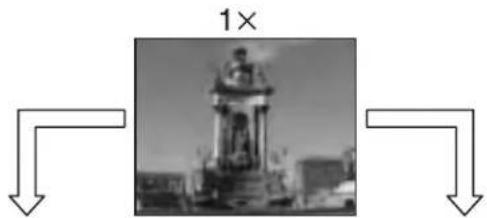
text_image
1×Picture size with the extended optical zoom not activated [example:


Picture size with the extended optical zoom activated [example:


E Z
3.6×
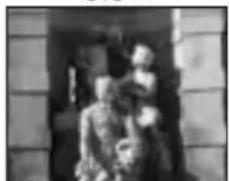
natural_image
Blurred grayscale image of two indistinct figures standing in front of a stone wall (no visible text or symbols)5×
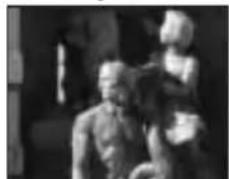
natural_image
Black-and-white photo of two shirtless men in a dimly lit room (no visible text or symbols)■ Picture size and maximum zoom magnification
(○: Available, —: Not available)
| Aspect ratio | Picture size | Maximum zoom magnification | Extended optical zoom |
| 4:3 | 6M/☐(6 | M)3.6× | — |
| 3:2 | 5M(5M) | ||
| 16:9 | 4.5M(4.5M) | ||
| 4:3 | 3M(3M EZ)2M(2M EZ)1M(1M EZ)0.3M/☐(0.3M EZ) | 5× | ○ |
| 3:2 | 25M/☐(2.5M EZ) | ||
| 16:9 | 2M(2M EZ) |
■ Extended optical zoom mechanism
When you set the picture size to [3M (3M EZ) (3 million pixels), the 6M (6 million pixels) CCD area is cropped to the center 3M (3 million pixels) area, allowing a picture with a higher zoom effect.

- Refer to P67 for aspect ratio settings, P67 for picture size and P27 for simple mode [❤️]
- “EZ” is an abbreviation of [Extended optical Zoom].
- You can further enhance the zoom magnification with the extended optical zoom without worrying about further picture distortion.
-
If you set a picture size that activates the extended optical zoom, the extended optical zoom icon [FF] displayed on the screen when you use the zoom function.
-
The zoom will stop moving for an instant near [W] (1×) when the extended optical zoom is used. This is not a malfunction.
- The indicated zoom magnification is an approximation.
- In motion picture mode [H] and [HIGH SENS.] in scene mode, the extended optical zoom does not work.

Using the Digital Zoom Further extending the zoom


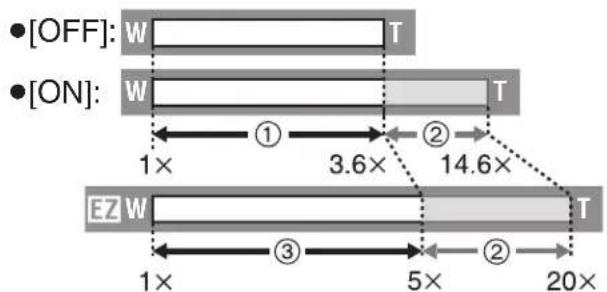
A maximum of 14.6× zoom can be achieved with the 3.6× optical zoom and the 4× digital zoom when [D.ZOOM] is set to [ON] in the [REC] menu. However, if a picture size that can use extended optical zoom is selected, a maximum of 20× zoom can be achieved with the 5× extended optical zoom and the 4× digital zoom.
■ Menu operation
1 Press [MENU/SET].
- When a scene mode is selected, press ◀ in the [SCENE MODE] menu (P48), press ▼ to select the [REC] menu icon [icon] and then press ▶.
2 Press ▲/▼ to select [D.ZOOM] and then press ▶.
3 Press ▼ to select [ON] and then press [MENU/SET].
![LEICA C-LUX 1 - Press ▼ to select [ON] and then press [MENU/SET]. - 1](/content/2026/05/1008992/images/7a6f47e3cfc03e6926fdc3b45656453faaabcb4348b4bf2c4e12aa2064c7d3ab.jpg)
text_image
REC AUDIO REC. OFF AF AF MODE AF AF ASSIST LAMP ON SLOW SHUTTER 1/8_ D.ZOOM OFF SELECT SET ON![LEICA C-LUX 1 - Press ▼ to select [ON] and then press [MENU/SET]. - 2](/content/2026/05/1008992/images/303ed08e9d335dc0ad19a79f10f08d0be37e6a120d83c14c43f90464fe8167d4.jpg)
4Press [MENU/SET] to close the menu.
- You can also press the shutter button halfway to close the menu.
■ Entering the digital zoom range
The on-screen zoom indication may momentarily stop moving when you rotate the zoom lever to the extreme Tele position. You can enter the digital zoom range by continuously rotating the zoom lever to Tele or releasing the zoom lever once and then rotating it to Tele again.
flowchart
graph TD
    A["●[OFF"]: W] --> B["①"]
    C["●[ON"]: W] --> D["②"]
    E["EZ W"] --> F["③"]
    G["T"] --> H["④"]
    I["T"] --> J["⑤"]
    K["T"] --> L["⑥"]
    M["T"] --> N["⑦"]
    O["T"] --> P["⑧"]
    Q["T"] --> R["⑨"]
    S["T"] --> T["⑩"]
    U["T"] --> V["⑪"]
    W["T"] --> X["⑫"]
    Y["T"] --> Z["⑬"]
    AA["T"] --> AB["⑭"]
    AC["T"] --> AD["⑮"]
    AE["T"] --> AF["⑯"]
    AG["T"] --> AH["⑰"]
    AI["T"] --> AJ["⑱"]
    AK["T"] --> AL["⑲"]
① Optical zoom
② Digital zoom
③ Extended optical zoom

- When using the digital zoom, the AF area in the center of the screen is displayed and it is bigger than usual. (P69)
- In digital zoom, the larger the picture the lower the picture quality.
- In the digital zoom range, the stabilizer function may not be effective.
- When using the digital zoom, we recommend using a tripod and the self-timer (P42) for taking pictures.
- The indicated zoom magnification is an approximation.
- The digital zoom does not work in simple mode [or [HIGH SENS.] in scene mode.
Checking the Recorded Picture (Review)

You can check the recorded pictures while still in [REC] mode.
1Press ▼ [REV].
![LEICA C-LUX 1 - 1Press ▼ [REV]. - 1](/content/2026/05/1008992/images/1fd19364712171543e825851db0c9267308f14623c6b885e44373365330e9a96.jpg)
text_image
REVIEW1X EXIT 4X DELETE![LEICA C-LUX 1 - 1Press ▼ [REV]. - 2](/content/2026/05/1008992/images/02b98930722c552c38923311d983c1541a7409a9ba2116d1682344b8b5e1b611.jpg)
- The last recorded picture appears for about 10 seconds.
- Review is canceled when the shutter button is pressed halfway or the ▼ [REV] is pressed again.
- You can check other pictures by pressing ◀/▶.
- When the recorded pictures are too bright or too dim, compensate the exposure. (P43)
2Rotate the zoom lever towards [T] to enlarge the picture.
- Rotate the zoom lever to [T] for a 4 × magnification and then rotate it even more for a 8 × magnification. When you rotate the zoom lever towards [W] after enlarging the picture, the magnification becomes lower.
3 Press ▲/▼/◄/► to move the position.
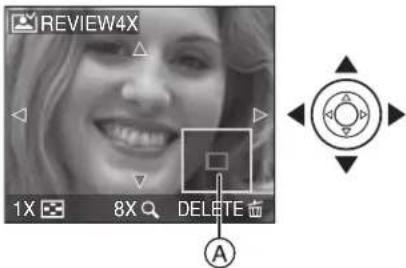
text_image
REVIEW4X 1X 8X DELETE A- When you change the magnification or the position to be displayed, the zoom position indication Ⓐ appears for about 1 second so that you can check the enlarged area.
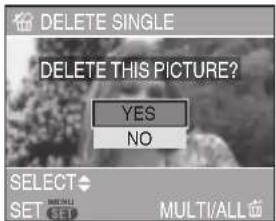
■ Deleting the recorded picture during Review (Quick deletion)
1 Press [血
2 Press ▲ to select [YES].
3 Press [MENU/SET].
text_image
DELETE SINGLE DELETE THIS PICTURE? YES NO SELECT SET ⬆ MULTI/ALL- Once deleted, pictures cannot be recovered. Double-check pictures before deleting them.
- Multiple pictures or all the pictures can be deleted. For information about how to delete pictures, refer to P33.

- When [ROTATE DISP.] is set to [ON], pictures recorded holding the camera vertically are played back vertically (rotated).
Playing Back Pictures

Press ◀/▶ to select the picture.
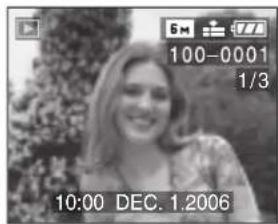
text_image
100-0001 1/3 10:00 DEC. 1.2006
◀: Play back the previous picture
▶: Play back the next picture
- The first recorded picture will be displayed after the last recorded picture.
- When [ROTATE DISP.] (P74) is set to [ON], pictures recorded by holding the camera vertically are played back vertically.
■ Fast forwarding/Fast rewinding
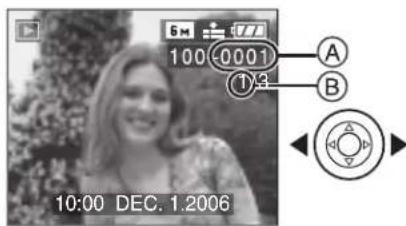
Press and hold ◀/▶ during playback
text_image
100 0001 ①3 A B 10:00 DEC. 1.2006◀: Fast rewind
▶: Fast forward
- The file number Ⓐ and the picture number Ⓑ only change one by one. Release ◀/▶ when the number of the desired picture appears to play back the picture.
- If you press and hold ◀/▶, the number of files forwarded/rewound at one time increases. The actual number of files forwarded/rewound at one time depends on the number of files recorded.
- In review playback in recording mode and in multi playback (P60), the pictures can only be forwarded or rewound one by one.
[Non-Text]
- This camera is based on the DCF standard (Design rule for Camera File system).
- The file format that can be played back on the camera is JPEG. (In some cases, even JPEG pictures cannot be played back.)
- The LCD monitor may not be able to display the details of the recorded pictures. You can use the playback zoom (P62) to check the details of the pictures.
- If you play back pictures that have been recorded with other equipment, the picture quality may deteriorate. (The pictures are displayed as [THUMBNAIL IS DISPLAYED] on the screen.)
- If you change a folder name or file name on your PC, the pictures may not play back on the camera.
- If you play back a non-standard file, the folder/file number is indicated by [—] and the screen may turn black.
- Depending on the subject, an interference fringe may appear on the screen. This is called moire. This is not a malfunction.
Deleting Pictures

■ To delete a single picture
1 Select the picture with ◀/▶.
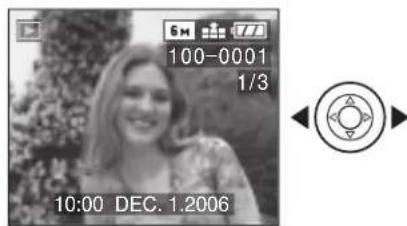
text_image
100-0001 1/3 10:00 DEC. 1.2006◀: Play back the previous picture
▶: Play back the next picture
2Press [面
3 Press ▲ to select [YES] and then press [MENU/SET].

text_image
DELETE SINGLE DELETE THIS PICTURE? YES NO SELECT SET MENU SET MULTI/ALL MENU /SET- While the picture is being deleted, [面] appears on the screen.
■ To delete [MULTI DELETE]/[ALL DELETE]
1Press [ ] twice.
2 Press ▲/▼ to select [MULTI DELETE] or [ALL DELETE] and then press [MENU/SET].
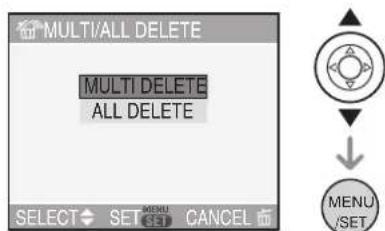
text_image
MULTI/ALL DELETE MULTI DELETE ALL DELETE SELECT SET MENU CANCEL MENU/SETBasic
- If you select [MULTI DELETE], perform steps 3 onwards.
- If you select [ALL DELETE], perform steps 5 onwards.
- When [FAVORITE] (P73) is set to [ON], [ALL DELETE EXCEPT] appears. If you select [ALL DELETE EXCEPT] perform steps 5 onwards. (However, if none of the pictures have [★ displayed, you cannot select [ALL DELETE EXCEPT] even if [FAVORITE] is set to [ON].)
3 Press ◀/▶ to select the picture and then press ▼ to set.
(Only when selecting [MULTI DELETE])
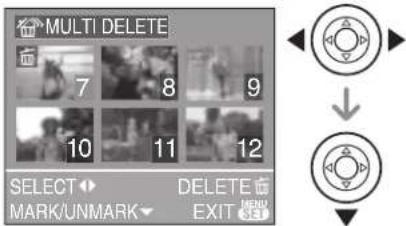
text_image
MULTI DELETE 7 8 9 10 11 12 SELECT DELETE MARK/UNMARK EXIT- Repeat the above procedure.
- [ appears on the selected pictures. If ▼ is pressed again, the setting is canceled.
- The icon [flashes red if the selected picture is protected and cannot be deleted. Cancel the protect setting and then delete the picture. (P77)
4Press [猫]
5 Press ▲ to select [YES] and then press [MENU/SET] to set.
(Screen when selecting [MULTI DELETE])
![LEICA C-LUX 1 - Press ▲ to select [YES] and then press [MENU/SET] to set. - 1](/content/2026/05/1008992/images/759d28bee353fb8cea81ef645a728cf975abed02b209a13d1ed3e0ed674baf38.jpg)
text_image
MULTI DELETE DELETE THE PICTURES YOU MARKED? YES NO SELECT SET MENU /SET- [DELETE ALL PICTURES?] is displayed when using [ALL DELETE] and [DELETE ALL EXCEPT ★] is displayed when using [ALL DELETE EXCEPT ★]
- If you press [MENU/SET] while deleting pictures using [ALL DELETE] or [ALL DELETE EXCEPT★the deleting will stop halfway.
[Non-Text]
- If you press [ twice and execute [ALL DELETE] or [ALL DELETE EXCEPT ] when pictures that were recorded on the same date are displayed on the 9 images playback screen using the calendar playback function (P61), be careful as all pictures that are not protected will be deleted and not only those pictures that were recorded on the same date.
- Once deleted, pictures cannot be recovered. Double-check pictures before deleting them.
- Do not turn off the camera while deleting.
- When deleting pictures, use a battery with sufficient battery power (P14) or the AC adaptor (ACA-DC4-E/U/J; optional).
- It is possible to delete up to 50 pictures at one time using [MULTI DELETE].
- The greater the number of pictures the longer it takes to delete them.
- If there are pictures that are protected [P77), do not conform to the DCF standard (P33) or are in a card with the Write-Protect switch slid to the [LOCK] side (P17), they are not deleted even if [ALL DELETE] or [ALL DELETE EXCEPT] is selected.
About the LCD Monitor
Changing the information displayed
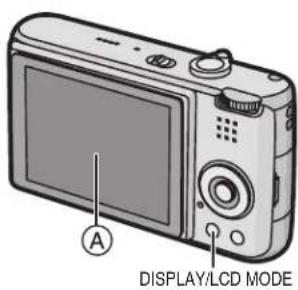
text_image
A DISPLAY/LCD MODEⒶ LCD monitor (LCD)
Press [DISPLAY] to change.
- When the menu screen appears, the [DISPLAY] button is not activated. During playback zoom (P62), while playing back motion pictures (P58) and during a slide show (P72), you can only select "Normal display" or "No display".
In simple mode [♥
text_image
(③) 3 BACKLIGHT ② ③⑧ Normal display
© No display
In recording mode

flowchart
graph TD
    A["Input Image"] --> B["Step 1"]
    B --> C["Step 2"]
    C --> D["Step 3"]
    D --> E["Step 4"]
    E --> F["Output Grid"]
    style A fill:#f9f,stroke:#333
    style E fill:#f9f,stroke:#333
    note right of C: ×1
(D) Normal display
E Display with histogram
⑤ No display (Recording guide line)
(G) No display
*1 Histogram
In playback mode
flowchart
graph TD
    H["Device H"] -->|100-0001 1/3| J["Device J"]
    H -->|1ST DAY 9 months 10 days 10:00 DEC. 1.2006| I["Device I"]
    I -->|F2.8 1/25 10:00 DEC. 1.2006| J
    J -->|2*3| I
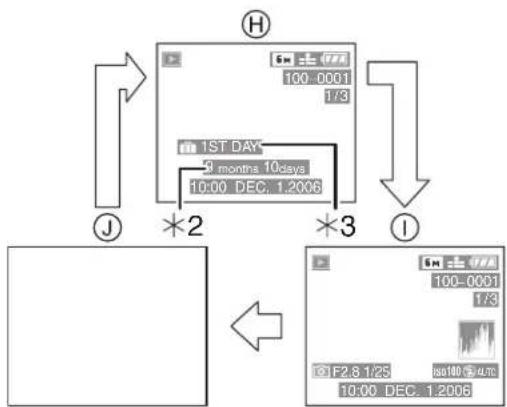
(H) Normal display
① Display with recording information and histogram
J No display
*2 Displayed if [BIRTHDAY SET.] and [WITH AGE] were set in [BABY1]/[BABY2] (P53) in scene mode before taking pictures.
*3 The number of days that have passed since the travel date are displayed if you set [TRAVEL DATE] (P56) before taking pictures.
■ Recording guide line
When you align the subject on the horizontal and vertical guide lines or the cross point of these lines, you can take pictures with well-designed composition by viewing the size, the slope and the balance of the subject.
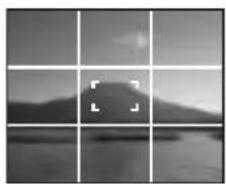
natural_image
Black and white landscape photo showing a distant mountain peak under a cloudy sky (no text or symbols)■ Histogram
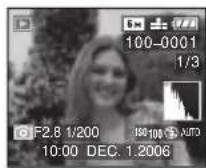
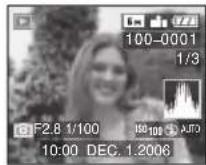
- A histogram is a graph that displays brightness along the horizontal axis (black to white) and the number of pixels at each brightness level on the vertical axis.
- It allows you to easily check a picture's exposure.
- It is very useful if manual adjustments of the lens aperture and shutter speed are available, especially in those situations where automatic exposure may be difficult due to uneven lighting. Using the histogram feature allows you to get the maximum performance from your camera.
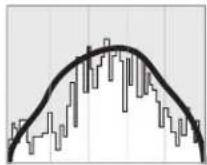
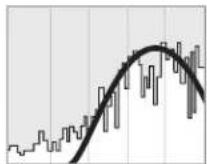
(A) When the values are concentrated on the left, the picture is under exposed.
⑧ When the values are distributed evenly, the exposure is proper and the brightness is well-balanced.
© When the values are concentrated on the right, the picture is over exposed.
Example of histogram
A

B
©

text_image
100-0001 1/3 F2.8 1/50 10:00 DEC. 1.2006Ⓐ Under Exposed
⑧ Properly Exposed
© Over Exposed
*Histogram
[Non-Text]
- When you take pictures with the flash or in dark places, the histogram is displayed in orange because the recorded picture and the histogram do not match each other.
- The histogram is an approximation in recording mode.
- The histogram of a picture may not match in recording mode and playback mode.
- The histogram displayed in this camera does not match histograms displayed by picture editing software used in PCs etc.
- The histogram does not appear in simple mode [or motion picture mode [ ] and during multi playback or calendar playback and playback zoom.
Brightening the LCD Monitor (Power LCD/High angle mode)

1Press [LCD MODE] for one second.
![LEICA C-LUX 1 - 1Press [LCD MODE] for one second. - 1](/content/2026/05/1008992/images/79779dca70a57fbb8ed8c7a30782381c0c26c083a3bc8339d46cd27337e32a04.jpg)
text_image
DISPLAY/LCD MODEⒶ LCD monitor (LCD)
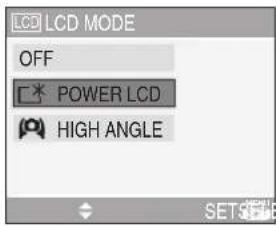
2 Press ▲/▼ to select a mode.
text_image
LCD LCD MODE OFF POWER LCD HIGH ANGLE
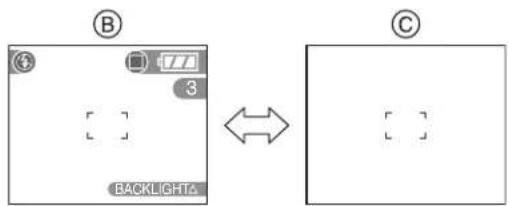
| [□*]: POWER LCD | The LCD monitor becomes brighter and easier to see even when taking pictures outdoors. |
| [□] : HIGH ANGLE | The LCD monitor is easier to see when taking pictures with the camera held high above your head. This is useful when you cannot get close to the subject because there is a person in the way. (However it becomes more difficult to see when looked at straight on.) 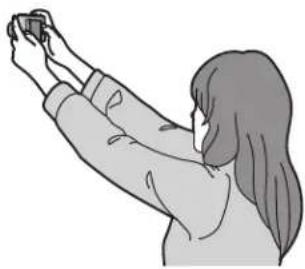 |
| [OFF] The LCD | monitor returns to the normal brightness. |
3Press [MENU/SET].
B
![LEICA C-LUX 1 - 3Press [MENU/SET]. - 1](/content/2026/05/1008992/images/82ce4210ac8ecd335bf18c1f16beec6148ced05cc6784fccf266af82413474ae.jpg)
natural_image
Black-and-white photo of a city skyline with a statue and camera interface overlay (no readable text or symbols)©
![LEICA C-LUX 1 - 3Press [MENU/SET]. - 2](/content/2026/05/1008992/images/f6ddb0455ad965929017b6ef8fb70375ed1a95060c6e4ea59a362303a95a4768.jpg)
natural_image
Black-and-white photo of a person standing at a monument with camera interface overlays (no readable text or symbols)⑧: POWER LCD
©: HIGH ANGLE
- The [POWER LCD] or [HIGH ANGLE] icon appears.
■ Canceling High angle mode or Power LCD
- If you press and hold [LCD MODE] again for 1 second the screen shown in step 2 is displayed. Select [OFF] to cancel Power LCD mode or High angle mode.

- High angle mode is also canceled if you turn the camera off or power save mode is activated.
- The brightness of the pictures displayed on the LCD monitor is adjusted when Power LCD mode or High angle mode is activated. Therefore, some subjects may look different on the LCD monitor. However, this does not affect the recorded pictures.
- The LCD monitor automatically returns to normal brightness after 30 seconds when recording in Power LCD mode. Press any button to make the LCD monitor bright again.
- You may not notice the High angle mode effect if the LCD monitor is difficult to see because of light from the sun etc. shining on it. In this case, we recommend using your hand or another object to block the light when using the camera.
-
High angle mode is not activated in the following cases.
-
In simple mode [♥
- In playback mode
- While the menu screen is displayed
– While the review screen is displayed
Taking Pictures using the Built-in Flash


natural_image
Illustration of a digital camera with labeled component A (no text or symbols beyond label)Ⓐ: Photo flash
Do not cover it with your fingers or other objects.
■ Switching to the appropriate flash setting
Set the flash to match the recording.
Press ▶ [4 to switch the flash setting.

flowchart
graph TD
    A["Circle with arrow"] --> B["A"]
    B --> C["A"]
    C --> D["S"]
    D --> E["Feedback loop"]
    E --> F["Input icon"]
    style A fill:#f9f,stroke:#333
    style B fill:#ccf,stroke:#333
    style C fill:#cfc,stroke:#333
    style D fill:#fcc,stroke:#333
    style E fill:#ffc,stroke:#333
- For information about flash settings that can be selected, refer to "Available flash settings by recording mode". (P39)
A: AUTO
The flash is automatically activated when the recording conditions make it necessary.
A: AUTO/Red-eye reduction ^4
The flash is automatically activated when the recording conditions make it necessary. It is activated once before the actual recording to reduce the red-eye phenomenon (eyes of the subject appearing red in the picture) and then activated again for the actual recording.
- Use this when you take pictures of people in low lighting conditions.
: Forced ON
The flash is activated every time regardless of the recording conditions.
- Use this when your subject is back-lit or under fluorescent light.
: Forced ON/Red-eye reduction \*1
- The flash setting is set to Forced ON/Red-eye reduction only when you set [PARTY] (P51) or [CANDLE LIGHT] (P52) in scene mode.
S: Slow sync./Red-eye reduction \*1
If you take a picture with a dark background landscape, this feature will slow the shutter speed when the flash is activated so that the dark background landscape will become bright. Simultaneously it reduces the red-eye phenomenon.
- Use this when you take pictures of people in front of a dark background.
: Forced OFF
The flash is not activated in any recording conditions.
- Use this when you take pictures in places where the use of the flash is not permitted.
*1 The flash is activated twice. The subject should not move until the second flash is activated.
■ Available flash settings by recording mode
The available flash settings depend on the recording mode.
(○: Available, —: Not available)
*2 It becomes Forced ON [ ] when the backlight compensation function is activated.
■ The available flash range to take pictures
The available flash range to take pictures depends on the ISO sensitivity selected.
| ISO sensitivity Available flash range | |
| AUTO | Wide |
| 60 cm (2 feet) to 4 m (13 feet) | |
| Tele | |
| 30 cm (1 foot) to 2 m (6 1/2 feet) | |
| ISO80 | Wide |
| 60 cm (2 feet) to 1.7 m (5 1/2 feet) | |
| Tele | |
| 30 cm (1 foot) to 80 cm (2 1/2 feet) | |
| ISO100 | Wide |
| 60 cm (2 feet) to 2 m (5 1/2 feet) | |
| Tele | |
| 30 cm (1 foot) to 1 m (3 1/4 feet) | |
| ISO200 | Wide |
| 60 cm (2 feet) to 2.8 m (9 feet) | |
| Tele | |
| 30 cm (1 foot) to 1.4 m (4 1/2 feet) | |
| ISO400 | Wide |
| 60 cm (2 feet) to 4 m (13 feet) | |
| Tele | |
| 40 cm (1 1/4 feet) to 2 m (6 1/2 feet) | |
- The available flash range differs in [HIGH SENS.] (P54) scene mode.
Wide: 80 cm (2 1/2 feet) to 5.7 m (19 feet)
Tele: 80 cm (2 1/2 feet) to 2.8 m (9 feet)
- The available flash range is an approximation.
• Refer to P66 for the ISO sensitivity.
• Refer to P25 for the focus range. - If ISO sensitivity is set to [AUTO] when using the flash, it will be automatically increased to a maximum of [ISO400].
• To avoid noise, we recommend decreasing the ISO sensitivity (P66) or setting [PICT.ADJ.] to [NATURAL]. (P71) - If you take a picture with the flash at close range when the zoom is near [W] (1×), the edges of the recorded picture may become dark. Rotate the zoom lever slightly and then take the picture.
■ Shutter speed for each flash setting
| Flash setting | Shutter speed (Sec.) |
| A: A U T O 1/30 to 1/2000 | |
| A: A U T O / Red-eye reduction | 1/30 to 1/2000 |
| : Forced ON | 1/30 to 1/2000 |
| : Forced ON/ Red-eye reduction | |
| S: Slow sync./ Red-eye reduction | 1/8^*3 to 1/2000 |
| : Forced OFF | 1/8^*3 to 1/2000 |
*3 The shutter speed changes depending on the slow shutter setting. (P70)
- There may be differences in the above shutter speeds in scene mode.
- [NIGHT SCENERY] (P50):
8 to 1/2000th
- [FIREWORKS] (P52):
1/4th, 1 second
- [STARRY SKY] (P53):
15 seconds, 30 seconds, 60 seconds

- Do not look directly at the flash at close range when it is activated.
- If you bring the flash too close to an object, the object may be distorted or discolored by the heat or lighting from the flash.
- Do not cover the photo flash with your fingers or other objects.
- In economy mode, the LCD monitor turns off and the status indicator flashes while the flash is charged. [This does not happen when using the AC adaptor (ACA-DC4-E/U/J; optional).] If the remaining battery power is low, the length of thime that the LCD monitor turns off to charge may become longer.
- If you press the shutter button halfway when the flash is activated, the flash icon turns red.
- When the jitter alert appears, we recommend using a tripod.
- When you take a picture beyond the available flash range, the exposure may not be adjusted properly and the picture may become bright or dark.
- When the flash is being charged, the flash icon flashes red, and you cannot take a picture even when you press the shutter button fully.
- When taking a picture with the flash, the white balance is automatically adjusted [except for [ ] Daylight]. However, the white balance may not be properly adjusted if the flash level is insufficient. (P65)
- When the shutter speed is fast, the flash effect may not be sufficient.
- If you repeat taking a picture, it may not actually be taken even if the flash is activated. Take a picture after the access indication disappears.
- The red-eye reduction effect differs between people. Also, if the subject was far away from the camera or was not looking at the first flash, the effect may not be evident.
- When you set continuous mode or auto bracket, only 1 picture is recorded for every flash activated.
Taking Pictures with the Self-timer

1 Press ◀ [ ] to select the self-timer mode.

text_image
Camera interface screenshot showing exposure settings and a circular dial indicator with '10' and '3' labelsSelf-timer set to 10 seconds
Self-timer set to 2 seconds
No display: canceled
2Press the shutter button halfway to focus and then press it fully to take the picture.
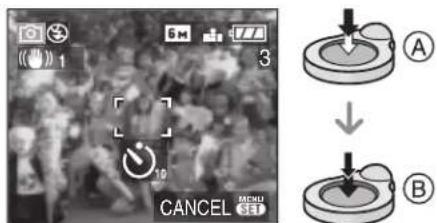
text_image
CANCEL MENU SET A B- Ⓐ: Press the shutter button halfway to focus.
- Ⓑ: Press the shutter button fully to take the picture.
- The self-timer indicator © flashes and the shutter is activated after 10 seconds (or 2 seconds).
- If you press [MENU/SET] while the self-timer is set, the self-timer setting is canceled.

- When using a tripod etc., setting the self-timer to 2 seconds is a convenient way to avoid the jitter caused by pressing the shutter button.
- When you press the shutter button once fully, the subject is automatically focused just before recording. In dark places, the self-timer indicator will flash and then may turn on brightly operating as an AF assist lamp (P70) to allow the camera to focus on the subject.
- In simple mode [the self-timer is fixed to 10 seconds.
- In [SELF PORTRAIT] (P51) in scene mode, the self-timer is fixed to 2 seconds.
- When you set the self-timer in continuous mode, the camera starts taking a picture 2 or 10 seconds after the shutter button is pressed. The number of pictures taken at one time is fixed to 3.
- We recommend using a tripod when recording with the self-timer. (When you use a tripod, make sure the tripod is stable when the camera is attached to it.)
Compensating the Exposure

Use this function when you cannot achieve appropriate exposure due to the difference in brightness between the subject and the background. Look at the following examples.
Under exposed

natural_image
Silhouette of a dog standing on a beach with reflection (no text or symbols visible)Compensate the exposure towards positive.

Properly exposed

natural_image
Silhouette of a dog standing on a beach with reflection (no text or symbols visible)
Over exposed
natural_image
Black and white photo of a dog running on a beach with reflection (no text or symbols visible)Compensate the exposure towards negative.
1 Press ▲ [+] until [EXPOSURE] appears, compensate the exposure with ◀/▶.
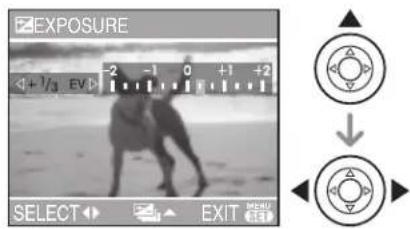
text_image
EXPOSURE +1/3 EV: -2 -1 0 +1 +2 SELECT EXIT MENU- You can compensate from [-2EV] to [+2EV] in steps of [1/3EV] .
- Select [0 EV] to return to the original exposure.
2Press [MENU/SET] to finish.
- You can also press the shutter button halfway to finish.
![LEICA C-LUX 1 - 2Press [MENU/SET] to finish. - 1](/content/2026/05/1008992/images/53dad91d287c544ff1c5b3af2f0ac5dca568102d8d19bc0d2bd28a823841064b.jpg)
- EV is an abbreviation of [Exposure Value]. It refers to the amount of light given to the CCD by the aperture value and the shutter speed.
- The exposure compensation value appears on the lower left of the screen.
- The set exposure value is memorized even if the camera is turned off.
- The compensation range of the exposure will be limited depending on the brightness of the subject.
- Exposure cannot be compensated when using [STARRY SKY] (P53) in scene mode.
Taking Pictures using Auto Bracket

In this mode, 3 pictures are automatically recorded in the selected exposure compensation range each time the shutter button is pressed. You can select the picture with the desired exposure from the 3 pictures with different exposures.
1 Press ▲ [+] several times until [AUTO BRACKET] appears, set the compensation range of the exposure with ◀/▶.
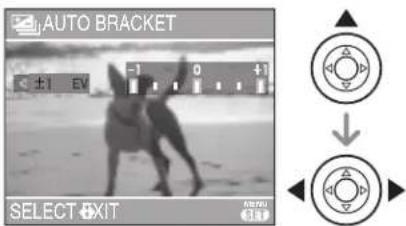
text_image
AUTO BRACKET ±1 EV -1 0 +1 SELECT EXIT- You can select [OFF] (0), [± 1 / 3 EV], [± 2 / 3 EV] or [± 1 EV].
- When you do not use auto bracket, select [OFF] (0).
2Press [MENU/SET] to finish.
- You can also press the shutter button halfway to finish.

- When setting auto bracket, the auto bracket icon [meaps on the lower left of the screen.
-
When taking pictures using auto bracket after setting the exposure compensation range, the pictures taken are based on the selected exposure compensation range. When the exposure is compensated, the exposure compensation value appears on the lower left of the screen.
-
The auto bracket setting is canceled if you turn the camera off or power save mode is activated.
- When setting auto bracket and continuous mode simultaneously, auto bracket will be performed.
- When auto bracket is set, the auto review function is activated regardless of the auto review setting. (The picture is not enlarged.) You cannot set the auto review function in the [SETUP] menu.
- When auto bracket is activated, [AUDIO REC.] cannot be used.
- The exposure may not be compensated with auto bracket depending on the brightness of the subject.
- When the flash is activated or [STARRY SKY] (P53) in scene mode is selected, you can take only 1 picture.
- If the number of recordable pictures is 2 or less, you cannot take pictures by setting auto bracket.
Optical Image Stabilizer

This mode detects jitter and compensates for it.
1 Press and hold the optical image stabilizer button Ⓐ until [STABILIZER] appears.

2 Press ▲/▼ to select the stabilizer function mode and then press [MENU/SET].
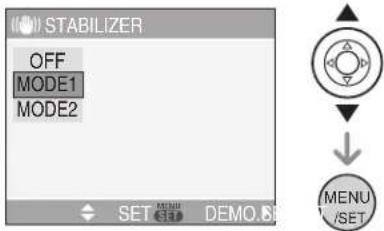
text_image
STABILIZER OFF MODE1 MODE2 SET DEMO.S MENU /SET| MODE1(1) | The stabilizer operates continuously to facilitate easier composition. |
| MODE2(2) | The jitter is compensated only when the shutter button is pressed. The stabilizing effect is greater. |
| OFF(0FF) | When you want to take a picture without stabilization. |
■ Demonstration of the optical image stabilizer (Demonstration Mode)
Press ▶ to display the demonstration. After the demonstration ends, the screen returns to the stabilizer function mode selection menu. Press ▶ again if you want to exit the demonstration before it ends. While the demonstration is displayed, the optical zoom is fixed to Wide (1×) and the zoom function cannot be activated. You also cannot take pictures.

- The stabilizer function may not be effective in the following cases.
- When there is a lot of jitter.
- When the zoom magnification is high.
– In digital zoom range.
- When taking pictures while following a moving subject.
- When the shutter speed becomes slower to take pictures indoors or in dark places.
Be careful of camera jitter when you press the shutter button.
- In simple mode [ ] or
[SELF PORTRAIT] (P51) in scene mode, the setting is fixed to [MODE2] and in [STARRY SKY] (P53) it is fixed to [OFF]. The stabilizer function mode selection menu does not appear.
- In motion picture mode [MODE2] cannot be set.
Taking Pictures using Continuous Mode

1 Press the continuous mode button to switch the contin. mode setting.
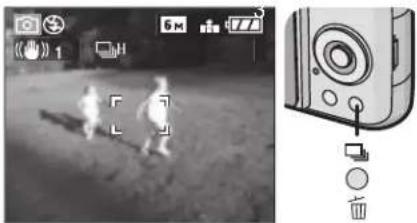
natural_image
Two people walking on a beach, with a close-up of a camera module showing adjustment knobs (no text or symbols visible)
flowchart
graph TD
    A["High frequency"] --> B["Low frequency"]
    B --> C["Unlimited"]
No display: canceled
*1 Depends on the available card memory, battery power, picture size and quality (compression).
2Take a picture.
- Hold down the shutter button fully to activate the continuous mode.
■ Number of pictures recorded in continuous mode
| Frequency(pictures/second) | Number of recordablepictures (pictures) | ||
 | 3^× 2 | max. 6 | max. 8 |
 | 2^× 2 | ||
 | approx. 1.5 | Depends on theremaining capacity of thecard. | |
*2 The frequency is constant regardless of the transfer speed of the card.
- The number of pictures indicated is when the shutter speed is faster than 1/60 and the flash is not activated.
-
In simple mode [the settings become as follows. [appears on the left of the screen. (P25)
-
[ENLARGE]:
/Max. 6 pictures - [☐ 4"×6"/10×15cm]/[☐ E-MAIL]:
/Max. 8 pictures

- When the continuous mode setting is set to Unlimited
- You can take pictures until the capacity of the card is full. - The frequency will become slower halfway. The frequency of a MultiMediaCard becomes even slower than that of an SD Memory Card. However, the exact timing of this depends on the number of recordable pictures and the card.
- The focus is fixed when the first picture is taken.
- When the self-timer is used, the number of recordable pictures in continuous mode is fixed to 3.
- Continuous mode is not canceled when the camera is switched off.
- When auto bracket and continuous mode are set simultaneously, auto bracket will be performed.
- The exposure and the white balance vary depending on the continuous mode setting. When continuous mode is set to [ ] or [ ], they are fixed to the values set for the first picture. When the frequency is set to [ ], they are adjusted each time you take a picture.
- When continuous mode is set, the auto review function is activated regardless of the auto review setting. (The picture is not enlarged.) You cannot set the auto review function in the [SETUP] menu.
- When continuous mode is activated, [AUDIO REC.] cannot be used.
- When the flash is activated or [STARRY SKY] (P53) in scene mode is selected, you can take only 1 picture.
Taking Close-up Pictures

This mode allows you to take close-up pictures of a subject, e.g. when taking pictures of flowers. You can take pictures of a subject as close as 5 cm (2 inches) from the lens by rotating the zoom lever upmost to Wide (1×).
■ Focus range
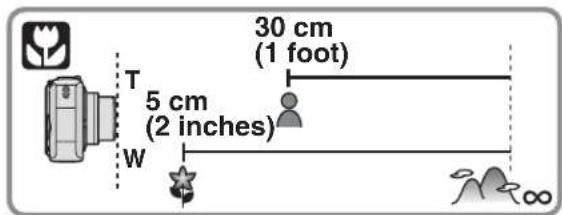
text_image
T 5 cm (2 inches) W 30 cm (1 foot)
• We recommend using a tripod and the self-timer (P42) in macro mode.
- When a subject is close to the camera, the effective focus range (depth of field) is significantly narrowed. Therefore, if the distance between the camera and the subject is changed after focusing on the subject, it may become difficult to focus on it again.
- If the distance between the camera and the subject is beyond the focus range of the camera, the picture may not be properly focused even if the focus indication lights.
- Macro mode gives priority to a subject close to the camera. Therefore, if the distance between the camera and the subject is more than 50 cm (1' 7 ^11/16 ) it takes longer to focus on it in macro mode than normal picture mode.
- The available flash range is about 60 cm (2 feet) to 4.0 m (13 feet) (Wide). (When the ISO sensitivity is set to [AUTO].)
- We recommend setting the flash to Forced OFF [ when you take pictures at close range.
- When you take pictures at close range, the resolution of the periphery of the picture may decrease slightly. This is not a malfunction.
Scene Mode

When you select a scene mode to match the subject and recording situation, the camera sets the optimal exposure and hue to obtain the desired picture.
• Refer to P49 to 55 for each scene menu.
1 Press ▲/▼ to select the scene mode.
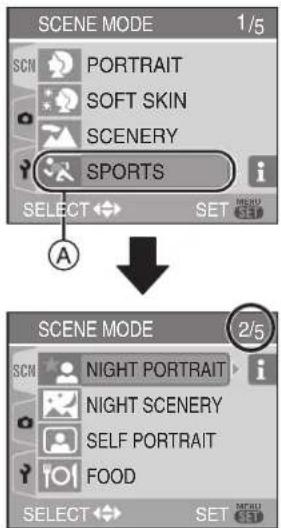
text_image
SCENE MODE 1/5 SCN PORTRAIT SOFT SKIN SCENERY SPORTS SELECT SET A SCENE MODE 2/5 SCN NIGHT PORTRAIT NIGHT SCENERY SELF PORTRAIT FOOD SELECT SET
- Press ▼ at Ⓐ to switch to the next menu screen.
- If [SCENE MODE] menu does not appear, press [MENU/SET] to display the [SCENE MODE] menu.
- When you press ▶, explanations about each scene mode are displayed. (When you press ◀, the screen returns to the [SCENE MODE] menu.)
2Press [MENU/SET].
■ About the menu screen items
- There are 5 menu screens (1/5, 2/5, 3/5, 4/5 and 5/5).
- You can switch menu screens from any menu item by rotating the zoom lever.

text_image
SCENE MODE 1/5 2/5 3/5 SCENE MODE PORTRAIT NIGHT PORTRAIT SCN SOFT SKIN SCENERY SPORTS SELECT NIGHT SCENERY SELF PORTRAIT FOOD SELECT SET SCN PARTY CANDLE LIGHT FIREWORKS STARRY SKY SELECT SET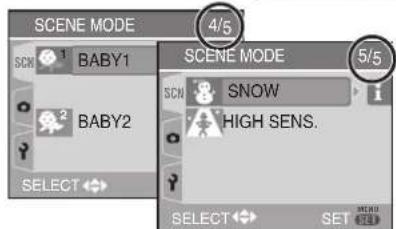
text_image
SCENE MODE 4/5 SCN 1 BABY1 SCN 2 BABY2 SCN 3 SNOW HIGH SENS. SELECT 5/5 SELECT SET[Non-Text]
- When you take a picture with a scene mode that is not adequate for the purpose, the hue of the picture may differ from the actual scene.
- When you want to change the brightness of the picture to be recorded, compensate the exposure (P43). (However, the exposure cannot be compensated in [STARRY SKY] (P53).
- Press ◀ and then press ▲/▼ in the [SCENE MODE] menu to select either the [REC] menu icon [P64) or the [SETUP] menu icon [P19) and set the desired items.
-
The following cannot be set in scene mode because the camera automatically adjusts them to the optimal setting.
-
[W.BALANCE]
- [SENSITIVITY]
- [COL.EFFECT]
- [PICT.ADJ.]
![LEICA C-LUX 1 - [Non-Text] - 1](/content/2026/05/1008992/images/ee9b661b4d8ad14f7df1a019f2461e81469c9205fb0afcca8e49f3817a919947.jpg)
Portrait mode
Press [RETO display the [SCENE MODE] menu and select a scene mode. (P48) The person stands out from the background and has a healthier complexion.
natural_image
Black-and-white photo of a person in formal attire, no visible text or symbols■ Technique for Portrait mode
To increase the effective of this mode:
1 Rotate the zoom lever as far as possible to Tele.
2 Move close to the subject to make this mode more effective.

- This mode is only suitable when taking pictures outdoors in the daytime.
• ISO sensitivity is fixed to [ISO80].

Soft skin mode
Press [to display the [SCENE MODE] menu and select a scene mode. (P48) The camera detects the face or skin area to achieve a smoother appearance of the skin than portrait mode.
natural_image
Black-and-white photo of a smiling person with no visible text or symbols■ Technique for Soft skin mode
To make this mode more effective:
1 Rotate the zoom lever as far as possible to Tele.
2 Move close to the subject to make this mode more effective.

- This mode is only suitable when taking pictures outdoors in the daytime.
- If a part of the background etc. is a color close to skin color, this part is also smoothed.
• This mode may not be effective when there is insufficient brightness.
• ISO sensitivity is fixed to [ISO80].

Scenery mode
Press [RETO display the [SCENE MODE] menu and select a scene mode. (P48) The camera focuses preferentially on a distant subject. This allows you to take pictures of a wide landscape.
natural_image
Black-and-white photo of a tree on a hillside under cloudy sky (no text or symbols visible)
• The focus range is 5 m (16 1/2 feet) to ∞.
- The flash setting is fixed to Forced OFF [icon].
- The setting on the AF assist lamp is disabled.

Sports mode
Press [ ] to display the [SCENE MODE] menu and select a scene mode. (P48) This mode allows you to take pictures of a fast moving subject e.g. when taking pictures of outdoor sports.

natural_image
Grayscale photo of a person standing in a valley with hands raised, no visible text or symbols■ Technique for Sports mode
- This mode is effective when taking pictures during the day in good weather.

- This mode is suitable for taking pictures outdoors in the daytime when you are 5 m (16 1/2 feet) or more away from the subject.

Night portrait mode
Press [to display the [SCENE MODE] menu and select a scene mode. (P48) This mode allows you to take pictures of a subject and a landscape with near real-life brightness by using the flash and slowing down the shutter speed.
natural_image
Black-and-white photo of a person in a circular frame, no visible text or symbols■ Technique for Night portrait mode
- Use the flash.
- Since the shutter speed becomes slower, we recommend using a tripod and the self-timer (P42) for taking pictures.
- Keep the subject still for about 1 second after taking the picture.
- We recommend rotating the zoom lever to Wide (1×) and being about 1.5 m (5 feet) from the subject when taking a picture.

- The focus range is 1.2 m (4 feet) to 5 m (16 1/2 feet). (Refer to P40 for the available flash range to take pictures.)
- The shutter may remain closed (max. about 1 sec.) after taking the picture because of signal processing. This is not a malfunction.
- Noise may become visible when you take pictures in dark places.
- When using the flash, Slow sync./Red-eye reduction [+S]lected and the flash is activated every time.

Night scenery mode
Press [REDACTED] to display the [SCENE MODE] menu and select a scene mode. (P48) This modes allows you to record the nightscape vividly by reducing the shutter speed.
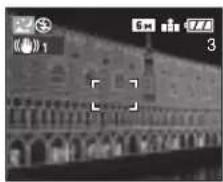
natural_image
Exterior view of a historic building with arched windows and a central tower (no signage or text visible)■ Technique for Night scenery mode
- Since the shutter speed becomes slower (up to about 8 sec.) use a tripod. We also recommend using the self-timer (P42) for taking pictures.

• The focus range is 5 m (16 1/2 feet) to ∞.
- The shutter may remain closed (max. about 8 sec.) after taking the picture because of signal processing. This is not a malfunction.
- Noise may become visible when you take pictures in dark places.
- The flash setting is fixed to Forced OFF [💡].
• ISO sensitivity is fixed to [ISO80].
- The setting on the AF assist lamp is disabled.
- You cannot set the slow shutter.

Self portrait mode
Press [to display the [SCENE MODE] menu and select a scene mode. (P48) This mode allows you to take pictures of yourself.
■ Technique for Self portrait mode
Press the shutter button halfway to focus. The self-timer indicator lights up when you are brought into focus. Making sure you hold the camera still, press the shutter button fully to take the picture.
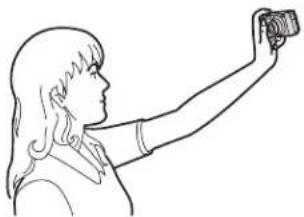
natural_image
Line drawing of a person taking a selfie with a camera (no text or symbols)- The subject is not focused when the self-timer indicator is blinking. Make sure to press the shutter button halfway again to focus.
- The recorded picture automatically appears on the LCD monitor for reviewing. Refer to P31 for information about using the review function.
- If the picture is blurry due to the slow shutter speed, we recommend using the 2 second self-timer. (P42)

- The available focus range is about 30 cm (1 foot) to 70 cm (2 1/4 feet).
- You can take a picture of yourself with audio (P68). If you do this, the self-timer indicator will light up while recording the audio. (P42)
- When you select [SELF PORTRAIT], the zoom magnification is automatically moved to Wide (1×).
-
The self-timer can only be set to off or 2 seconds (P42). If it is set to 2 seconds, this setting will remain until the camera is turned off or the mode dial is rotated.
-
The stabilizer function mode is fixed to [MODE2]. (P45)
• The AF mode is fixed to 5-area-focusing. (P69) - The setting on the AF assist lamp is disabled.

Food mode
Press [A] to display the [SCENE MODE] menu and select a scene mode. (P48) This mode allows you to take pictures of food with a natural hue without being affected by the ambient light in restaurants etc.
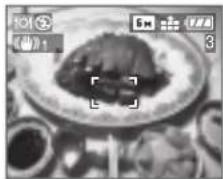
natural_image
Close-up of a plated dish with food and utensils, no visible text or symbols
- The focus range becomes the same as macro mode. [5 cm (2 inches) (Wide)/30 cm (1 foot) (Tele) to ]

Party mode
Press [to display the [SCENE MODE] menu and select a scene mode. (P48) Select this mode when you want to take pictures at a wedding reception, indoor party etc. By using the flash and slowing down the shutter speed, both people and the background can be recorded with a brightness close to real life.
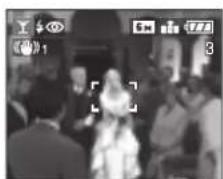
text_image
Street photo with visible store signboards and people in a crowd■ Technique for Party mode
- Since the shutter speed becomes slower, we recommend using a tripod and the self-timer (P42) for taking pictures.
Advanced
- We recommend rotating the zoom lever to Wide (1×) and being about 1.5 m (5 feet) from the subject when taking pictures.

- The flash setting can be set to Slow sync./Red-eye reduction [+ S forced ON/Red-eye reduction [+]

Candle light mode
Press [1] to display the [SCENE MODE] menu and select a scene mode. (P48) This mode allows you to take pictures with a candle-lit atmosphere.

natural_image
Black-and-white photo of a child sitting at a birthday cake with adults watching (no visible text or symbols)■ Technique for Candle light mode
- If you make the most of the candle light, you can take successful pictures without using the flash. - We recommend using a tripod and the self-timer (P42) for taking pictures.

- The focus range becomes the same as macro mode. [5 cm (2 inches) (Wide)/30 cm (1 foot) (Tele) to ] - The flash setting can be set to Slow sync./Red-eye reduction [ forced ON/Red-eye reduction [

Fireworks mode
Press [To] to display the [SCENE MODE] menu and select a scene mode. (P48) This mode allows you to take beautiful pictures of fireworks exploding in the night sky.

natural_image
Abstract grayscale pattern resembling a starburst or burst (no text or symbols)■ Technique for Fireworks mode
- Since the shutter speed becomes slower, we recommend using a tripod.

- This mode is most effective when the subject is 10 m (32.8 feet) or more away.
• The shutter speed becomes the following. - When [OFF] is set on the optical image stabilizer function: Fixed to 1 second
- When [MODE1] or [MODE2] is set on the optical image stabilizer function: 1/4th or 1 second (The shutter speed becomes 1 second only when the camera has determined that there is little jitter such as when using a tripod etc.)
• Histograms are always displayed in orange. (P36) - The flash setting is fixed to Forced OFF [icon].
- You cannot set the AF mode.
• The AF area is not displayed. - The setting on the AF assist lamp is disabled.
- You cannot set the slow shutter.

Starry sky mode
Press [to display the [SCENE MODE] menu and select a scene mode. (P48) This mode allows you to take vivid pictures of a starry sky or a dark subject that you could not take in [NIGHT SCENERY] by making the shutter speed slower.

natural_image
Dark outdoor scene with blurred foliage and small objects, no visible text or symbols■ Setting the shutter speed
- Select a shutter speed of [15 SEC.], [30 SEC.] or [60 SEC.].
1 Press ▲/▼ to select the number of seconds and then press [MENU/SET].
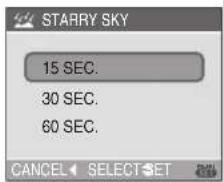
text_image
STARRY SKY 15 SEC. 30 SEC. 60 SEC. CANCEL SELECT SET2 Take pictures.
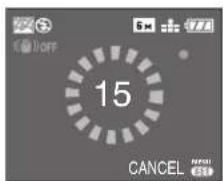
text_image
OFF 15 CANCEL ↕- Press the shutter button to display the countdown screen. Do not move the camera after this screen is displayed. When countdown finishes,
[PLEASE WAIT...] is displayed for the same length of time as the set shutter speed for signal processing. - Press [MENU/SET] to stop taking the picture while the countdown screen is displayed.
■ Technique for Starry sky mode
- The shutter opens for 15, 30 or 60 seconds. Be sure to use a tripod. We also recommend taking pictures with the self-timer. (P42)

• Histograms are always displayed in orange. (P36)
- The flash setting is fixed to Forced OFF [∅].
- The optical image stabilizer function is fixed to [OFF].
• ISO sensitivity is fixed to [ISO80].
- You cannot compensate the exposure or set [AUDIO REC.], auto bracket, burst mode, set the slow shutter.

Baby mode 1 Baby mode 2
Press [MENU] to display the [SCENE MODE] menu and select a scene mode. (P48) This mode takes pictures of a baby with a healthy complexion. When the flash is used, the light from it is weaker than usual. You can set the birthdays of two babies by using [BABY1] and [BABY2].
- The baby's age can be displayed when playing back pictures.
■ Age display setting
- If you want the age to be displayed, set the birthday in advance, select [WITH AGE] and press [MENU/SET].
- If you do not want the age to be displayed, select [WITHOUT AGE] and press [MENU/SET].

text_image
9 months 10days 10:00 DEC. 1.2006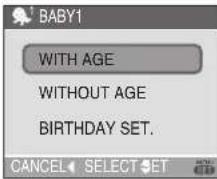
text_image
BABY1 WITH AGE WITHOUT AGE BIRTHDAY SET. CANCEL SELECT SET■ Birthday setting
1 Press ▲/▼ to select [BIRTHDAY SET.] and then press [MENU/SET].
2 When the message [PLEASE SET THE BIRTHDAY OF THE BABY] appears, select items (Year/Month/Day) using
◀/▶ and set them using ▲/▼.
3 Press [MENU/SET] to finish the setting.
- If you select [WITH AGE] without setting the birthday in advance, a message is displayed. Press [MENU/SET] and set the birthday in steps 2 and 3.

- The focus range becomes the same as macro mode. [5 cm (2 inches) (Wide)/30 cm (1 foot) (Tele) to ]
- After turning on the camera in [BABY1]/[BABY2] in scene mode or switching to [BABY1]/[BABY2] from other scene modes, the age and current date and time are displayed for about 5 seconds at the bottom of the screen.
- The age display style differs depending on the language setting in the recording mode.
- The date of birth is displayed as [0 month 0 day].
- If the age is not properly displayed, check the clock and birthday settings.
- If the camera is set to [WITHOUT AGE], the age is not recorded even if the time and birthday are set. This means the age cannot be displayed even if camera is set to [WITH AGE] after taking the pictures.
- Use [RESET] in the [SETUP] menu to reset the birthday setting. (P22)

Snow mode
Press [to display the [SCENE MODE] menu and select a scene mode. (P48) This mode will adjust the white balance and the exposure to show the snow as white as possible.
natural_image
Grayscale photo of a snowy landscape with silhouettes and no visible text or symbols
High Sensitivity mode
Press [1] to display the [SCENE MODE] menu and select a scene mode. (P48) This mode sets the ISO sensitivity higher than usual. A slight blurring of the subject is created when taking pictures indoors etc.
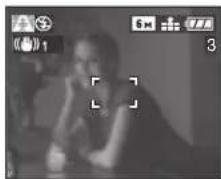
natural_image
Black-and-white photo of a person sitting at a desk, no visible text or symbols
- ISO sensitivity is automatically set to the optimal value between [ISO800] and [ISO1600].
- The focus range becomes the same as macro mode. [5 cm (2 inches) (Wide)/30 cm (1 foot) (Tele) to ]
- The resolution of the recorded picture decreases slightly because of high sensitivity processing. This is not a malfunction.
- The extended optical zoom and digital zoom cannot be used.
Recording which day of the vacation you take the picture

If you set the departure date in advance, you can record which day of the vacation you take the picture.
- When you play back a picture, the date on which it was taken is displayed.
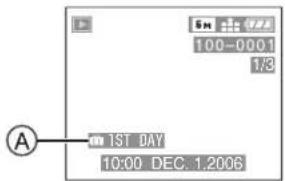
text_image
10:00-00:01 1/3 A 1ST DAY 10:00 DEC, 1.2006(A): The number of days that have passed since the departure date
■ Setting the travel date
1 Press [MENU/SET] and then press ◀.
![LEICA C-LUX 1 - Press [MENU/SET] and then press ◀. - 1](/content/2026/05/1008992/images/27369af5424467a037e45370d98c8a2d45e8c268ac579e5b24c72fa34ae7fe56.jpg)
text_image
REC 1/3 WB W.BALANCE AUTO ISO SENSITIVITY AUTO ASPECT RATIO 4:3 PICT.SIZE 6 M QUALITY SELECT EXIT MENU/ SET2 Press ▼ to select the [SETUP] menu icon [?] and then press ▶.
![LEICA C-LUX 1 - Press ▼ to select the [SETUP] menu icon [?] and then press ▶. - 1](/content/2026/05/1008992/images/165e6d8fb699c07bb208d2a9b3924a561b3fa522ee72600434ce3cdc48740820.jpg)
text_image
SETUP 1/4 CLOCK SET MONITOR ±0 TRAVEL DATE OFF POWER SAVE 2MIN. ECO ECONOMY OFF SELECT EXIT![LEICA C-LUX 1 - Press ▼ to select the [SETUP] menu icon [?] and then press ▶. - 2](/content/2026/05/1008992/images/102f2ea31a44ea317cbb96106c44cd92a59bf6f0434569cef84412f15af14e5e.jpg)
3 Press ▲/▼ to select [TRAVEL DATE] and then press ▶.
![LEICA C-LUX 1 - Press ▲/▼ to select [TRAVEL DATE] and then press ▶. - 1](/content/2026/05/1008992/images/8dd0addbe9bd776bea7292e564f45f74e93c7b6a5f8f2caa02720d24cec60bd0.jpg)
text_image
SETUP 1/4 CLOCK SET MONITOR ±0 TRAVEL DATE OFF POWER SAVE 2MIN. ECO ECONOMY OFF SELECT EXIT![LEICA C-LUX 1 - Press ▲/▼ to select [TRAVEL DATE] and then press ▶. - 2](/content/2026/05/1008992/images/10290fda3d1439d8bc02e03fe974c2a2718ce1cc945e3da5dc29b85f2cb50071.jpg)
4 Press ▼ to select [SET] and then press [MENU/SET].
![LEICA C-LUX 1 - Press ▼ to select [SET] and then press [MENU/SET]. - 1](/content/2026/05/1008992/images/93962f252fe8734b03d96f9317796d9c0379df39530d7e80b83c0482b0a33259.jpg)
text_image
SETUP 1/4 CLOCK SET MONITOR ±0 TRAVEL DATE OFF POWER SAVE SET ECO ECONOMY OFF SELECT SET![LEICA C-LUX 1 - Press ▼ to select [SET] and then press [MENU/SET]. - 2](/content/2026/05/1008992/images/dcac3ad24795911fd69a98c4db1fd927f84477259573992b628689f72f09c284.jpg)
5 Press ▲/▼/◄/► to select the date.
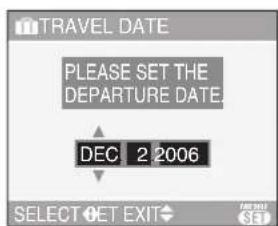
text_image
TRAVEL DATE PLEASE SET THE DEPARTURE DATE DEC 2 2006 SELECT GET EXIT
◀/▶: Select the desired item.
▲/▼: Set the year, month and date.
6Press [MENU/SET] twice to close the menu.
7Take a picture.
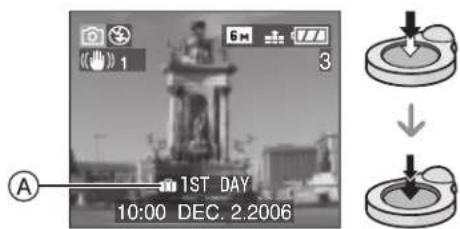
text_image
1ST DAY 10:00 DEC. 2.2006- The current date and time and which day of the vacation it is are displayed for about 5 seconds at the bottom of the screen if the camera is turned on when the travel date is set, after setting the clock, departure date or travel date and after switching from playback mode to another mode.
- When [TRAVEL DATE] is set, fi appears on the lower right of the screen.
■ Canceling the travel date
If you leave [TRAVEL DATE] set to [SET], the number of days that have passed since the departure date will continue to be recorded. When the vacation is finished, set [TRAVEL DATE] to [OFF] on the screen shown in step 4 and then press [MENU/SET] twice.

- The travel date is calculated using the date in the clock setting (P18) and the departure date you set.
- The travel date setting is memorized even if the camera is turned off.
- If you set a departure date and then take a picture on a date before this departure date, [-] (minus) is displayed in orange and the day of the vacation that you took the picture is not recorded.
- If you set a departure date and then change the clock setting to the date and time at the travel destination, [-] (minus) is displayed in white and the day of the vacation that you
took the picture is recorded when the travel destination date is, for example, one day before the departure date.
- If [TRAVEL DATE] is set to [OFF], the number of days that have passed since the departure date will not be recorded even if you set the travel date or the clock. Even if [TRAVEL DATE] is set to [SET] after taking the pictures, which day of the vacation you took them is not displayed.
- If you set a departure date when the clock is not set, the message [PLEASE SET THE CLOCK] appears. In this case, set the clock.
• The [TRAVEL DATE] setting also affects simple mode [♥
Motion Picture Mode

1 Press the shutter button halfway to focus and then press it fully to start recording.

text_image
A 30fps V0A R 3s 2s B- When the subject is focused, the focus indication lights.
- The focus, zoom and aperture value are fixed to the setting when recording starts (the first frame).
- The available recording time Ⓐ is displayed on the top right and the elapsed recording time Ⓑ is displayed on the bottom right of the screen. For example, 1 hour 20 minutes and 30 seconds is displayed as [1h20m30s].
- The available recording time and the elapsed recording time are approximations.
- Audio recording starts simultaneously from the camera's built-in microphone.
- When using the stabilizer function, it is fixed to [MODE1].(P45)
2Press the shutter button fully to stop recording.
- If the card becomes full in the middle of recording, the camera stops recording automatically.
■ Changing the picture quality setting
1Press [MENU/SET].
2 Press ▲/▼ to select [ASPECT RATIO] and then press ▶.

text_image
REC 1/2 WB W.BALANCE AUTO ASPECT RATIO 4:3 PICT.MODE 16:9 AF AF MODE AF AF ASSIST LAMP ON SELECT SET
3 Press ▲/▼ to select the item and then press [MENU/SET].
4 Press ▲/▼ to select
[PICT.MODE] and then press ▶.
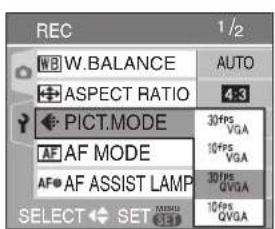
text_image
REC 1/2 WB W.BALANCE AUTO ASPECT RATIO 4:3 PICT.MODE 30fps VGA AF AF MODE 10fps VGA AF AF ASSIST LAMP 30fps QVGA SELECT SET 10fps QVGA
5 Press ▲/▼ to select the item and then press [MENU/SET].
If you selected [4.3] the screen shown in step 2
| Item Picture size fps | ||
| 30fpsVGA | 640×480 pixels0 | 30 |
| 10fpsVGA | ||
| 30fpsQVGA | 320×240 pixels | 30 |
| 10fpsQVGA | 10 | |
If you selected [16.9] the screen shown in step 2
| Item Picture size fps | ||
| 30fps 16:9 | 848×480 pixels0 | 30 |
| 10fps 16:9 | ||
- fps (frames per second); This refers to the number of frames used in 1 second.
- You can record smoother motion pictures with 30 fps.
- You can record longer motion pictures with 10 fps although the picture quality is lower.
- The file size with [10fpsQVGA] is small so it is suitable for e-mails.
6Press [MENU/SET] to close the menu.
- You can also press the shutter button halfway to close the menu.
[Non-Text]
- The focus range is 5 cm (2 inches) to (Wide), 30 cm (1 foot) to (Tele).
- Refer to P105 for information about the available recording time.
- The available recording time is an approximation. (It varies depending on the recording condition and the types of SD memory Card.)
- The available recording time changes with subjects.
- The available recording time displayed on the screen may not decrease regularly.
- Motion pictures cannot be recorded without audio.
- This unit does not support recording motion pictures on MultiMediaCards.
- When you set the picture quality to [30fpsVGA] or [30fps16:9], we recommend using a high speed SD Memory Card with “10MB/s” or greater displayed on the package.
- Depending on the type of SD Memory Card, recording may stop in the middle.
-
Depending on the type of SD Memory Card, the card access indication may appear for a while after recording motion pictures. This is not a malfunction.
-
When motion pictures recorded with the camera are played back on other equipment, the quality of the picture and sound may deteriorate and it may not be possible to play them back. Also the recording information may not be displayed correctly.
- In motion picture mode [ ], you cannot use the direction detection function and the review function.
- You cannot set [MODE2] on the optical image stabilizer function.
- The bundled software includes QuickTime to play back motion picture files recorded with the camera on the PC.
Displaying Multiple Images (Multi Playback)

1 Rotate the zoom lever towards [W] to display multiple images.
(Screen when 9 images are displayed)
![LEICA C-LUX 1 - Rotate the zoom lever towards [W] to display multiple images. - 1](/content/2026/05/1008992/images/d8acd735586a2546e013aee652dcb0feeacfea17f1639018b6ed4023ff83959d.jpg)
text_image
DEC. 1, 2006 1/26 A W T W T CANCEL• [W] : 1 image →9 images → 25 images →Calendar display
• After the multiple images are displayed, rotate the zoom lever further towards [W] to display 25 images and the calendar screen (P61). Rotate the zoom lever towards [T] to return to the previous image.
- When you switch to multiple images, a scroll bar Ⓐ appears. You can confirm the location of the displayed picture in all the recorded pictures with this scroll bar.
2 Press ▲/▼/◄/► to select a picture.
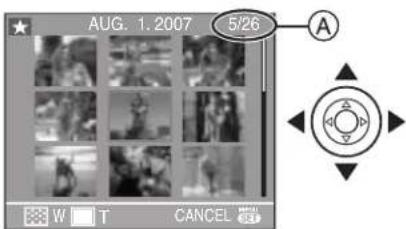
text_image
AUG. 1, 2007 5/26 W T CANCEL(A): Number of the selected picture and the total number of recorded pictures
- The recording date and number of the selected picture and the total number of recorded pictures are displayed.
-
Depending on the recorded picture and the setting, the following icons will appear.
-
[★(Favorites)
- [Motion picture)
- [BABY1]/[BABY2] in scene mode.)
- [Travel date)
■ Examples of 25 images
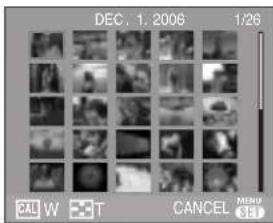
natural_image
Grid of grayscale surveillance camera images labeled DEC 1, 2006 and 1/26, with no visible text or symbols on the images themselves.■ To return to normal playback
Rotate towards [T] or press [MENU/SET].
The picture appears framed in orange.
■ To delete a picture during multi playback
1 Press ▲/▼/◄/► to select a picture and then press [图标].
2 Press ▲ to select [YES].
3 Press [MENU/SET].

- Even if the indications on the screen are turned off in normal playback mode (P33), the recording information etc. appears on the screen in multi playback. If you return to the 1 image playback screen, the camera returns to the normal playback screen.
- Pictures will not be displayed in the rotated direction even if [ROTATE DISP.] is set to [ON]. (P74)
Displaying pictures by recording date
(Calendar playback)

You can display pictures by recording date using the calendar playback function.
1 Rotate the zoom lever towards [W] to display the calendar screen.
![LEICA C-LUX 1 - Rotate the zoom lever towards [W] to display the calendar screen. - 1](/content/2026/05/1008992/images/a701a0a65b15f5c83716ea2ec335586638f48959adf53828c5e90cb003135271.jpg)
text_image
SUN MON TUE WED THU FRI SAT 3 4 5 6 7 8 9 10 11 12 13 14 15 16 17 18 19 20 21 22 23 24 25 26 27 28 29 30 31 2006 12 DAY MONTH SET MENU SET![LEICA C-LUX 1 - Rotate the zoom lever towards [W] to display the calendar screen. - 2](/content/2026/05/1008992/images/cc6b80ac11b31d6c99fb41f076e3e06f3c807158dd5dd156629bf89e382b8189.jpg)
- The recording date of the picture selected in the playback screen becomes the date selected when the calendar screen is first displayed.
- If there are multiple pictures with the same recording date, the first picture recorded on that day is displayed.
• The calendar is displayed monthly.
2 Press ▲/▼/◄/► to select the date to be played back.
▲/▼: Select the month
◀/▶: Select the date
- If there were no pictures recorded during a month, the month is not displayed.
3Press [MENU/SET] to display the pictures that were recorded on the selected date.
![LEICA C-LUX 1 - 3Press [MENU/SET] to display the pictures that were recorded on the selected date. - 1](/content/2026/05/1008992/images/bf86adfa07ef1eedb111f794d0759448f4f0f89d2e65bdff43469f3f83d98214.jpg)
text_image
DEC. 1.2006 5/10 CAL W CANCEL![LEICA C-LUX 1 - 3Press [MENU/SET] to display the pictures that were recorded on the selected date. - 2](/content/2026/05/1008992/images/e3188d882f286dbc62e13ba558fa17e2e22d33c35cd7f65dd748dbf6545d271c.jpg)
- The pictures that were recorded on the selected date are displayed on the 9 images playback screen.
- Rotate the zoom lever towards [W] to return to the calendar screen.
4 Press ▲/▼/◄/► to select a picture and then press [MENU/SET].
- The selected picture is displayed on the 1 image playback screen.
■ To return to the 1 image playback screen
After the calendar screen is displayed, rotate the zoom lever towards [T] to display 25 images, 9 images and the 1 image. (P60)

- The pictures are displayed without being rotated even if you set [ROTATE DISP.] to [ON]. (P74)
- You can display the calendar between January 2000 and December 2099.
- If the recording date of the picture selected in 25 images multi playback is not between January 2000 and December 2099, the camera displays it in the oldest recording date in the calendar.
- Pictures edited on a PC will be displayed with dates different from the actual recording dates.
- If the date is not set in the camera (P18), the recording date is set as January 1st, 2006.
Using the Playback Zoom

1 Rotate the zoom lever towards [T] to enlarge the picture.
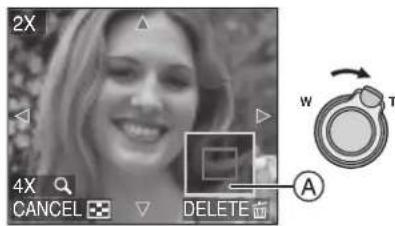
text_image
2X 4X CANCEL DELETE W T A•[T]: 1×→2×→4×→8×→16×
- When you rotate the zoom lever towards [W] after enlarging the picture, the magnification becomes lower. When you rotate the zoom lever towards [T], the magnification becomes higher.
- When you change the magnification, the zoom position indication Ⓐ appears for about 1 second so that you can check the position of the enlarged section.
2 Press ▲/▼/◄/► to move the position.
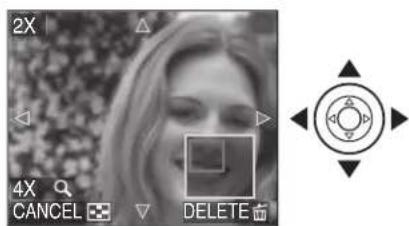
text_image
2X 4X CANCEL DELETE- When you move the position to be displayed, the zoom position indication appears for about 1 second.
■ To stop using the playback zoom
Rotate the zoom lever towards [W] or press [MENU/SET].
■ To delete a picture during the playback zoom
1 Press [ ]
2 Press ▲ to select [YES].
3 Press [MENU/SET].

- Even if the indications on the screen are turned off in normal playback mode (P35), the magnification and operation appear on the screen when the playback zoom is activated. You can switch between displaying or not displaying the indications on the screen by pressing [DISPLAY]. When you set the magnification to 1 × , the indications on the screen are displayed as in normal playback mode.
- The more a picture is enlarged, the more its quality deteriorates.
- If you want to save the enlarged picture, use the trimming function. (P79)
- The playback zoom may not operate if pictures have been recorded with other equipment.
Playing Back Motion Pictures/Pictures with Audio

■ Motion pictures
Press ◀/▶ to select a picture with a motion picture icon [3]PS VGA
[10fps VGA] 30fps QVGA 10fps QVGA 30fps 16:9
[1]fas and then press ▼ to play back.

text_image
PLAY MOTION 1/3 PICTURE 5s 10:00 DEC. 1.2006- The motion picture recording time Ⓐ is displayed on the screen. After playback starts, the motion picture recording time disappears and the elapsed playback time is displayed on the bottom right of the screen.
For example, 1 hour 20 minutes and 30 seconds is displayed as [1h20m30s].
- The cursor displayed during playback is the same as ▲/▼/◄/►.

- Press ▼ again to stop motion picture playback and return to the normal playback screen.
Fast forwarding/Fast rewinding
Press and hold ◀/▶ during motion picture playback.
◀: Fast rewind
▶: Fast forward
- The camera returns to normal motion picture playback when ◀/▶ is released.
To pause
Press ▲ during motion picture playback.
- Press ▲ again to cancel pause.
■ Pictures with audio
Press ◀/▶ to select a picture with the audio icon [icon] and then press ▼ to play back.
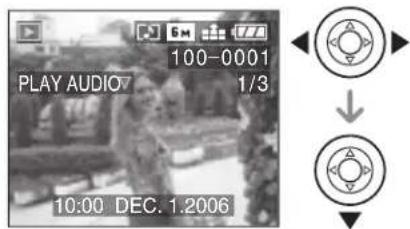
text_image
100-0001 PLAY AUDIO 7 1/3 10:00 DEC. 1.2006• Refer to [AUDIO REC.] (P68) and [AUDIO DUB.] (P78) for information about how to create still pictures with audio.

- Sound can be heard through the speaker. Refer to [VOLUME] (P22) for information about how to adjust the volume in the [SETUP] menu.
- The file format that can be played back with this camera is QuickTime Motion JPEG.
- Please note that the bundled software includes QuickTime to play back motion picture files created with the camera on the PC.
- Some QuickTime Motion JPEG files recorded by a PC or other equipment may not play back on the camera.
- If you play back motion pictures that have been recorded with other equipment, the picture quality may deteriorate or the pictures may not play back.
- When using a high capacity card, it is possible that fast rewinding may be slower than usual.
- You cannot use the following functions with motion pictures and pictures with audio.
- Playback zoom (While playing back or pausing motion pictures and while playing audio) - [ROTATE DISP.]/[ROTATE]/ [AUDIO DUB.] (Motion pictures only) - [RESIZE]/[TRIMMING]/[ASPECT CONV.]
Using the [REC] Mode Menu
![LEICA C-LUX 1 - Using the [REC] Mode Menu - 1](/content/2026/05/1008992/images/a50c2a683d008d40b4bf6b1a2e7a21e5b523aa0538a95a81178df7778fcc5fa0.jpg)
Increase the variety of pictures you can take by setting color effect, picture adjustment etc.
- Set the mode dial to the desired recording mode.
- Menu items differ depending on the mode selected with the mode dial (P7). This page describes how to set [AUDIO REC.] in normal picture mode [Refer to P65 to 81 for each menu item.)
- Select [RESET] in the [SETUP] menu to return the menu settings to the initial settings at the time of purchase. (P22)
1 Press [MENU/SET].
2 Press ▲/▼ to select the menu item.

text_image
REC 1/3 WB W.BALANCE AUTO ISO SENSITIVITY AUTO ASPECT RATIO 4:3 PICT.SIZE 6 M QUALITY SELECT EXIT A REC 2/3 AUDIO REC. OFF AF AF MODE AF AF ASSIST LAMP ON SLOW SHUTTER 1/B- D.ZOOM OFF SELECT EXIT- Press ▼ at Ⓐ to switch to the next menu screen.
3 Press ▶, press ▲/▼ to select the setting and then press [MENU/SET].
![LEICA C-LUX 1 - Press ▶, press ▲/▼ to select the setting and then press [MENU/SET]. - 1](/content/2026/05/1008992/images/821289d173288c5611f59cd7002b79cc4c0c66afe0e24e812c0b4f772aa59a0b.jpg)
text_image
REC 2/3 AUDIO REC. OFF AF AF MODE ON AF AF ASSIST LAMP ON SLOW SHUTTER 1/8- D.ZOOM OFF SELECT SET MENU/ SET4Press [MENU/SET] to close the menu.
- You can also press the shutter button halfway to close the menu.
■ About the menu screen items
- There are 3 menu screens (1/3, 2/3 and 3/3).
- You can switch menu screens from any menu item by rotating the zoom lever.
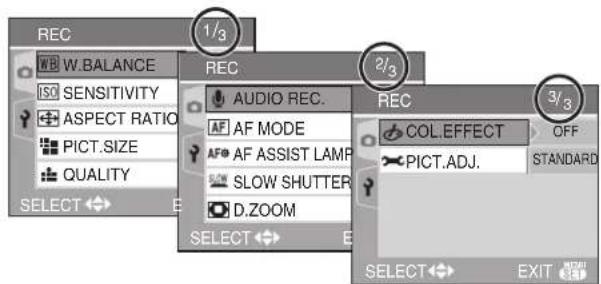
text_image
REC 1/3 W.BALANCE REC 2/3 AUDIO REC. REC 3/3 COL.EFFECT OFF AF MODE AF ASSIST LAMP SLOW SHUTTER D.ZOOM SELECT SELECT EXIT[W.BALANCE] Adjusting the hue for a more natural picture
![LEICA C-LUX 1 - [W.BALANCE] Adjusting the hue for a more natural picture - 1](/content/2026/05/1008992/images/ed6aca4d38a023e2670e268706e5cca9750d1f0889cef422fc98d4f3751e84d3.jpg)
Press [1] to display the [REC] mode menu and select the item to set. (P64) This function allows you to reproduce a white color close to real life in pictures recorded under sunlight, halogen lighting etc. in which the white color may appear reddish or bluish. Select a setting that matches the recording conditions.
| AUTO for auto setting (auto white balance) | |
| [05AH] (Daylight) for recording outdoors on a bright day | |
![LEICA C-LUX 1 - [W.BALANCE] Adjusting the hue for a more natural picture - 2](/content/2026/05/1008992/images/cb19c000cb1219075e047502a7b7dbcd2a2ac3217fdc0ce7bfc7ee8d1020c3f6.jpg) (Cloudy) for recording outdoors on a cloudy day (Cloudy) for recording outdoors on a cloudy day | |
| [6X4Y] (Halogen) for recording under halogen lighting | |
| [DBYA] (White set) for using the preset white balance | |
![LEICA C-LUX 1 - [W.BALANCE] Adjusting the hue for a more natural picture - 3](/content/2026/05/1008992/images/df3a30e2910a3df72b921533a12667ef2c5acd7c7eabf81e357b2d5bca0c6089.jpg) SET (White set) SET (White set) | for setting the white balance again |
- If you select a setting other than [AUTO], you can finely adjust the white balance.
■ Auto white balance
The available white balance range is shown in the following illustration. When you take a picture beyond the available white balance range, the picture may appear reddish or bluish. Also, auto white balance may not operate properly if the subject is surrounded by many light sources. In these cases, set the white balance to a mode other than [AUTO].
1 Auto white balance will work within this range.
2 Blue sky
3 Cloudy sky (Rain)
4 TV screen
5 Sunlight
6 White fluorescent light
7 Incandescent light bulb
8 Sunrise and sunset
9 Candlelight

K=Kelvin Color Temperature
■ Setting the white balance manually (White set) SET
Use this to set the white balance manually.
1 Select [] White set) and then press [MENU/SET].
2 Aim the camera at a sheet of white paper etc. so that the frame in the center is filled by the white object only and then press [MENU/SET].
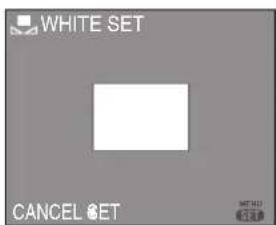
text_image
WHITE SET CANCEL SET3 Press [MENU/SET] twice to close the menu.
- You can also press the shutter button halfway to finish.
■ Finely adjusting the white balance (white balance fine adjustment WB±) You can adjust the white balance finely when you cannot acquire the desired hue by setting the white balance.
- Set the white balance to [ ]/[ ] [ ]
1 Press ▲ [☑] several times until [WB ADJUST.] appears and then press ◀/▶ to adjust the white balance.

text_image
WB WB ADJUST. RED BLUE SELECT EXIT MENU- ◀ [RED]: Press when the hue is bluish.
- [BLUE]: Press when the hue is reddish.
- Select [0] to return to the original white balance.
2Press [MENU/SET] to finish.
- You can also press the shutter button halfway to finish.
- The white balance icon on the screen turns red or blue.
![LEICA C-LUX 1 - 2Press [MENU/SET] to finish. - 1](/content/2026/05/1008992/images/d88bd62d145b0f1cd117b0eadf879fcf5a45ca7ed70743501b79e4e861bfef6b.jpg)
About the white balance
- When you take a picture with the flash, the white balance is automatically adjusted [except for ]. However, the white balance may not be properly adjusted if the flash level is insufficient.
- The white balance cannot be set in simple mode [●] and scene mode.
About the white balance fine adjustment
- You can finely adjust the white balance independently for each white balance item.
- The white balance fine adjustment setting is reflected in the picture when using the flash.
- The white balance fine adjustment setting is memorized even if the camera is turned off.
- The white balance fine adjustment level in [■White set) returns to "0" when you reset the white balance using White set [■SET].
- You cannot finely adjust the white balance when [COL.EFFECT] (P71) is set to [COOL], [WARM], [B/W] or [SEPIA].

[SENSITIVITY] Setting the light sensitivity
![LEICA C-LUX 1 - [SENSITIVITY] Setting the light sensitivity - 1](/content/2026/05/1008992/images/4c3cf561861b6882421c62f1d465a52c0cd49d2bb4756d6fba229c357bbe0c21.jpg)
Press [to] display the [REC] mode menu and select the item to set. (P64) ISO is a measure of sensitivity to light. The higher the sensitivity is set, the less light is needed to take a picture so the camera becomes more suitable for recording in dark places.
- When setting to [AUTO], the ISO sensitivity is automatically adjusted from [ISO80] to [ISO200] according to the brightness. (It can be adjusted from [ISO80] to [ISO400] when using the flash.)
| ISO sensitivity | 80←→400 | |
| Use in bright places (e.g. outdoors) | Suitable | Not suitable |
| Use in dark places | Not suitable | Suitable |
| Shutter speed | Slow | Fast |
| Noise | Less | Increased |
![LEICA C-LUX 1 - [SENSITIVITY] Setting the light sensitivity - 2](/content/2026/05/1008992/images/b58bc1bfa3a84de8d0319bd2fd92b40d6cb95064d669914652f922f108bf8098.jpg)
- ISO sensitivity is automatically set to the optimal value between [ISO800] and [ISO1600] in [HIGH SENS.] (P54) scene mode.
- To avoid picture noise, we recommend decreasing the ISO sensitivity or setting [PICT.ADJ.] to [NATURAL]. (P71)
- ISO sensitivity cannot be set in scene mode, motion picture mode [H] and simple mode [♥]
![LEICA C-LUX 1 - [SENSITIVITY] Setting the light sensitivity - 3](/content/2026/05/1008992/images/2dab9dddc1249f3864a8d3dbb9f6d6a7e4ac24ccfde0c66b6524f736ad9311c6.jpg)
[ASPECT RATIO]
Setting the aspect ratio of pictures


Press [1] to display the [REC] mode menu and select the item to set. (P64) By changing the aspect ratio, you can select an angle of view that matches the subject.
| 4:3 | Select to take pictures with the same aspect ratio as a 4:3 TV or a PC monitor. |
 | |
| 3:2 | Select to take pictures with the same 3:2 aspect ratio as 35 mm film. |
 |
| 16:9 | This is suitable for landscapes etc.where a wide view is preferable.This is also suitable for playing back pictures on a wide-screen TV, high-definition TV etc. | |
 | ||

- In motion picture mode [☐, you can select [4:3 [.]. 16:9
- The ends of the recorded pictures may be cut at printing. (P101)
[PICT.SIZE]/[QUALITY]
![LEICA C-LUX 1 - [PICT.SIZE]/[QUALITY] - 1](/content/2026/05/1008992/images/a12d14e9f40ed86f58aaa48ec128dab48916dbdbd1df4bce66713bdf41167108.jpg)
Setting a picture size and quality that matches your use of the pictures


Press [REC] to display the [REC] mode menu and select the item to set. (P62) A digital picture is made of numerous dots called pixels. Although you cannot see the difference on the camera's screen, the more pixels the finer the picture will be when it is printed on a large piece of paper or displayed on a PC monitor. Picture quality refers to the compression rate when saving digital pictures.

natural_image
Black-and-white photo of a waterfront scene with two inset images labeled A and B showing different scenes (no text or symbols)Ⓐ Many pixels (Fine)
⑧ Few pixels (Rough)
* These pictures are examples to show the effect.
■ Number of pixels
You can print pictures more clearly when a large picture size [F(6M) is selected.
When a smaller picture size [0.3M (0.3M EZ) is selected, you can record more pictures and attach them to an e-mail or post them on a website because their file size is small.
■ When the aspect ratio is 4:3
| 6M (6M) | 2816×2112 pixels |
| 3M (3M EZ) | 2048×1536 pixels |
| 2M (2M EZ) | 1600×1200 pixels |
| 1M (1M EZ) | 1280×960 pixels |
| 0.3M (0.3M EZ) | 640×480 pixels |
■ When the aspect ratio is 3:2
| 5M (5M) | 2816×1880 pixels |
| 25M (2.5M EZ) | 2048×1360 pixels |
■ When the aspect ratio is 16.9
| 4.5M (4.5M) | 2816×1584 pixels |
| 2M (2M EZ) | 1920×1080 pixels |
Quality
You can increase the number of recordable pictures without changing the picture size if quality is set to [ ]
| Fine (Low compression):This gives priority to picture quality.Picture quality will be high. | |
| Standard (High compression):This gives priority to the number of recordable pictures. Standard quality pictures are recorded. |

- The number of pixels that can be selected differs depending on the aspect ratio. If you change the aspect ratio, set the picture size.
- “EZ” is an abbreviation of [Extended optical Zoom]. This is a function which further extends the optical zoom ratio. If you select a picture size with EZ displayed, the zoom ratio is extended to a maximum of 5× when the digital zoom is set to [OFF]. (P29)
- The extended optical zoom does not work in [HIGH SENS.] in scene mode so the picture size for [EZ] is not displayed.
• Pictures may appear mosaic depending on the subject and the recording conditions.
• Refer to P103 for information about the number of recordable pictures.
• The number of recordable pictures depends on the subject. - The number of recordable pictures displayed on the screen may not correspond with recorded frames.
- In simple mode [the settings become as follows.
- □ E N L A R G E :
[5(6M [)]/F4:3
- □ 4"×6"/10×15cm:
[2.5M] (2.5M EZ [1/2 standard
- E-MAIL:
[0.30.3M EZ [4:3 Standard

[AUDIO REC.]
Recording still pictures with audio

Press [MENU] to display the [REC] mode menu and select the item to set. (P64) You can record audio with the still picture if this is set to [ON]. This means you can record the conversation that took place when you were recording or an explanation of the picture.
• [t] appears on the screen when you set [AUDIO REC.] to [ON].
- Focus on the subject and press the shutter button to start recording. Recording will automatically stop about 5 seconds later. There is no need to press and hold the shutter button.
- Audio is recorded from the built-in microphone on the camera.
- If you press [MENU/SET] during audio recording, the audio recording is canceled. The audio is not recorded.
- The total number of pictures that can be stored on each card will decrease slightly when audio is recorded with each picture.

- You cannot take pictures with audio in auto bracket, burst mode or [STARRY SKY] (P53) in scene mode.

[AF MODE]
Setting the focus method


Press [O] display the [REC] mode menu and select the item to set. (P64) Select the mode that matches the recording conditions and the composition.

(5-area-focusing):
The camera focuses on any of 5 focus areas. This is effective when the main subject is not in the center of the image.


H [3-area-focusing (High speed)]:
The camera quickly focuses on any of 3 focus areas – left, right or center. This is effective when the main subject is not in the center of the image.
![LEICA C-LUX 1 - H [3-area-focusing (High speed)]: - 1](/content/2026/05/1008992/images/d588ce482d0d873a8271c130617daa5cbecfdebd6ff306b3d703339a05059454.jpg)
![LEICA C-LUX 1 - H [3-area-focusing (High speed)]: - 2](/content/2026/05/1008992/images/1a3f4911be3bf645923396004b1d88f22e8a2026fd623f1ca55f5575ea3bf1c2.jpg)
[1-area-focusing (High speed)]:
The camera quickly focuses on the subject in the AF area in the center of the screen.
![LEICA C-LUX 1 - [1-area-focusing (High speed)]: - 1](/content/2026/05/1008992/images/f57d70501b1ef17eae9171dca83e4f573c0cd02a11f922174177d70ee88c74f9.jpg)
![LEICA C-LUX 1 - [1-area-focusing (High speed)]: - 2](/content/2026/05/1008992/images/bdb987a68120a8982975b566ea07a5807a29678b79c3c7fdae1976937c3f3e63.jpg)
(1-area-focusing):
The camera focuses on the subject in the AF area in the center of the screen.

(Spot-focusing):
The camera focuses on a limited small area in the screen.

■ About 3-area-focusing (High speed) and 1-area-focusing (High speed)
- You can focus on the subject more quickly than with other AF modes.
- The picture may stop moving for a moment before being brought into focus when you press the shutter button halfway. This is not a malfunction.

- The AF area displayed in the center of the screen is bigger than usual when using the digital zoom or when taking pictures in dark places.
- The focus position is not predetermined. It is set to a position automatically determined by the camera at the time of focusing. If you want to determine the focus position to take pictures, switch the AF mode to 1-area-focusing mode (High speed), 1-area-focusing mode or Spot-focusing mode.
- Switch the AF mode to 1-area-focusing mode (High speed) or 1-area-focusing mode if it is difficult to focus using Spot-focusing mode.
- The AF mode cannot be set in simple mode [●[FIREWORKS] (P52) or [SELF PORTRAIT] (P51) in scene mode.

[AF ASSIST LAMP]
Focusing in low light conditions becomes easier


Press [1] to display the [REC] mode menu and select the item to set. (P64) Illuminating the subject makes it easier for the camera to focus when recording in low light conditions that make focusing difficult.
- If the AF assist lamp is set to [ON], an AF area with a size wider than usual is displayed and the AF assist lamp Ⓐ turns on when you press the sh halfway in dark places etc

| ON The AF assist lamp turns on in low light conditions. At this time, the AF assist lamp icon [AF] appears on the screen. The effective range of the AF assist lamp is 1.5 m (5 feet). |
| OFF The AF assist lamp does not turn on. |

- Be careful about the following when using the AF assist lamp.
- Do not look at the AF assist lamp from close up.
- Do not cover the AF assist lamp with your fingers or other objects.
- When the AF assist lamp is turned on, the AF area in the center of the screen is displayed and it is bigger than usual. (P69)
- When you do not want to use the AF assist lamp (e.g. when taking pictures of animals in dark places), set the [AF ASSIST LAMP] to [OFF]. In this case, it will become more difficult to focus on the subject.
- The setting for [AF ASSIST LAMP] is fixed to [ON] in simple mode [♥]
- The setting for the [AF ASSIST LAMP] is fixed to [OFF] in [SCENERY] (P49), [NIGHT SCENERY] (P50), [FIREWORKS] (P52) and [SELF PORTRAIT] (P51) in scene mode.

[SLOW SHUTTER]
Recording bright pictures in dark places


Press [RECO] to display the [REC] mode menu and select the item to set. (P64) The shutter speed is automatically adjusted. However, if you want brighter pictures you can manually select an even slower shutter speed.
- The slow shutter speeds you can select are: [1/8–], [1/4–], [1/2–] and [1–].
- This is effective if you want to take bright pictures of both a night landscape and a subject using [NIGHT PORTRAIT] (P50) in scene mode.
| Slow shutter setting | 1/8-←→ |
| Brightness Darker | Brighter |
| Jitter Less More |
Example
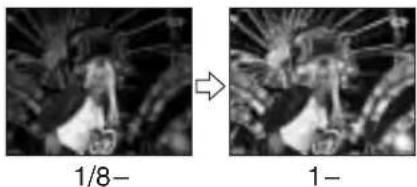
natural_image
Two grayscale images showing a biological structure before and after transformation, labeled 1/8- and 1- respectively (no text or symbols on the structures themselves)
- This should usually be set to [1/8–] to take pictures. (When you select a slow shutter speed other than [1/8–], [SLC] appears on the lower left of the screen.)
- When the shutter speed is made slower using [SLOW SHUTTER], jitter is likely to occur. We recommend using a tripod and the self-timer (P42) for taking pictures.
- You cannot set the slow shutter in [NIGHT SCENERY] (P51), [FIREWORKS] (P52) and [STARRY SKY] (P53) in scene mode.

[COL.EFFECT]
Setting color effects for the recorded pictures
![LEICA C-LUX 1 - [COL.EFFECT] - 1](/content/2026/05/1008992/images/84b43e99fd6d9696c47bc34d0e6e47d1b083b8d938acbc1dd81ca78cb2520fd3.jpg)
![LEICA C-LUX 1 - [COL.EFFECT] - 2](/content/2026/05/1008992/images/d3494c49823051c9ddcaa7cfae1e2b44ab3e21b293b2860eebc66723fcf21eee.jpg)
Press [RECO] to display the [REC] mode menu and select the item to set. (P64) Select a color effect that matches the recording conditions and your image of the recording.
| COOL The picture becomes bluish. | |
| WARM The picture becomes reddish. | |
| B/W | The picture becomes black and white. |
| SEPIA | The picture becomes sepia. |
![LEICA C-LUX 1 - [COL.EFFECT] - 3](/content/2026/05/1008992/images/1c80553ff40c6b99207c5416ff1727bab36a914453ba0076c12f00f3a8405776.jpg)
[PICT.ADJ.]
Adjusting the picture quality for the recorded pictures
![LEICA C-LUX 1 - [PICT.ADJ.] - 1](/content/2026/05/1008992/images/360760854d96917b04c473256a170470981fdb326f174d497c61528e453f572b.jpg)
Press [to display the [REC] mode menu and select the item to set. (P64) Select an effect that matches the recording situation and your image of the recording.
| NATURAL | The picture becomes softer. |
| VIVID | The picture becomes sharper. |
![LEICA C-LUX 1 - [PICT.ADJ.] - 2](/content/2026/05/1008992/images/92edd3d244678e9425f419d79f15674f0e34d458fb6a15a165dabebf584c3e01.jpg)
- When you take pictures in dark places, noise may become visible. To avoid noise, we recommend setting [PICT.ADJ.] to [NATURAL].
Using the [PLAY] mode menu
![LEICA C-LUX 1 - Using the [PLAY] mode menu - 1](/content/2026/05/1008992/images/4f3b749551cd965756cdf5f690802027c7b3407bb29971ff8dfb0c90b48d3ab8.jpg)
You can use various functions in playback mode to rotate pictures, set protection for them etc.
• Refer to P72 to 81 for each menu item.
1Press [MENU/SET].
2 Press ▲/▼ to select the menu item.
![LEICA C-LUX 1 - 1Press [MENU/SET]. - 1](/content/2026/05/1008992/images/05c957c5afb55cd870f6aa51fbd6cfc90afd038f0f7bb8f53bf927cb2f054c7c.jpg)
text_image
PLAY 1/3 SLIDE SHOW FAVORITE OFF ROTATE DISP. ON ROTATE DPOF PRINT SELECT EXIT A PLAY 2/3 PROTECT AUDIO DUB. RESIZE TRIMMING ASPECT CONV. SELECT EXIT- Press ▼ at Ⓐ to switch to the next menu screen.
3Press ▶.
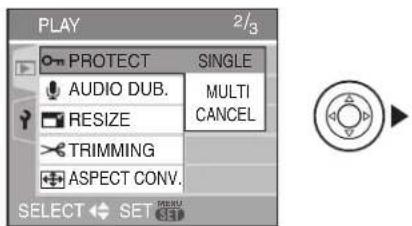
text_image
PLAY 2/3 PROTECT SINGLE AUDIO DUB. MULTI RESIZE CANCEL TRIMMING ASPECT CONV. SELECT SET MENU• After selecting a menu item in step 3, refer to the description of the menu item in the operating instructions and then set it.
■ About the menu screen items
- There are 3 menu screens (1/3, 2/3 and 3/3).
- You can switch menu screens from any menu item by rotating the zoom lever.
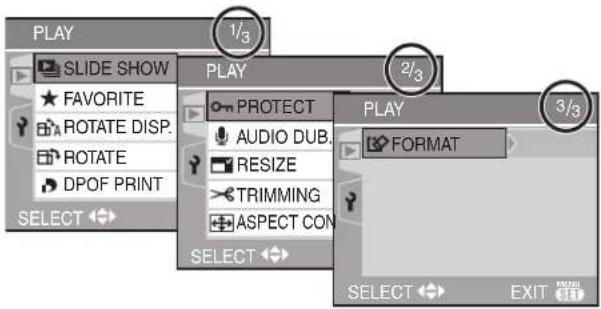
text_image
PLAY SLIDE SHOW FAVORITE ROTATE DISP. ROTATE DPOF PRINT SELECT PLAY PROTECT AUDIO DUB. RESIZE TRIMMING ASPECT CON SELECT PLAY FORMAT 3/3 SELECT EXIT[SLIDE SHOW]
![LEICA C-LUX 1 - [SLIDE SHOW] - 1](/content/2026/05/1008992/images/fdb4affd8137e6698ac79743bb9016e2c737a9637a85a72790c4b36d5fcf8152.jpg)
Playing back pictures in order for a fixed duration
Press [To] display the [PLAY] mode menu and select the item to set. (P72) This is recommended when playing back pictures on a TV screen. You can skip unwanted pictures if [FAVORITE] (P73) has been set.
1 Press ▲/▼ to select [ALL] or [★] and then press [MENU/SET].
![LEICA C-LUX 1 - Press ▲/▼ to select [ALL] or [★] and then press [MENU/SET]. - 1](/content/2026/05/1008992/images/de6a4327d5aa398ada228bd980b0237ba58adc9e0558048cf72979f250385c94.jpg)
text_image
PLAY 1/3 SLIDE SHOW ALL FAVORITE ★ A ROTATE DISP. ON ROTATE DPOF PRINT SELECT SET MENU MENU/SET| [ALL] Displays all pictures. | |
| [★] | Displays only those pictures that have been set as favorites (P73). |
- The screen shown in step 1 appears when [FAVORITE] is set to [ON]. When [FAVORITE] is set to [OFF], perform step 2 onwards.
- If none of the pictures have [★ displayed, you cannot select [★even if [FAVORITE] is set to [ON].
2 Press ▲ to select [START] and then press [MENU/SET].
(Screen when [ALL] is selected)
![LEICA C-LUX 1 - Press ▲ to select [START] and then press [MENU/SET]. - 1](/content/2026/05/1008992/images/5f2fc7816c049c346174f48fd49e921f1b408f409c48343362c611b1ae7ef76a.jpg)
text_image
SLIDE SHOW START DURATION 1SEC. AUDIO OFF CANCEL SELECT SET MENU/SET![LEICA C-LUX 1 - Press ▲ to select [START] and then press [MENU/SET]. - 2](/content/2026/05/1008992/images/724029033f91c568f1468f369dd9aaaf0d8204ff53529227a8dc920854d1b3b5.jpg)
text_image
A B C- The cursor displayed during a slide show Ⓐ or while a slide show is paused Ⓑ or during [MANUAL] slide show © is the same as ▲/▼/◀/▶.
- Press ▲ to pause the slide show. Press ▲ again to cancel pause.
- Press ◀/▶ while paused to display the previous or next picture.
3Press ▼ to finish.
■ Setting the audio and duration
Select [DURATION] or [AUDIO] on the screen shown in step 2 and set.
| [DURATION] | Can be set to [1SEC.], [2SEC.], [3SEC.], [5SEC.] or [MANUAL] (manual playback). |
| [AUDIO] If set | to [ON], the audio of the pictures with audio is played back. |
- You can only select [MANUAL] when [★has been selected in step 1.
-
Press ◀/▶ to display the previous or next picture when [MANUAL] is selected.
-
If you set [AUDIO] to [ON] and then play back a picture with audio, the next picture will be displayed after the audio has finished.
- You cannot play back motion pictures and use power save in a slide show. (However, the setting for power save mode is fixed to [10MIN.] while pausing a slide show or playing back a manual slide show.)

[FAVORITE] Setting your favorite pictures
Press [1] to display the [PLAY] mode menu and select the item to set. (P72) You can do the following if a mark has been added to pictures and they have been set as favorites.
- Delete all the pictures not set as favorites. ([ALL DELETE EXCEPT ★(P33))
- Play back the pictures set as favorites only as a slide show. (P72)
1 Press ▼ to select [ON] and then press [MENU/SET].
![LEICA C-LUX 1 - Press ▼ to select [ON] and then press [MENU/SET]. - 1](/content/2026/05/1008992/images/de9adbce861eb9e43a516aed4ae89e5cd2e7df9032bd52097bad4544d0ba36dc.jpg)
text_image
PLAY 1/3 SLIDE SHOW FAVORITE OFF A ROTATE DISP. ON ROTATE CANCEL DPOF PRINT SELECT SET MENU/SET- You cannot set pictures as favorites if [FAVORITE] is set to [OFF]. Also the favorites icon [★will not appear when [FAVORITE] is set to [OFF] even if it was previously set to [ON].
- You cannot select [CANCEL] if none of the pictures have [★]displayed.
2Press [MENU/SET] to close the menu.
3 Press ◀/▶ to select the picture then press ▲.
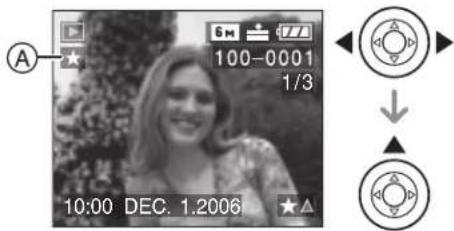
text_image
100-0001 1/3 10:00 DEC. 1.2006- Repeat the above procedure.
- If ▲ is pressed while the ★] favorites icon Ⓐ is displayed, [★is cleared, and the favorites setting is canceled.
- You can set up to 999 pictures as favorites.
■ Deleting all favorites
1 Select [CANCEL] on the screen shown in step 1 and then press [MENU/SET].
2 Press ▲ to select [YES] and then press [MENU/SET].
3 Press [MENU/SET] to close the menu.

- When printing pictures at a photo printing store, [ALL DELETE EXCEPT (P33) is useful so only the pictures you want to be printed remain on the card.
- You may not be able to set pictures taken with other equipment as favorites.

[ROTATE DISP.]/[ROTATE]
To display the picture rotated
Press [1] to display the [PLAY] mode menu and select the item to set. (P72) This mode allows you to automatically display pictures vertically if they were recorded holding the camera vertically or rotate pictures manually in 90° steps.
■ Rotate display
(The picture is automatically rotated and displayed.)
1 Press ▼ to select [ON] and then press [MENU/SET].
![LEICA C-LUX 1 - Press ▼ to select [ON] and then press [MENU/SET]. - 1](/content/2026/05/1008992/images/15dfbf1f9cbe7f3410eb07ed9288b0b08ed6584dfe4ef2ebd387bcc3624efadc.jpg)
text_image
PLAY 1/3 SLIDE SHOW FAVORITE OFF ROTATE DISP. OFF ROTATE ON DPOF PRINT SELECT SET![LEICA C-LUX 1 - Press ▼ to select [ON] and then press [MENU/SET]. - 2](/content/2026/05/1008992/images/018bf026a9192676f3a1774691f187f29e436d3cbe899d16f9b44e8ee1b5c22c.jpg)
- The pictures are displayed without being rotated when you select [OFF].
• Refer to P32 for information about how to play back pictures.
2Press [MENU/SET] to close the menu.
Rotate
(The picture is rotated manually.)
1 Press ◀/▶ to select the picture and then press ▼.
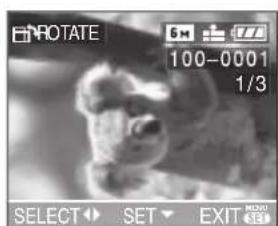
text_image
ROTATE 100-0001 1/3 SELECT SET EXIT MONO $15
- The [ROTATE] function is disabled when [ROTATE DISP.] is set to [OFF].
- Motion pictures and protected pictures cannot be rotated.
2 Press ▲/▼ to select the direction to rotate the picture and then press [MENU/SET].
![LEICA C-LUX 1 - Press ▲/▼ to select the direction to rotate the picture and then press [MENU/SET]. - 1](/content/2026/05/1008992/images/47340b6b679c3ab3bbe90555481dd1e2911b0565bf273044c1c8f658976e1f35.jpg)
text_image
ROTATE CANCEL SELECT SET![LEICA C-LUX 1 - Press ▲/▼ to select the direction to rotate the picture and then press [MENU/SET]. - 2](/content/2026/05/1008992/images/41d8691f563de8786fe2b423ca86dc58a70ac3562aae94236f83a736d42bac7a.jpg)
| The picture rotates clockwise in steps of 90°. | |
| The picture rotates counter-clockwise in steps of 90°. |
3Press [MENU/SET] twice to close the menu.
Example
When rotating clockwise ( )→
Original picture



- When [ROTATE DISP.] is set to [ON], pictures recorded holding the camera vertically are played back vertically (rotated).
- If you take pictures when aiming the camera up or down, it may not be possible to display the pictures vertically. (P25)
- The picture may be slightly blurred when the camera is connected to the TV with the AV cable (supplied) and played back vertically.
-
When you play back pictures on a PC, they cannot be displayed in the rotated direction unless the OS or software is compatible with Exif. Exif is a file format for still pictures which allows recording information etc. to be added.
-
Rotated pictures are displayed rotated when they are played back in review playback and playback zoom however are displayed without being rotated when they are played back in multi playback.
- It may not be possible to rotate pictures that have been recorded with other equipment.
[DPOF PRINT]
![LEICA C-LUX 1 - [DPOF PRINT] - 1](/content/2026/05/1008992/images/f45fb3b5af6b9809e398d52fa65f7b6c1848e9aa1dd82d10c63007f565eb7a81.jpg)
Setting the picture to print and the number of prints
Press [to] display the [PLAY] mode menu and select the item to set. (P72) DPOF (Digital Print Order Format) is a system that allows the user to select which pictures to print, how many copies of each picture to print and whether or not to print the recording date on the pictures when using a DPOF compatible photo printer or photo printing store. For details, ask at your photo printing store.
Press ▲/▼ to select [SINGLE], [MULTI] or [CANCEL] and then press [MENU/SET].
![LEICA C-LUX 1 - Press ▲/▼ to select [SINGLE], [MULTI] or [CANCEL] and then press [MENU/SET]. - 1](/content/2026/05/1008992/images/420f44f1b3ce75f3f27bd3a899de7b359f4d80b7a1e4b8a4a7c769b0b8d23284.jpg)
text_image
PLAY 1/3 SLIDE SHOW FAVORITE ROTATE DISP. ROTATE DPOF PRINT SELECT SET SINGLE MULTI CANCEL![LEICA C-LUX 1 - Press ▲/▼ to select [SINGLE], [MULTI] or [CANCEL] and then press [MENU/SET]. - 2](/content/2026/05/1008992/images/32e40a9771296cb0678de93df1f8827a979aa99d910227b98a9d35a9d37335d9.jpg)
- You cannot select [CANCEL] if there are no prints that have been set in the DPOF print settings.
■ Single setting
1 Press ◀/▶ to select the picture to print and then press ▲/▼ to set the number of prints.

text_image
DPOF SET THIS 1 100-0001 1/14 COUNT 1 DATE DISPLAY SELECT EXIT- The number of prints icon 📋 appears.
- The number of prints can be set from 0 to 999. The DPOF print setting is canceled when the number of prints is set to "0".
2Press [MENU/SET] twice to close the menu.
■ Multi setting
1 Press ◀/▶ to select the picture to print then press ▲/▼ to set the number of prints.
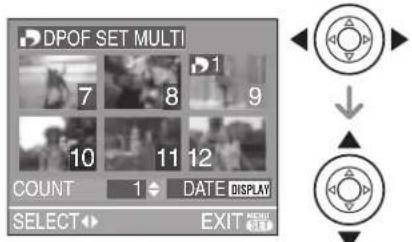
text_image
DPOF SET MULTI 7 8 9 10 11 12 COUNT 1 DATE DISPLAY SELECT EXIT- The number of prints icon 📋 appears.
- Repeat the above procedure. (You cannot set all the pictures at one time.)
- The number of prints can be set from 0 to 999. The DPOF print setting is canceled when the number of prints is set to "0".
2Press [MENU/SET] twice to close the menu.
■ To cancel all settings
1 Press ▲ to select [YES] and then press [MENU/SET].
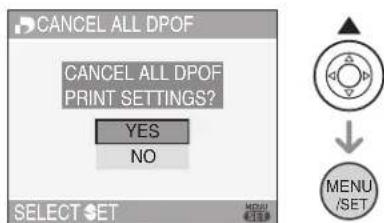
text_image
CANCEL ALL DPOF CANCEL ALL DPOF PRINT SETTINGS? YES NO SELECT SET MENU SET2Press [MENU/SET] to close the menu.
■ To print the date
After setting the number of prints, set/cancel printing with the recording date by pressing [DISPLAY].

text_image
DPOF SET THIS 1 DATE 100-0001 1/14 COUNT 1 DATE DISPLAY SELECT EXIT- The date print icon [DATE appears.
- When you go to a photo printing store for digital printing, be sure to order the printing of the date additionally if required.
- Depending on the photo printing store or the printer, the date may not be printed even if you set to print the date. For further information, ask at your photo printing store or refer to the operating instructions for the printer.

- DPOF is an abbreviation of [Digital Print Order Format]. This feature allows you to write print information to media and then use the information on a DPOF-compliant system.
- DPOF print setting is a convenient function when printing pictures with a printer that supports PictBridge (P86). The date printing setting on the printer may take priority over the date printing setting on the camera. Check the date printing setting on the printer also. (P86)
- It is necessary to delete all previous DPOF print information made on other equipment when setting DPOF print on the camera.
- If the file is not based on the DCF standard, the DPOF print setting cannot be set. DCF is an abbreviation of [Design rule for Camera File system].

[PROTECT]
Preventing accidental erasure of pictures
Press [A] to display the [PLAY] mode menu and select the item to set. (P72) You can set protection for pictures you do not want to be deleted by mistake.
Press ▲/▼ to select [SINGLE], [MULTI] or [CANCEL] and then press [MENU/SET].
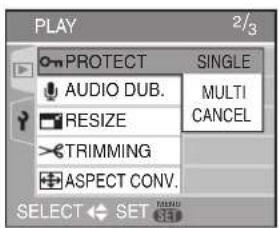
text_image
PLAY 2/3 PROTECT AUDIO DUB. RESIZE TRIMMING ASPECT CONV. SELECT SET
■ Single setting
1 Press ◀/▶ to select the picture and then press ▼ to set/cancel.
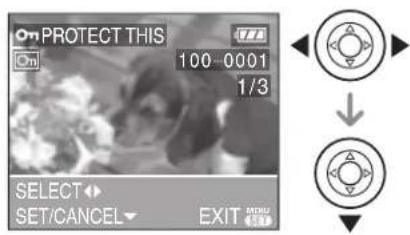
text_image
ON PROTECT THIS 100-0001 1/3 SELECT SET/CANCEL EXIT| SET The p | protect icon [ ] appe$ |
| CANCEL | The protect icon [ ] disappears. |
2Press [MENU/SET] twice to close the menu.
■ Multi setting/To cancel all settings
Perform the same operation as in "[DPOF PRINT] Setting the picture to print and the number of prints". (P75 to 77)
![LEICA C-LUX 1 - 2Press [MENU/SET] twice to close the menu. - 1](/content/2026/05/1008992/images/56977689608c7ba06e790bc17bdd01e6a06146ab2c1d4bff115683c45790a895.jpg)
- If you press [MENU/SET] while canceling protection, the canceling will stop halfway.
- The protect setting may not be effective on other equipment.
- If you want to delete protected pictures, cancel their protection.
- Even if you protect pictures on a card, they will be deleted if the card is formatted. (P81)
- Even if you do not protect pictures on an SD Memory Card, they cannot be deleted when the card's write protect switch Ⓐ is set to [LOCK].
![LEICA C-LUX 1 - 2Press [MENU/SET] twice to close the menu. - 2](/content/2026/05/1008992/images/e5a90aab981521012c00027ef0bbcaa87352644246b184245ea94a87bed4dca9.jpg)
- The following functions cannot be used with protected pictures.
- [ROTATE]
- [AUDIODUB.]
![LEICA C-LUX 1 - 2Press [MENU/SET] twice to close the menu. - 3](/content/2026/05/1008992/images/6f871f86665aa6fbd592b3550038b6d9fa08f422321853810e5365befbb264a0.jpg)
[AUDIO DUB.]
Adding audio after taking pictures
Press [1] to display the [PLAY] mode menu and select the item to set. (P72) You can add the audio after taking a picture.
1 Press ◀/▶ to select the picture and then press ▼ to start audio recording.

text_image
AUDIO DUB 100-0001 1/3 SELECT START EXIT- The message [OVERWRITE AUDIO DATA?] screen appears when audio has already been recorded. Press ▲ to select [YES] and then press [MENU/SET] to start audio recording. (The original audio is overwritten.)
-
Audio dubbing cannot be used with the following pictures:
-
Motion pictures
- Protected pictures
- Audio dubbing may not work properly on pictures recorded by other equipment.
2Press ▼ to stop recording.
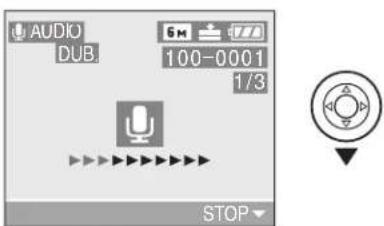
text_image
AUDIO DUB 100-0001 1/3 STOP- The audio recording stops automatically if ▼ is not pressed after about 10 seconds.
3Press [MENU/SET] twice to close the menu.
![LEICA C-LUX 1 - 3Press [MENU/SET] twice to close the menu. - 1](/content/2026/05/1008992/images/a26aab2e60783150075bbb6a0fb77a03ec486685bb9482f422737d075a328dff.jpg)
[RESIZE]
Making the picture smaller
Press [1] to display the [PLAY] mode menu and select the item to set. (P72) This function is useful if you want to reduce the file size of a picture to attach it to an e-mail or upload it to a website.
1 Press ◀/▶ to select the picture and then press ▼.
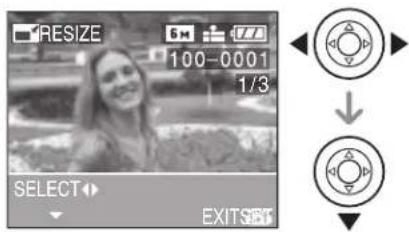
text_image
RESIZE 100-0001 1/3 SELECT EXIT SET• The following pictures cannot be resized.
- When the aspect ratio setting is [4:3]
- Pictures recorded in [0.3(0.3M EZ)
- When the aspect ratio setting is 3:2:
- Pictures recorded in [2.5M (2.5M EZ)
- When the aspect ratio setting is 16:9:
– Pictures recorded in [2(M EZ)
- Motion pictures
– Pictures with audio
- It may not be possible to resize pictures recorded with other equipment.
2 Press ◀/▶ to select the size and then press ▼.
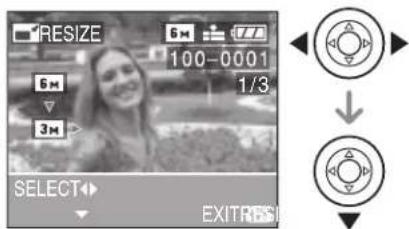
text_image
RESIZE 100-0001 1/3 SELECT EXITRBSI- Sizes smaller than the recorded picture are displayed.
- When the aspect ratio setting is - 3M/[2M] 1M 0.3M

- When the aspect ratio setting is
- When the aspect ratio setting is
- The message [DELETE ORIGINAL PICTURE?] appears.
3 Press ▲/▼ to select [YES] or [NO] and then press [MENU/SET].
![LEICA C-LUX 1 - Press ▲/▼ to select [YES] or [NO] and then press [MENU/SET]. - 1](/content/2026/05/1008992/images/efa89cfe37d989b160ca06582ce0e5bee2ffbc2e70b8b7b6ac68fe3db1e5e886.jpg)
text_image
RESIZE DELETE ORIGINAL PICTURE? YES NO SELECT ANSEL![LEICA C-LUX 1 - Press ▲/▼ to select [YES] or [NO] and then press [MENU/SET]. - 2](/content/2026/05/1008992/images/75d6a3333c359102f9c9b5c5d86dc4b538821f45a8f8051c8ffd3a7069595731.jpg)
- The picture is overwritten when you select [YES]. Resized pictures cannot be restored when they are overwritten.
- A resized picture is newly created when you select [NO].
- If the original picture is protected, you cannot overwrite it. Select [NO] and newly create a resized picture.
4Press [MENU/SET] twice to close the menu.
![LEICA C-LUX 1 - 4Press [MENU/SET] twice to close the menu. - 1](/content/2026/05/1008992/images/d0e7cf9ad85a83f05d19a714d25141f0e85589ece3570de030b542b107a64a3d.jpg)
[TRIMMING] Enlarging a picture and trimming it
Press [1] to display the [PLAY] mode menu and select the item to set. (P72) You can enlarge and then clip the important part of the recorded picture.
1 Press ◀/▶ to select the picture and then press ▼.

text_image
>STRIMMING 100-0001 1/3 SELECT SET EXIT• The following pictures cannot be trimmed:
- Motion pictures
– Pictures with audio
- It may not be possible to trim pictures recorded with other equipment.
2Enlarge or decrease the parts to be trimmed with the zoom lever.
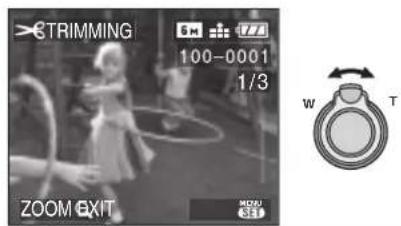
text_image
>STRIMMING 100-0001 1/3 ZOOM EXIT W T3 Press ▲/▼/◄/► to move the position of the part to be trimmed.
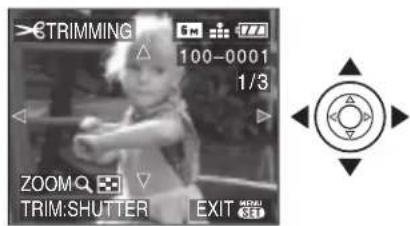
text_image
>TRIMMING 100-0001 1/3 ZOOM TRIM:SHUTTER EXIT4Press shutter button.
- The message [DELETE ORIGINAL PICTURE?] appears.
5 Press ▲/▼ to select [YES] or [NO] and then press [MENU/SET].
![LEICA C-LUX 1 - Press ▲/▼ to select [YES] or [NO] and then press [MENU/SET]. - 1](/content/2026/05/1008992/images/58ae04680e64f87b0a54096ef6eea12294fb65ed910ee87a691437b4164a317a.jpg)
text_image
TRIMMING DELETE ORIGINAL PICTURE? YES NO CANCEL SELECT SET MENU SET- The picture is overwritten when you select [YES]. The trimmed pictures cannot be restored when they are overwritten.
- A trimmed picture is newly created when you select [NO].
- When the original picture is protected, you cannot overwrite it. Select [NO] and newly create a trimmed picture.
6Press [MENU/SET] twice to close the menu.
![LEICA C-LUX 1 - 6Press [MENU/SET] twice to close the menu. - 1](/content/2026/05/1008992/images/615b3f55b4d2335662cae9d6d58ea94344652ddf6b3b5378a6936e642dd45e46.jpg)
- Depending on the cut size, the picture size of the trimmed picture may become smaller than that of the original picture.
- The picture quality of the trimmed picture will deteriorate.
[ASPECT CONV.]
![LEICA C-LUX 1 - [ASPECT CONV.] - 1](/content/2026/05/1008992/images/d03c7713a7519d01b46303ba57e59c172b972031bd226584ecbc97f5243e932e.jpg)
Changing the aspect ratio of a 16:9 picture
Press [1] to display the [PLAY] mode menu and select the item to set. (P72) You can convert pictures taken with a
[16] spect ratio to a [ ] or a 3:2 4:3 aspect ratio.
1 Press ▲/▼ to select [3:2] or [4:3] and then press [MENU/SET].
![LEICA C-LUX 1 - Press ▲/▼ to select [3:2] or [4:3] and then press [MENU/SET]. - 1](/content/2026/05/1008992/images/db1afab74d8a449f20b9d6de1c13c507b57d2b18e5c1aa8559f0a47905310a0b.jpg)
text_image
PLAY 2/3 ON PROTECT AUDIO DUB. OFF RESIZE ON TRIMMING ASPECT CONV. 3:2 SELECT SET 4:3 MENU/SET- Only pictures taken with a 16:9 aspect ratio can be converted.
- You may not be able to convert pictures taken on other equipment.
2 Press ◀/▶ to select a picture and then press ▼.

text_image
ASPECT CONV. 100-0001 1/3 SETSELECT EXIT MDAU SET- If you select and set a picture with an aspect ratio other than 16:9 message [CANNOT BE SET ON THIS PICTURE] is displayed on the screen.
3 Press ◀/▶ to determine the horizontal position and press the shutter button to set.
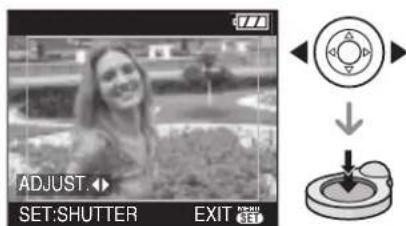
text_image
ADJUST. SET:SHUTTER EXIT- Use ▲/▼ to set the frame position for pictures rotated vertically.
- The message [DELETE ORIGINAL PICTURE?] appears.
4 Press ▲/▼ to select [YES] or [NO] and then press [MENU/SET].
![LEICA C-LUX 1 - Press ▲/▼ to select [YES] or [NO] and then press [MENU/SET]. - 1](/content/2026/05/1008992/images/15b8b18bc179ee699f37205d67a94c51f0d781b8dfed1221b889e42968cc0715.jpg)
text_image
ASPECT CONV. DELETE ORIGINAL PICTURE? YES NO CANCEL SELECT SET![LEICA C-LUX 1 - Press ▲/▼ to select [YES] or [NO] and then press [MENU/SET]. - 2](/content/2026/05/1008992/images/3e585355f03f1d39ab7560d53af96a26677a097aca43cb222020273e346ef7be.jpg)
- The picture is overwritten when you select [YES]. If you convert the aspect ratio of a picture and then overwrite it, you cannot restore it.
- A picture with the converted aspect ratio is newly created when you select [NO].
- When the original picture is protected, you cannot overwrite it. Select [NO] and newly create a picture with the converted aspect ratio.
5Press [MENU/SET] twice to close the menu.
![LEICA C-LUX 1 - 5Press [MENU/SET] twice to close the menu. - 1](/content/2026/05/1008992/images/4ab4c7fd2a0522665552f7c258ba8a7227a66f9d530381cd813843d852a8010e.jpg)
• After converting the aspect ratio, the picture size may become larger than that of the original picture.
• The following pictures cannot be converted:
– Pictures with audio
- Motion pictures
- Files that do not conform to the DCF standard cannot be converted. DCF is an abbreviation of [Design rule for Camera File system].
![LEICA C-LUX 1 - 5Press [MENU/SET] twice to close the menu. - 2](/content/2026/05/1008992/images/992d0e1210d8cb5779184ae4110fd513bd82c0b1cf70f4fe4834986527e56d7c.jpg)
[FORMAT] Initializing the card
Press [to display the [PLAY] mode menu and select the item to set. (P72) Usually, it is not necessary to format the card. Format it when the message [MEMORY CARD ERROR] appears.
Press ▲ to select [YES] and then press [MENU/SET].
![LEICA C-LUX 1 - Press ▲ to select [YES] and then press [MENU/SET]. - 1](/content/2026/05/1008992/images/6e535e47b556f95e456853e6f0c0c14a72cbeea947e52f88db68f19b8bb1938e.jpg)
text_image
DELETE ALL DATA ON THE MEMORY CARD? YES NO SELECT SET![LEICA C-LUX 1 - Press ▲ to select [YES] and then press [MENU/SET]. - 2](/content/2026/05/1008992/images/b31e9b9c5e283ba63c45ecc6d7f25fb5133a39c257fc0a80504671bfdba76473.jpg)
![LEICA C-LUX 1 - Press ▲ to select [YES] and then press [MENU/SET]. - 3](/content/2026/05/1008992/images/b252b99b45feac6543676c7189449acb43bf53b1db814425216ab7db1d347262.jpg)
- Formatting irretrievably deletes all the data including any protected pictures. Check the data carefully before formatting.
- If the card has been formatted on a PC or other equipment, format it on the camera again.
- Use a battery with sufficient battery power (P14) or the AC adaptor (ACA-DC4-E/U/J; optional) when formatting.
- Do not turn the camera off during formatting.
- You cannot format an SD Memory Card when the card's write protect switch is set to [LOCK].
- If the card cannot be formatted, consult your nearest Leica dealer.
Installing the Software on the CD
The supplied CD contains Adobe Photoshop Elements (Windows® V4.0, Mac® V3.0) and Apple QuickTime® V6.3 (English) for Windows®.
Installation of Adobe® Photoshop Elements
Notice: the serial numbers for Adobe® Photoshop Elements are printed on the CD-ROM paper sleeve.
With Windows® computers
(Windows® XP and higher; Windows® Media Center Edition 2005 and higher) Insert the CD-ROM into your CD/DVD drive. Usually the Adobe® Photoshop Elements Installer will start automatically. If not, open the CD/DVD drive in the Windows® Explorer. In the root directory you will find the installer file [setup.exe]. Double click this file and the installer will start. You need to be logged in as administrator. Follow the instructions.
With MACINTOSH® computers
(Mac® OS X Version 10.2.8 and 10.3 and later) Insert the CD into your CD/DVD drive. Open the corresponding window. Double click on the file "Install Adobe® Photoshop Elements" [in D: "Adobe® Photoshop Elements installieren"; in F: "Installer Adobe® Photoshop Elements"] and follow the instructions.
Installation of Quick Time for Windows (Windows 2000 and higher):
Notice: Apple QuickTime ^® is required to playback AUDIO and VIDEO files created by the LEICA C-LUX 1.
Insert the CD into your CD/DVD drive. Usually the Adobe® Photoshop Elements installer will start automatically. Cancel the installer and open the CD/DVD drive in the Windows Explorer. In the subfolder "Apple QuickTime" double click the file "QuickTimeInstaller.exe" and follow the instructions to install the software.
Notice: Leave the field for the serial number blank and continue.
Updates and further language versions are available for download at www.apple.com/quicktime
Notice: Restart your computer after the installation of the software to finalize the installation process.
Connecting to a PC

You can acquire recorded pictures to a PC by connecting the camera and the PC. The software [Adobe ^fi Photoshop Elements] (for Windows ^® ) in the CD-ROM (supplied) allows you to easily acquire pictures recorded with the camera to a PC, print them and send them by e-mail.

text_image
Diagram illustrating the connection between a laptop, digital camera, and cable via USB cable, with labeled components and signal paths.Ⓐ: USB connection cable (supplied)
⑧: AC adaptor (ACA-DC4-E/U/J; optional)
- Use a battery with sufficient battery power or the AC adaptor (ACA-DC4-E/U/J; optional).
- Turn the camera off before inserting or removing the cable for the AC adaptor (ACA-DC4-E/U/J; optional).
1Turn on the camera and the PC.
2Connect the camera to a PC via the USB connection cable Ⓐ (supplied).
- Connect the USB connection cable with the [ ] mark facing the [◀] mark on the [DIGITAL] socket.
- Hold the USB connection cable at © and insert straight in or take straight out. (If you forcibly insert the USB connection cable at a slant or upside down you can deform the connection terminals and damage the camera or the connected equipment.)

text_image
ACCESS D⑭: This message appears during data transfer.
3 Press ▲ to select [PC] and then press [MENU/SET].
![LEICA C-LUX 1 - Press ▲ to select [PC] and then press [MENU/SET]. - 1](/content/2026/05/1008992/images/4fdddfc09f5072e1073d067b948711ff74b010bc6d7b7e4ff0f3ac7fcc9c0587.jpg)
text_image
USB USB MODE PLEASE SELECT THE USB MODE. PC PictBridge(PTP) SELECT SET MENU/SET- If you set [USB MODE] in the [SETUP] menu to [PC] in advance, it is not necessary to set this every time you connect to a PC. (P22)
- If you set [USB MODE] to [PictBridge (PTP)] and then connect the camera to the PC, messages may appear on the screen of the PC.
Select [Cancel] to close the messages and disconnect the camera from the PC. Set [USB MODE] to [PC] again.
[Windows]
The drive appears in the [My Computer] folder.
- If you are connecting the camera to a PC for the first time, the required driver is installed automatically so that the camera can be recognized by Windows Plug and Play. The drive then appears on the [My Computer] folder.
[Macintosh]
The drive is displayed on the screen.
- The drive is displayed as [LEICA] when you connect the camera with no card inserted.
- The drive is displayed as [NO_NAME] or [Untitled] when you connect the camera with a card inserted.
■ Folder Composition
Folders are displayed as shown in the following illustration.
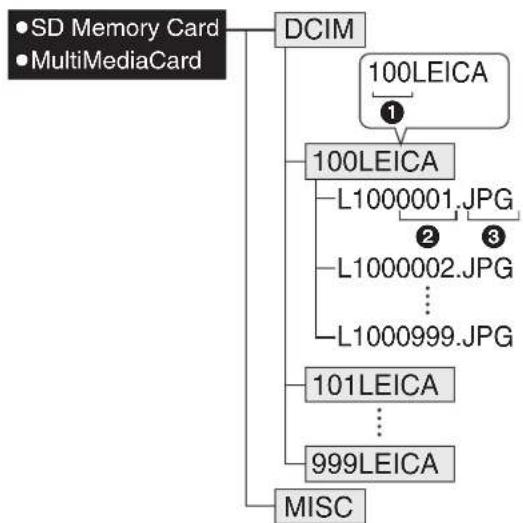
flowchart
graph TD
    A["SD Memory Card"] --> D["DCIM"]
    B["MultiMediaCard"] --> D
    D --> C["100LEICA"]
    C --> E["100LEICA"]
    E --> F["L1000001.JPG"]
    F --> G["2"]
    F --> H["3"]
    F --> I["L1000002.JPG"]
    I --> J["..."]
    I --> K["L1000999.JPG"]
    E --> L["101LEICA"]
    L --> M["..."]
    L --> N["999LEICA"]
    O["MISC"] --> L
① Folder number
② File number
③ JPG: pictures
MOV: motion pictures
The items in each folder are as follows.
| DCIM Folders from [100LEICA] to [999LEICA] | |
| 100LEICA to 999LEICA | Pictures/motion pictures |
| MISC Files on which the DPOF print settings are recorded | |
- The data for up to 999 pictures recorded by the camera can be included in 1 folder. If the number of pictures exceeds 999, another folder is created.
- To reset the file number or the folder number, select [NO.RESET] in the [SETUP] menu. (P22)
■ Conditions under which a different folder number is used
In the following cases, the picture is not recorded in the same folder as the previously recorded picture. It is recorded in a folder with a new number.
1 When the folder just recorded to contains a picture file with the number 999 in it (example: L1000999.JPG).
2 When the card just recorded to contains, for example, a folder with the number 100 (100LEICA) in it and that card is removed and replaced with a card that has a folder with the number 100 in it recorded by a camera from a different maker (100XXXXX, with XXXXX being the name of the maker) and then a picture is recorded.
3 When recording after selecting [NO.RESET] (P22) from the [SETUP] menu. (Pictures will be recorded to a new folder with a number sequential to the folder recorded to immediately before. By using [NO.RESET] on a card that does not contain folders or pictures, such as one just formatted, the folder number can be reset to 100.)
■ PictBridge (PTP) setting
Even if you set [USB MODE] to
[PictBridge (PTP)], you can connect to your PC if the OS is Windows XP Home Edition/Professional or Mac OS X.
- Pictures can only be read on the camera. They cannot be written to a card or deleted.
- When there are 1000 or more pictures on a card, the pictures may not be imported.

- Do not use any other USB connection cables except the supplied one.
- Do not disconnect the USB connection cable while [ACCESS] is displayed.
- If battery power is exhausted while the camera and the PC are communicating, the recorded data may be damaged. When you connect the camera to the PC, use a battery with sufficient battery power (P14) or the AC adaptor (ACA-DC4-E/U/J; optional).
- If the remaining battery power becomes low while the camera and the PC are communicating, the status indicator flashes and the alarm beeps. In this case, stop the communication at once on the PC.
- When connecting the camera to a Windows 2000 OS PC with the USB connection cable, do not replace the card while the camera and the PC are connected. The information on the card may be damaged. Disconnect the USB connection cable before replacing the card.
• Pictures edited or rotated with a PC may be displayed in black in playback mode (P32), multi playback (P60) and calendar playback (P61). - Read the operating instructions for the PC.
Printing the Pictures

By connecting the camera directly to a printer supporting PictBridge via the USB connection cable (supplied), you can select the pictures to print and start printing on the camera's screen.
Set print settings such as the print quality on the printer beforehand. (Read the printer operating instructions.)

text_image
Diagram illustrating the connection between a printer, digital camera, and cable via USB cable, with labeled components and signal paths.Ⓐ: USB connection cable (supplied)
⑧: AC adaptor (ACA-DC4-E/U/J; optional)
- It may take time to print some pictures. Use a battery with sufficient battery power (P14) or the AC adaptor (ACA-DC4-E/U/J; optional) when you connect to a printer.
- Turn the camera off before inserting or removing the cable for the AC adaptor (ACA-DC4-E/U/J; optional).
1 Turn on the camera and the printer.
2Connect the camera to a printer via the USB connection cable Ⓐ (supplied).
- Connect the USB connection cable with the [ ] mark facing the [◀] mark on the [DIGITAL] socket.
- Hold the USB connection cable at © and insert straight in or take straight out.
3 Press ▼ to select [PictBridge (PTP)] and then press [MENU/SET].
![LEICA C-LUX 1 - Press ▼ to select [PictBridge (PTP)] and then press [MENU/SET]. - 1](/content/2026/05/1008992/images/45fbbe41ebcd8597d8de29a133bf5394daf51c7ab5887b8ce99aae91c2245fef.jpg)
text_image
USB/USB MODE PLEASE SELECT THE USB MODE. PC PictBridge(PTP) SELECT SET MENU /SET- If you set [USB MODE] in the [SETUP] menu to [PictBridge (PTP)] in advance, it is not necessary to set this every time you connect to a PC. (P22)
![LEICA C-LUX 1 - Press ▼ to select [PictBridge (PTP)] and then press [MENU/SET]. - 2](/content/2026/05/1008992/images/26ee47462b096691ed961bdb0c0407e1fb54237a6dc7d7caffa23cf7d256b39c.jpg)
- Do not use any other USB connection cables except the supplied one.
• To find out more about PictBridge compliant printers, contact your local dealer.
■ Single picture
1 Press ▲ to select [SINGLE PICTURE] and then press [MENU/SET].
![LEICA C-LUX 1 - Press ▲ to select [SINGLE PICTURE] and then press [MENU/SET]. - 1](/content/2026/05/1008992/images/650400729dca47730d76b21e3ffab381caa0a51cbd52fa7624e3ffe96c0640c0.jpg)
text_image
PictBridge SINGLE PICTURE DPOF PICTURE SELECT SET MENU/SET2 Press ◀/▶ to select the picture and then press ▼.
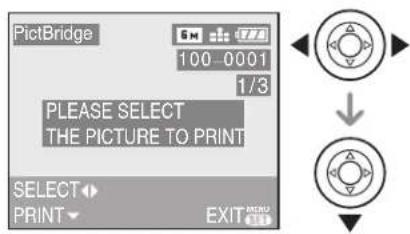
text_image
PictBridge 100-0001 1/3 PLEASE SELECT THE PICTURE TO PRINT SELECT PRINT EXIT• The message disappears in about 2 seconds.
3 Press ▲ to select [PRINT START] and then press [MENU/SET].
![LEICA C-LUX 1 - Press ▲ to select [PRINT START] and then press [MENU/SET]. - 1](/content/2026/05/1008992/images/4af818e34515fe991d7c52aef5d950f68012b19c95e194ed271197605759c81c.jpg)
text_image
SINGLE PICTURE PRINT START PRINT WITH DATE NUM. OF PRINTS 1 PAPER SIZE PAGE LAYOUT SELECT CANCEL SET MENU/SET- Press [MENU/SET] to cancel printing.
4Disconnect the USB connection cable after printing.
■ Setting date printing, the number of prints, the paper size and the page layout
Select and set each item in step 3.
- Items not supported by the printer are displayed in gray and cannot be selected.
- When you want to print pictures in a paper size or a layout which is not supported by the camera, set [PAPER SIZE] or [PAGE LAYOUT] to and then set the paper size or the layout on the printer. (For details, refer to the operating instructions of the printer.)
•[PRINTWITHDATE]
| Settings on the printer are prioritized. | |
| OFF | Date is not printed. |
| ON | Date is printed. |
- If the printer does not support date printing, the date cannot be printed on the picture.
• [NUM. OF PRINTS]
Set the number of prints.
•[PAPERSIZE]
(Paper sizes that can be set with this unit) The paper sizes are displayed on pages 1/2 and 2/2. Press ▼ to select.
| 1/2 | |
| Settings on the printer are prioritized. | |
| L/3.5"×5" | 89 mm×127 mm |
| 2L/5"×7" | 127 mm×178 mm |
| POSTCARD | 100 mm×148 mm |
| A4 | 210 mm×297 mm |
| 2/2* | |
| CARD SIZE | 54 mm×85.6 mm |
| 10×15cm | 100 mm×150 mm |
| 4"×6" | 101.6 mm×152.4 mm |
| 8"×10" | 203.2 mm×254 mm |
| LETTER | 216 mm×279.4 mm |
*These items cannot be displayed when the printer does not support the paper sizes.
•[PAGELAYOUT]
(Layouts that can be set with this unit)
| Settings on the printer are prioritized. | |
| 1 photo/page | |
| 1 photo/page | |
| 2 photo/page | |
| 4 photo/page |
- An item cannot be selected if the printer does not support the page layout.
■ DPOF picture
- Set the DPOF print setting on the camera in advance. (P75)
1Press ▼ to select [DPOF PICTURE] and then press [MENU/SET].
![LEICA C-LUX 1 - 1Press ▼ to select [DPOF PICTURE] and then press [MENU/SET]. - 1](/content/2026/05/1008992/images/edd17a1fdff293c9744aef1f18010fab06492c175f755e53cb8a116e9fabe283.jpg)
text_image
PictBridge SINGLE PICTURE DPOF PICTURE SELECT SET 3.0 MENU/SET2 Press ▲ to select [PRINT START] and then press [MENU/SET].
![LEICA C-LUX 1 - Press ▲ to select [PRINT START] and then press [MENU/SET]. - 1](/content/2026/05/1008992/images/030ace3feba74b9074758f67da037ca157fcef9287074abbfbda0e8d68ae1fa7.jpg)
text_image
DPOF PRINT START PAPER SIZE PAGE LAYOUT DPOF SET CANCEL SELECT SET MENU/SET- You cannot select [PRINT START] when the DPOF print setting is not set. Select [DPOF SET] and then set the DPOF print setting. (P75)
- Press [MENU/SET] to cancel printing.
3Disconnect the USB connection cable after printing.
■ Setting the date printing with the DPOF print in advance
We recommend setting DPOF date printing with [DPOF PRINT] (P76) in advance when the printer supports it. If you select [DPOF PICTURE], printing starts and the recording date is printed.
■ Layout printing
- When printing a picture several times on 1 sheet of paper
For example, if you want to print a picture 4 times on 1 sheet of paper, set [PAGE LAYOUT] to 📄 and then set [NUM. OF PRINTS] to 4.
- When printing different pictures on 1 sheet of paper (only in DPOF printing)
For example, if you want to print 4 different pictures on 1 sheet of paper, set [PAGE LAYOUT] to 📁 and then set [COUNT] in [DPOF PRINT] (P75) to 1 for each of the 4 pictures.
[Non-Text]
- Do not disconnect the USB connection cable when the cable disconnection warning icon [1] is displayed. (Depending on the printer, the icon may not be displayed.)
- If the remaining battery power becomes low while the camera and the printer are connected, the status indicator blinks and the alarm beeps. If this happens during printing, press [MENU/SET] and stop printing at once. If not printing, disconnect the USB connection cable.
-
The camera is receiving an error message from the printer when the [●] indication lights orange during printing. After finishing printing, make sure there are no problems with the printer.
-
If the total number of DPOF prints or the number of DPOF pictures printed is high, pictures may be printed several times. The remaining number of prints indicated may differ from the number set. This is not a malfunction.
- With date printing, the setting on the printer may take priority over the setting on the camera. Check the date print setting on the printer also.
Playing Back Pictures on a TV Screen

■ Playing back pictures using the AV cable (supplied)
- Set the aspect ratio of the TV on the camera. (P23)
- Turn the camera and the TV off.
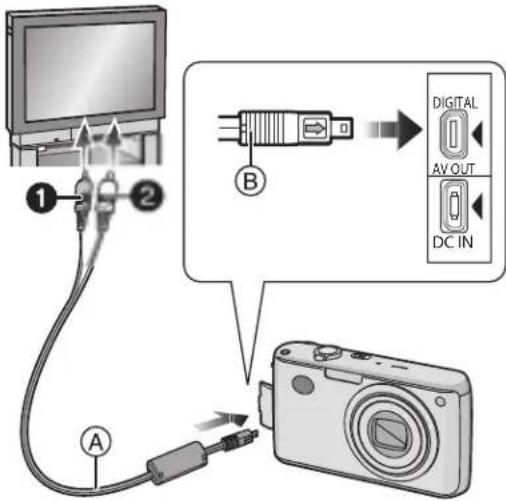
text_image
Diagram showing cable connection to a computer monitor and a camera, with labeled components and directional indicators.1Connect the AV cable Ⓐ (supplied) to the [AV OUT] socket on the camera.
- Connect the AV cable with the [→] mark facing the [◀] mark on the [AV OUT] socket.
- Hold the AV cable at Ⓑ and insert straight in or take straight out.
2Connect the AV cable to the video input and the audio input sockets on the TV.
• ① Yellow: to the video input socket
• ② White: to the audio input socket
3Turn the TV on and select external input.
4Turn the camera on.

- Do not use any other AV cables except the supplied one.
- The top and bottom or left and right of the picture may be cut off slightly when it is displayed due to the characteristics of the TV.
- Depending on the screen mode setting of the TV when you connect the camera to a wide-screen TV or a high-definition TV, the picture may be stretched horizontally or vertically and the top and bottom and or left and right of the picture may be cut off when it is displayed. In this case, change the screen mode setting.
• Audio playback is monaural.
- Read the operating instructions for the TV.
- When you play back a picture vertically, it may be blurry.
- You can view pictures on TVs in other countries (regions) which use the NTSC or PAL system when you set [VIDEO OUT] in the [SETUP] menu. Even if you set [VIDEO OUT] to [PAL], the output signal will still be NTSC in the recording mode.
■ Playing back pictures on a TV with an SD Memory Card slot
Still pictures recorded on an SD Memory Card can be played back on a TV with an SD Memory Card slot.

- Depending on the TV model, pictures may not be displayed on the full screen.
- Motion pictures cannot be played back. To play back motion pictures, connect the camera to the TV with the AV cable (supplied).
- You may not be able to play back MultiMediaCards.
Screen Display
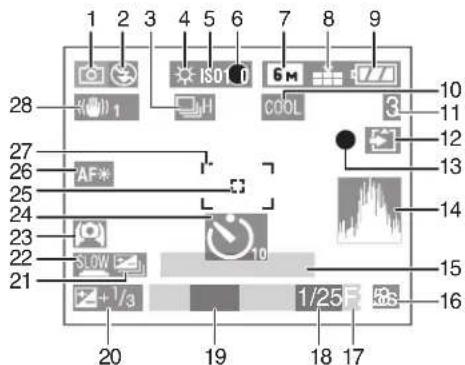
text_image
1 2 3 4 5 6 7 8 9 ISO1 0 6 M COOL 28 10 11 27 AF* 12 26 25 13 24 14 23 SLOW 15 22 21 +1/3 1/25 F 8s 20 19 18 17Ⓐ In recording
1 Recording mode (P24)
2 Flash mode (P38)
3 Continuous mode (P46)
: Audio recording (P58, 68)
4 White balance (P65)
5 ISO sensitivity (P66)
6 Focus (P24)
7 Picture size (P67)
8 Quality (P67)
In Motion picture mode (P58)
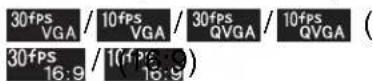
4
: Jitter alert (P26)
9 Battery indication (P14)
10 Color effect mode (P71)
11 Number of recordable pictures/ Available recording time e.g. In Motion picture mode (P58): 1h20m30s
12 Card access indication (P17)
13 Recording state
14 Histogram (P36)
15 Age (P53)
• This is displayed for about 5 seconds when the camera is turned on in baby
mode, after setting the clock or birthday, and after switching from other modes to baby mode.
Number of days that have passed since the travel date (P56)
- This is displayed for about 5 seconds if the camera is turned on when the travel date is set, after setting the clock, travel date and after switching from playback mode to another mode.
16 Elapsed recording time (P58)
Travel date (P56):
17 Current date and time
- This is displayed for about 5 seconds when the camera is turned on, after setting the clock and after switching from playback mode to recording mode.
Zoom (P29)/Extended optical zoom (P29)/Digital zoom (P30)

18 Shutter speed (P24)
19 Aperture value (P24)
20 Exposure compensation (P43)
21 Auto bracket (P44)
22 Slow shutter (P70)
23 High angle mode (P37)/Power LCD (P37): [ * ]
24 Self-timer mode (P42)
25 Spot AF area (P69)
26 AF assist lamp (P70)
27 AF area (P24)
28 Optical image stabilizer (P45)
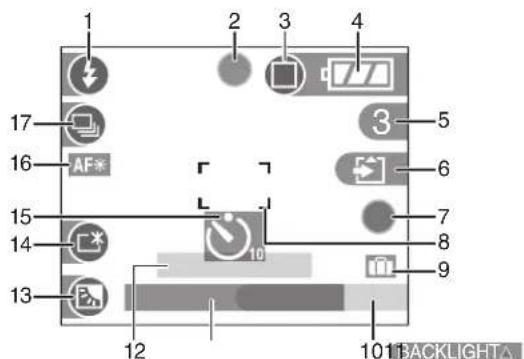
text_image
1 2 3 4 5 6 7 8 9 10 11 BACKLIGHT△ 12 13 14 15 16 AF* 17B Recording in simple mode
1 Flash mode (P38)
2 Focus (P24)
3 Picture mode (P27)
: Jitter alert (P26)
4 Battery indication (P14)
5 Number of recordable pictures
6 Card access indication (P17)
7 Recording state
8 AF area (P24)
9 Trvel date (P20)
10 Operation for backlight compensation (P28)
11 Current date and time
- This is displayed for about 5 seconds when the camera is turned on, after setting the clock and after switching from playback mode to simple mode.
Zoom (P29)/Extended optical zoom (P29)
EZW T 1X
12 Number of days that have passed since the travel date (P56)
This is displayed for about 5 seconds if the camera is turned on when the travel date is set, after setting the clock and after switching from playback mode to another mode.
13 Backlight compensation (P28)
14 Power LCD (P37)
15 Self-timer mode (P42)
16 AF assist lamp (P70)
17 Continuous mode (P46)
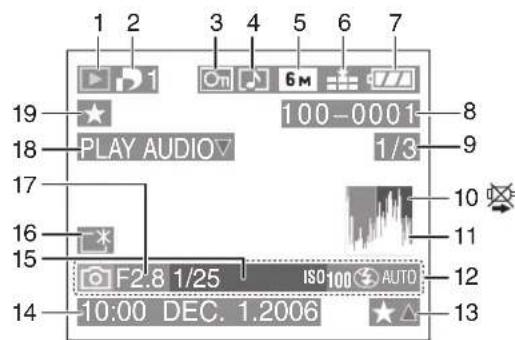
text_image
1 2 3 4 5 6 7 19 100-0001 18 PLAY AUDIO 1/3 17 16 F2:8 1/25 ISO 100 AUTO 15 14 10:00 DEC. 1.2006 13© In playback
1 Playback mode (P32)
2 Number of DPOF prints (P75)
3 Protected picture (P77)
4 Picture with audio/Motion pictures (P63)
5 Picture size (P67)
6 Quality (P67)
In Motion picture mode (P58)

4 : 3
In Simple mode (P27)
- This is displayed when printing using a printer supporting PictBridge. (Depending on the printer, the icon may not be displayed.)
Motion picture recording time (P58): 1h20m30s
11 Histogram (P36)
12 Recording information
13 Favorites settings (P73)/Elapsed playback time (P63): 1h20m30s
14 Recorded date and time
15 Age (P53)
16 Power LCD (P37)
17 The number of days that have passed (P56)
18 Audio playback (P63)
PLAY MOTION
PICTURE▼ : In motion picture mode (P58)
19 Favorites (P73)
Cautions for Use
■ Optimal use of the camera
Take care not to drop or knock the unit or put a lot of pressure on it.
- Do not leave the unit in your pants pocket when you sit down or forcefully insert it into a full bag etc.
• Take care not to drop or knock the bag that you inserted the unit in as it may strongly shock the unit.
- A strong shock to the unit may break the lens, screen or outer case and cause the unit to malfunction.
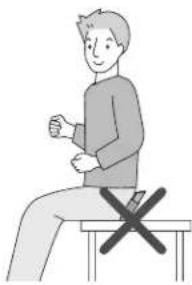
natural_image
Illustration of a person sitting on a bench with a cross symbol (no text or labels)Keep the camera as far away as possible from electromagnetic equipment (such as microwave ovens, TVs, video games etc.).
- If you use the camera on top of or near a TV, the pictures and sound on the camera may be disrupted by electromagnetic wave radiation.
- Do not use the camera near cell phones because doing so may result in noise adversely affecting the pictures and sound.
- Recorded data may be damaged, or pictures may be distorted, by strong magnetic fields created by speakers or large motors.
- Electromagnetic wave radiation generated by microprocessors may adversely affect the camera, disturbing the pictures and sound.
- If the camera is adversely affected by electromagnetic equipment and stops functioning properly, turn the camera off and remove the battery or disconnect AC adaptor (ACA-DC4-E/U/J; optional). Then reinsert the battery or reconnect AC adaptor and turn the camera on.
Do not use the camera near radio transmitters or high-voltage lines.
- If you record near radio transmitters or high-voltage lines, the recorded pictures and sound may be adversely affected.
Always use the supplied cords and cables. If you use optional accessories, use the cords and the cables supplied with them.
Do not extend the cords or the cables.
Do not spray the camera with insecticides or volatile chemicals.
- If the camera is sprayed with such chemicals, the body of the camera may be damaged and the surface finish may peel off.
- Do not keep rubber or plastic products in contact with the camera for a long period of time.
Do not use benzine, thinner or alcohol for cleaning the camera.
- Before cleaning the camera, remove the battery or disconnect the AC adaptor (ACA-DC4-E/U/J; optional) from the electrical outlet.
- The body of the camera may be damaged and the surface finish may peel off.
- Wipe the camera with a soft, dry cloth. To remove stubborn stains, wipe with a cloth that is soaked in a detergent diluted with water and then with a soft, dry cloth.
- If you use a chemically treated cloth, read the instructions that come with the cloth.
- If rain water or other drops of water splash onto the camera, wet a soft cloth with tap water, wring it well, then use it to wipe the camera body carefully. Lastly, wipe the camera again with a dry cloth.
Card
Do not leave the card where the temperature is high, where electromagnetic waves or static electricity are easily generated or exposed to direct sunlight.
Do not bend or drop the card.
- The card may be damaged or the recorded content may be damaged or deleted.
- Put the card in the card case or the storage bag after use and when storing or carrying the card.
- Do not allow dirt, dust or water to get into the terminals on the back of the card and do not touch the terminals with your fingers.
Battery
The battery is a rechargeable lithium ion battery. Its ability to generate power comes from the chemical reaction that takes place inside it. This reaction is susceptible to the surrounding temperature and humidity. If the temperature is too high or too low, the operating time of the battery will become shorter.
Always remove the battery after use. Store the removed battery in the battery carrying case (supplied).

natural_image
Illustration of a battery pack and its open case with a cable, no text or symbols presentIf you drop the battery accidentally, check to see if the body of the battery and the terminals are damaged.
- Inserting a damaged battery in the camera will damage the camera.
Take along charged spare batteries when going out.
- Be aware that the operating time of the battery becomes shorter in low temperature conditions such as at a ski resort.
- When you travel, do not forget to take along the battery charger (supplied) so that you can charge the battery in the country that you are travelling in.
Dispose of unusable battery.
• The battery has a limited life.
- Do not throw the battery into fire because it may cause an explosion.
- Unusable batteries should be discarded in accordance with battery recycling laws. Call the RBRC hotline on 1-800-822-8837 for information (for U.S. only).
Do not allow battery terminals to come into contact with metal objects (such as necklaces, hairpins etc.).
- This can cause short circuiting or heat generation and you may be badly burned if you touch a battery in that state.
- Charger
- If you use the battery charger near a radio, the radio reception may be disturbed. Keep the charger 1 m (3 feet) or more away from radios.
- The charger may generate whirring sounds when it is being used. This is not a malfunction.
• After using the charger, be sure to disconnect it from the electrical outlet. (A very small amount of current is consumed if it is left connected.) - Keep the terminals of the charger and battery clean.
Message Display
Confirmation messages or error messages will be displayed on the screen in some cases.
The major messages are described below as examples.
[THIS MEMORY CARD IS PROTECTED]
The Write-Protect switch on the SD Memory Card is moved to [LOCK]. Move the switch back to unlock it. (P17, 77)
[NO VALID PICTURE TO PLAY]
Record a picture or insert a card with a recorded picture and then play it.
[THIS PICTURE IS PROTECTED]
Delete or overwrite the picture after canceling the protect setting. (P77)
[THIS PICTURE CANNOT BE DELETED]/ [SOME PICTURES CANNOT BE DELETED]
Pictures not based on the DCF standard cannot be deleted. If you want to delete some pictures, format the card after saving necessary data on a PC etc. (P84)
[NO ADDITIONAL DELETE SELECTIONS CAN BE MADE]
You have exceeded the number of pictures that can be set at once with
[MULTI DELETE]. Delete the selected pictures and then select [MULTI DELETE] again to delete any remaining pictures. More than 999 favorites have been set.
[CANNOT BE SET ON THIS PICTURE]/ [CANNOT BE SET ON SOME PICTURES]
If the pictures are not based on the DCF standard, the DPOF print cannot be set.
[MEMORY CARD ERROR FORMAT THIS CARD?]
The card format cannot be recognized by the camera. Format the card again with the camera after saving necessary data on a PC etc. (P84)
[PLEASE TURN CAMERA OFF AND THEN ON AGAIN]
This message appears when the camera is not operating properly. Turn the camera off and on. If the message persists, contact your Leica dealer or your nearest Leica distributer.
[MEMORY CARD ERROR PLEASE CHECK THE CARD]
- An error has occurred accessing the card. Insert the card again.
- A card with a capacity more than 2 GB is inserted. Do not use a card with a capacity more than 2 GB.
[READ ERROR PLEASE CHECK THE CARD]
An error has occurred reading the data. Insert the card again. Make sure the card is inserted properly and then play back again.
[WRITE ERROR PLEASE CHECK THE CARD]
An error has occurred writing the data. Turn the camera off and remove the card. Insert the card again and turn the camera on. Make sure the camera is turned off before removing or inserting the card to avoid damage.
[MOTION RECORDING WAS CANCELLED DUE TO THE LIMITATION OF THE WRITING SPEED OF THE CARD]
- When you set the picture quality to [30fpsVGA] or [30fps16:9], we recommend using a high speed SD Memory Card with "10MB/s" or greater displayed on the package.
- Depending on the type of SD Memory Card, recording may stop in the middle.
[A FOLDER CANNOT BE CREATED]
A folder cannot be created because there are no remaining folder numbers that can be used. (P85)
Format the card after saving necessary data on a PC etc. (P84)
If you execute [NO.RESET] in the [SETUP] menu after formatting, the folder number is reset to 100. (P22)
[PICTURE IS DISPLAYED FOR 4:3 TV]/ [PICTURE IS DISPLAYED FOR 16:9 TV]
- The AV cable is connected to the camera. Press [MENU/SET] if you want to delete this message at once.
- Select [TV ASPECT] in the [SETUP] menu to change the TV aspect. (P23)
- This message also appears when the USB connection cable is connected to the camera only.
In this case, connect the other end of the USB connection cable to a PC or a printer. (P84, 86)
Troubleshooting
If you return the menu settings to the initial settings at the time of purchase, the condition may improve.
Select [RESET] in the [SETUP] menu. (P22)
■ Battery and power source
1: The camera cannot be operated even when it is turned on.
• Is the battery inserted correctly?
- Check the direction of the battery. (P15)
• Is the battery sufficiently charged?
- Use a battery that has been sufficiently charged.
2: The LCD monitor turns off while the camera is turned on.
- Is power save mode (P20) or economy mode (P20) activated?
- Press the shutter button halfway to cancel these modes.
• Is the battery exhausted? - Charge the battery or replace it with a battery which has enough capacity.
3: The camera turns off immediately after it is turned on.
- Is the battery charge insufficient to operate the camera?
- Use a battery that has been sufficiently charged.
- If you leave the camera on, the battery will be exhausted. Turn the camera off frequently by using power save mode (P20) etc.
■ Recording
1: The picture cannot be recorded.
• Is the card inserted?
• Is the mode dial correctly set?
• Is there any memory remaining on the card?
- Before recording, delete some pictures. (P33)
2: The recorded picture is whitish. The lens is dirty.
- The picture can become whitish if there is dirt e.g. fingerprints on the lens. If the lens is dirty, turn on the camera, eject the lens barrel (P12) and gently wipe the lens surface with a soft, clean, and dry cloth.
3: The recorded picture is too bright or dark.
- Check that the exposure is correctly compensated. (P43)
4: The subject is not focused properly.
- The focus range varies depending on the recording mode.
Rotate the mode dial to set the proper mode for the distance to the subject.
• Is the subject beyond the focus range of the camera? (P25)
• Have you taken a picture with jitter?
5: The recorded picture is blurred. The optical image stabilizer is not effective.
- The shutter speed will become slower and the optical image stabilizer function may not work properly when taking pictures especially in dark places. In this case, we recommend holding the camera firmly with both hands when taking pictures. (P25) When [SLOW SHUTTER] (P70) is set, we recommend using a tripod and the self-timer (P42) when taking pictures.
6: The recorded picture looks rough. Noise appears on the picture.
- Is the ISO sensitivity high or the shutter speed slow?
- Reduce the ISO sensitivity. (P66)
- Set [PICT.ADJ.] to [NATURAL]. (P71)
- Take pictures in bright places.
- In [HIGH SENS.] (P54) in scene mode, the resolution of the recorded picture decreases slightly because of high sensitivity processing. This is not a malfunction.
7: Motion picture recording stops in the middle.
- Are you using a MultiMediaCard?
- This unit does not support this mode with MultiMediaCards.
- When you set the picture quality to [30fpsVGA] or [30fps16:9], we recommend using a high speed SD Memory Card with "10MB/s" or greater displayed on the package.
- Depending on the type of SD Memory Card, recording may stop in the middle.
LCD monitor
1: The LCD monitor sometimes turns off although the camera is turned on.
- Have you set economy mode? (P20) – In economy mode, the LCD monitor turns off while the flash is charged.
2: The LCD monitor becomes darker or brighter for a moment.
- This phenomenon appears when you press the shutter button halfway to set the aperture value and does not affect the recorded pictures.
3: The LCD monitor flickers indoors.
- The LCD monitor may flicker for a few seconds after turning the camera on indoors under fluorescent light. This is not a malfunction.
4: The LCD monitor is too bright or dark.
- Adjust the brightness of the screen. (P20)
- Is the power LCD function or high angle mode activated?
5: Black, red, blue and green dots appear on the LCD monitor.
- These pixels do not affect the recorded pictures. This is not a malfunction.
6: Noise appears on the LCD monitor.
- In dark places, noise may appear to maintain the brightness of the LCD monitor. This does not affect the pictures you are recording.
7: A vertical line appears on the LCD monitor.
- This is a phenomenon called smear. It is a characteristic of CCD and appears when the subject has a bright part. Uneven colors may also appear around the smear. This is not a malfunction. It is recorded in motion pictures but is not recorded on still pictures.
Flash
1: The flash is not activated.
- Is the flash setting set to Forced OFF [?]? - Change the flash setting. (P38) - The flash is not activated when motion picture mode [HSCENERY] (P49), [NIGHT SCENERY] (P50), [FIREWORKS] (P52) or [STARRY SKY] (P53) in scene mode is selected.
2: The flash is activated 2 times.
- When you select red-eye reduction (P38), the flash is activated once before the actual recording to reduce the red-eye phenomenon (eyes of the subject appearing red in the picture) and then activated again for the actual recording.
■ Playback
1: The picture being played back is rotated and displayed in an unexpected direction.
The camera has a function that automatically rotates the display of pictures recorded holding the camera vertically. (If you take pictures when aiming the camera up or down, the camera may recognize that it is being held vertically.)
- You can display the pictures without being rotated when [ROTATE DISP.] (P74) is set to [OFF].
- You can rotate pictures with the [ROTATE] function. (P74)
2: The picture is not played back.
- Is the mode dial set to playback [12]
• Is the card inserted?
• Is there a picture in the card?
3: The folder number and the file number are displayed as [—] and the screen turns black.
- Is the picture edited with a PC or recorded with a digital camera from another manufacturer?
This may also happen if the battery is removed immediately after recording or if recording with a exhausted battery.
- Format the data to delete the pictures mentioned above. (P81) (Formatting irretrievably deletes all data including the other pictures. Check the data carefully before formatting.)
4: The picture is displayed with a date different from the actual recording date in calendar playback.
- Was the picture edited with a PC or recorded with a digital camera from another manufacturer?
This kind of picture may be displayed with a date different from the actual recording date in calendar playback. (P61)
- Is the clock in the camera set properly? (P20)
For example, if the clock setting on the camera is different from the date and time set on the PC and you acquire pictures recorded with the camera to the PC and then write them back to the card, the pictures may be displayed with dates different from the actual recording dates in calendar playback etc.
1: The picture does not appear on the television.
- Is the camera connected to the TV correctly?
- Set the TV input to external input mode.
- Set [VIDEO OUT] to [NTSC].(P23)
2: The display areas on the TV screen and the camera's LCD monitor are different.
Depending on the TV model, the area display may be smaller so the picture may be stretched horizontally or vertically and the top and bottom or left and right of the picture may be cut off when it is displayed. This is due to the TV specifications and is not a malfunction.
3: The motion pictures cannot be played back on a TV.
- Are you trying to play back the motion pictures by directly inserting the card in the card slot of the TV?
- Connect the camera to the TV with the AV cable (supplied) and then play back the pictures on the camera.
4: The picture cannot be transferred when the camera is connected to a PC.
- Is the camera connected to the PC correctly?
- Is the camera recognized by the PC correctly?
- Set [USB MODE] to [PC]. (P22, 84)
5: The card is not recognized by the PC.
- Disconnect the USB connection cable. Connect it again while the card is inserted in the camera.
6: The picture cannot be printed when the camera is connected directly to a printer.
- Does the printer support PictBridge?
- You cannot print pictures with printers which do not support PictBridge. (P86)
- Set [USB MODE] to [PictBridge (PTP)]. (P22, 86)
7: The edges of the pictures are cut off when printed.
- When using a printer with a trimming or borderless printing function, cancel this function before printing. (For details, refer to the operating instructions for the printer.)
- When you order photo studios to print pictures, ask the photo studio if the pictures can be printed with both ends.
8: The picture is not displayed fully on the TV.
- Set the aspect of the TV on the camera. (P23)
Others
1: An unreadable language was selected by mistake.
- Press [MENU/SET], select the [SETUP] menu icon [ ] and then select the [ ] icon to set the desired language. (P23)
2: The setting for the auto review function is disabled.
- Are you taking pictures using auto bracket (P44)? Is the camera in continuous mode (P46) or motion picture mode [H(P58) or [SELF PORTRAIT] ? Is [AUDIO REC.] set to [ON] (P68)? - In these cases, you cannot set the auto review function in the [SETUP] menu.
3: A red lamp sometimes turns on when the shutter button is pressed halfway.
- In dark places, the AF assist lamp (P70) lights red to make it easier to focus on a subject.
4: The AF assist lamp does not turn on.
- Is [AF ASSIST LAMP] on the [REC] mode menu set to [ON]? (P70)
- Are you taking pictures in dark places?
- The AF assist lamp does not turn on in bright places.
- The AF assist lamp does not turn on when [SCENERY] (P49), [NIGHT SCENERY] (P50) [SELF PORTRAIT] (P51), or [FIREWORKS] (P52) in scene mode is selected.
5: The camera becomes warm.
- The surface of the camera may become warm during use. This does not affect the performance or quality of the camera.
6: The lens clicks.
- When the brightness changes due to zoom or camera movement etc., the lens may click and the picture on the screen may drastically change. However, the picture is not affected. The sound is caused by the automatic adjustment of the aperture. This is not a malfunction.
7: The clock is reset.
- If you do not use the camera for a long time, the clock may be reset. When the message [PLEASE SET THE CLOCK] appears, set the clock again. (P18)
- When you take a picture before setting the clock, [0:00 0. 0. 0] is recorded.
Others
8: The file numbers are not recorded consecutively.
- When you perform an operation after taking a certain action, the pictures may be recorded in folders with different numbers from the ones used prior to the operation. (P83)
9: The file numbers are recorded in ascending order.
- If the battery is inserted or removed when the camera is not turned off, the recorded folder numbers are lost. However if you turn the camera on again and record pictures, the recorded folder numbers are different from the prior recorded folder numbers.
10: The picture is displayed in black.
• Pictures edited or rotated with a PC may be displayed in black in playback mode (P32), multi playback (P60) and calendar playback (P61).
Number of recordable pictures and available recording time
- The number of recordable pictures and the available recording time are an approximation. (These vary depending on the recording conditions and the type of card.)
- The number of recordable pictures varies depending on the subjects.
■ Number of recordable pictures
| Aspect ratio | 4:3 | ||||||
| Picture size | 6M/(16M):(2816×2112 pixels) | 3M(3MEZ):(2048×1536 pixels) | 2M(2MEZ):(1600×1200 pixels) | ||||
| Quality | |||||||
| Card | 16 MB 4 | 8 8 16 13 27 | |||||
| 3 | 2 | M B 9 | 1 | 9 | |||
| 64 MB 20 | 40 38 75 61 120 | ||||||
| 128 MB | 41 82 78 150 | 125 | 240 | ||||
| 256 MB | 81 | 160 | 150 | 290 | 240 | 470 | |
| 512 MB | 160 | 320 | 300 | 590 | 480 | 940 | |
| 1 GB | 320 | 640 | 600 | 1180 | 970 | 1880 | |
| 2 GB | 660 | 1270 | 1220 | 2360 | 1920 | 3610 | |
| Aspect ratio | 4:3 | 3:2 | |||||
| Picture size | 1M (1MEZ): (1280×960 pixels) | 0.3M / ☐ : (0.3MEZ): (640×480 pixels) | 5M (5M): (2816×1880 pixels) | ||||
| Quality | |||||||
| Card | 16 MB 21 | 40 68 110 | 4 10 | ||||
| 32 MB 45 | 85 145 | 230 10 | 21 | ||||
| 64 MB 93 | 175 | 290 | 480 22 45 | ||||
| 128 MB | 190 | 350 | 600 | 970 | 46 | 92 | |
| 256 MB | 370 | 690 | 1170 | 1900 | 91 | 180 | |
| 512 MB | 730 | 1370 | 2320 | 3770 | 180 | 350 | |
| 1 GB | 1470 | 2740 | 4640 | 7550 | 360 | 710 | |
| 2 GB | 2920 | 5120 | 8780 | 12290 | 730 | 1420 | |

Others
| Aspect ratio | 3:2 | 16:9 | |||||
| Picture size | 25M / ( 2 .(2048×1360 pixels) | 5 45M (4.5M): Z(2816×1584 pixels) | ) 2M (2M EZ):(1920×1080 pixels) | ||||
| Quality | |||||||
| Card | 1 | 6 | M | B | 9 | 1 | 8 5 |
| 32 MB 20 | 40 12 25 | 27 53 | |||||
| 64 MB 43 | 83 27 53 | 57 105 | |||||
| 128 MB 88 | 165 55 105 | 115 220 | |||||
| 256 MB 170 | 330 105 | 210 230 430 | |||||
| 512 MB 340 | 650 210 | 420 450 860 | |||||
| 1 GB | 680 | 1310 | 430 | 850 | 910 | 1720 | |
| 2 GB | 1360 | 2560 | 870 | 1700 | 1800 | 3410 | |

■ Available recording time
| Picture quality setting | 30fps VGA | 10fps VGA | 30fps QVGA | 10fps QVGA | 30fps 16:9 | 10fps 16:9 | |
| SD Memory Card | 16 MB 6 | s 26 s 26 s | 1 min 23 s | 5 s | 2 2 s | ||
| 32 MB 17 | s 59 s 59 s | 2 min 55 s | 14 s | 50 s | |||
| 64 MB 39 | s 2 min 2 | min 6 min | 33 s | 1 min 46 s | |||
| 128 MB | 1 min 23 s | 4 min 10 s | 4 min 10 s | 12 min 20 s | 1 min 11 s | 3 min 35 s | |
| 256 MB | 2 min 45 s | 8 min 10 s | 8 min 10 s | 24 min | 2 min 20 s | 7 min | |
| 512 MB | 5 min 30 s | 16 min 20 s | 16 min 20 s | 47 min 50 s | 4 min 40 s | 14 min | |
| 1 GB | 11 min | 32 min 50 s | 32 min 50 s | 1 h 35 min | 9 min 20 s | 28 min 10 s | |
| 2 GB | 22 min 30 s | 1 h 7 min | 1 h 7 min | 3 h 15 min | 19 min 20 s | 57 min 30 s | |

- The numbers inside the thick black lines are the number of recordable pictures in simple mode. (P27)
- The number of recordable pictures and the available recording time displayed on the LCD monitor may not decrease in order.
- This unit does not support recording motion pictures on MultiMediaCards.
- The extended optical zoom does not work in [HIGH SENS.] (P54) in scene mode so the picture size for [EZ] is not displayed.

Specifications
Camera:
Power Source: DC 5.1 V
Power Consumption: 1.6 W (When recording)
0.8 W (When playing back)
Camera effective pixels: 6,000,000 pixels
Image sensor: 1/2.5" CCD, total pixel number 6,370,000 pixels, Primary color filter
Lens: Optical 3.6× zoom, f=4.6 mm to 16.8 mm (35 mm film camera equivalent: 28 mm to 102 mm)/F2.8 to F5.6
Digital zoom: Max. 4×
Extended optical zoom: Max. 5× (Except for the maximum picture size for each aspect ratio)
Focus: Normal/Macro, 5-area-focusing/3-area-focusing (High speed)/
1-area-focusing (High speed)/1-area-focusing/Spot-focusing cm (1'7^11/16") to
Macro/Simple/Motion picture: 5 cm (2 inches) (Wide)/30 cm (1 foot) (Tele) to ∞
Shutter system: Electronic shutter+Mechanical shutter
Continuous recording frequency: 3 frames/second (High frequency), 2 frames/second (Low frequency), Approx. 1.5 frames/second (Unlimited)
Number of recordable pictures:
Max. 8 frames (Standard), max. 6 frames (Fine), Depends on the remaining capacity of the card (Unlimited).
(Performance in continuous recording is only with SD Memory Card. MultiMediaCard performance will be less.)
Motion picture recording: 848×480 pixels/640×480 pixels/320×240 pixels (30 or 10 frames/second with audio. The maximum recording time depends on the capacity of the card.)
ISO sensitivity: AUTO/80/100/200/400
[HIGH SENS.] mode: 800 to 1600 Shutter speed: 8 to 1/2000th
[STARRY SKY] mode: 15 seconds, 30 seconds, 60 seconds Motion picture mode: 1/30th to 1/20000th
White balance: AUTO/Daylight/Cloudy/Halogen/White set Exposure (AE): Program AE
Exposure compensation (1/3 EV Step, -2 EV to +2 EV) Metering mode: Multiple
LCD monitor: 2.5" low-temperature polycrystalline TFT LCD (Approx. 207,000 pixels) (field of view ratio about 100%)
Flash: Flash range: (ISO AUTO)
Approx. 60 cm (2 feet) to 4 m (13 feet) (Wide)
[HIGH SENS.] mode: Approx. 80 cm (2 1/2 feet) to 5.7 m (19 feet) (Wide)
AUTO, AUTO/Red-eye reduction, Forced ON (Forced ON/Red-eye reduction), Slow sync./Red-eye reduction, Forced OFF
Microphone: Monaural Speaker: Monaural
Recording media: SD Memory Card/MultiMediaCard (Still pictures only)
Picture size
| Still picture: When the aspect ratio setting is [ ] | 4:3 |
| 2816×2112 pixels, 2048×1536 pixels, 1600×1200 pixels, 1280×960 pixels, 640×480 pixels | |
| When the aspect ratio setting is [ 3:2 | |
| 2816×1880 pixels, 2048×1360 pixels | |
| When the aspect ratio setting is [ 16:9 | |
| 2816×1584 pixels, 1920×1080 pixels | |
| Motion pictures: When the aspect ratio setting is [ ] | 4:3 |
| 640×480 pixels, 320×240 pixels | |
| When the aspect ratio setting is [ 16:9 | |
| 848×480 pixels |
Quality: Fine/Standard
Recording file format
Still Picture: JPEG (based on Design rule for Camera File system, based on Exif 2.2 standard)/DPOF corresponding
Picture with audio: JPEG (based on Design rule for Camera File system, based on Exif 2.2 standard)+QuickTime (picture with audio)
Motion pictures: QuickTime Motion JPEG (motion pictures with audio)
Interface
Digital: USB 2.0 (Full Speed)
Analog video/audio: NTSC/PAL Composite (Switched by menu), Audio line output (monaural)
Terminal
AV OUT/DIGITAL: Dedicated jack (8 pin)
DC IN: Dedicated jack
| Dimensions: | Approx. 94.1 mm (W)×51.1 mm (H)×24.2 mm (D) [ 3^11/16 ′′(W)×2 ( H ) ^15 / x_6 ′′ (D)] (excluding the projection part) |
| Weight: | Approx. 132 g/4.66 oz (excluding card and battery), Approx. 160 g/5.64 oz (with card and battery) |
| Operating temperature: | 0 °C to 40 °C (32 °F to 104 °F) |
Operating humidity: 10% to 80%
Battery Charger
Input: 110 V to 240 V\~50/60 Hz, 0.2 A
Output: CHARGE 4.2 V---0.8 A
Equipment mobility: Movable
Battery Pack (lithium-ion)
Voltage/capacity: 3.7 V, 1150 mAh
Index
A
AC Adaptor 82, 86
AF Assist Lamp 70
AF Mode 69
AF/AE Lock 25
Aspect Ratio 67
Aspect Ratio Conversion ....80
Audio Dubbing 78
Audio Recording 58,68
Auto Bracket 44
Auto Review 21
Auto White Balance 65
Available Recording Time 105
B
Baby Mode 53
Backlight Compensation 28
Battery Carrying Case 95
Brightness of the LCD Monitor .....20
Built-in Flash 38
C
Calendar Playback 61
Candle Light Mode 52
Card Access Indication 17
Charger 95
Charging 14
Clock Set 18,20
Color Effect 71
Condensation 5
Continuous Mode 46
Customer Service 111
D
Date Printing 76, 88, 89
Deleting Pictures ....33
Demonstration of the Optical Image Stabilizer 45
Digital Zoom 30
DPOF Print Setting 75
E
Economy Mode ....20
Exposure 26
Exposure Compensation 43
Extended Optical Zoom 29
EZ 29,67
F
File Number 22, 83, 92
Fine 68
Fireworks Mode 52
Focus 25
Folder Composition 83
Folder Number 22, 83, 92
Food Mode 51
Formatting 81
H
High Angle Mode 37
High Sensitivity Mode ....54
Histogram 36
1
ISO Sensitivity 66
Information Service 111
Installation of sorfware 82
J
Jitter 26
L
Language Setting 23
Layout 88
LCD Monitor 35, 91
M
Macro Mode 47
MANUAL 73
Mass Storage 22
Motion Picture Mode ....58
Multi Playback 60
N
Night Portrait Mode ....50
Night Scenery Mode 50
Normal Recording 24
NO.RESET 22
NTSC 23
Number of Prints 76,88
Number of Recordable Pictures ..... 14, 105
0
Operation Tone ......21
Operation Tone Level 21
Operational Sound 21
Optical Image Stabilizer 45
Optical Zoom 29
P
PAL 23
Paper Size 86
Party Mode 51
PC 22,82
PictBridge 22,86
Picture Adjustment 71
Picture Quality Setting (Motion Picture Mode) ....58
Picture Quality Setting (Simple Mode) ... 27
Picture Size 67
Pictures with Audio 63
Playback Pictures on TV 100
Playback Zoom 62
Playing Back Motion Pictures ....63
Portrait Mode 49
Power LCD 37
Power Save 20
Protect 77
Q
Quality 67
R
Recording Guide Line 36
Reset of Setting 22
Resizing 78
Review 31
Rotate 74
Rotate Display 74
s
Scene Menu 23
Scene Mode 48
Scenery Mode 49
Self Portrait Mode 51
Self-timer 42
Setting Favorites ....73
Setup Menu 19
Shutter sound 22
Shutter Tone 22
Simple Mode .....27
Slide Show 72
Slow Shutter 70
Snow Mode ....54
Soft Skin Mode 49
Sports Mode 49
Spot-focusing 69
Standard 68
Starry Sky Mode ....53
Status Indicator 1
T
Travel Date 20,56
Trimming 79
TV Aspect 23
U
USB Connection Cable 82, 86
USB Mode 22, 82, 87
V
Video Output 23,90
Volume of Speakers ......22
W
White Balance 65
White Balance Fine Adjustment .....66
White Set 65
Numerics
1-area-focusing 69
1-area-focusing (High speed) .....69
3-area-focusing (High speed) 69
5-area-focusing 69
Leica Academy
As well as outstanding high-performance products for taking, reproducing and viewing photographs, for many years we have also been offering the special services of the Leica Akademie, with practical seminars and training courses, which are intended to share our knowledge about the world of photography, projection and magnification with both beginners and advanced photographic enthusiasts.
The contents of the courses, which are run by a trained team of experts in the modern, well-equipped training suite at our Solms factory and in the Hofgut Altenberg, vary from general photography to areas of special interest and offer a range of suggestions, information and advice for your own work.
You can obtain the current Leica Akademie brochure from:
Leica Camera AG
Leica Akademie
Current information about products, news, events and the Leica company is available on our homepage on the Internet at:
http://www.leica-camera.com
Leica information service
The Leica information service can provide you with an answer to any technical questions relating to the Leica range either in writing, on the telephone or by e-mail.
Leica Camera AG
Leica Customer Service
Leica AG's Customer Service center, or the repair service of the Leica national offices, is available to assist you in maintaining your Leica equipment or in case of damage. Please contact your nearest authorized Leica dealer.
Leica Camera AG
Customer Service